Badu-Apraku Baffour, Bankole Faith Ayobami, Ajayo Babatope Samuel, Fakorede Morakinyo Abiodun Bamidele, Akinwale Richard Olutayo, Talabi Abidemi Olutayo, Bandyopadhyay Ranajit, Ortega-Beltran Alejandro
International Institute of Tropical Agriculture (IITA), Ibadan, Nigeria.
Obafemi Awolowo University, Ile-Ife, Nigeria.
Crop Prot. 2021 Jan;139:105386. doi: 10.1016/j.cropro.2020.105386.
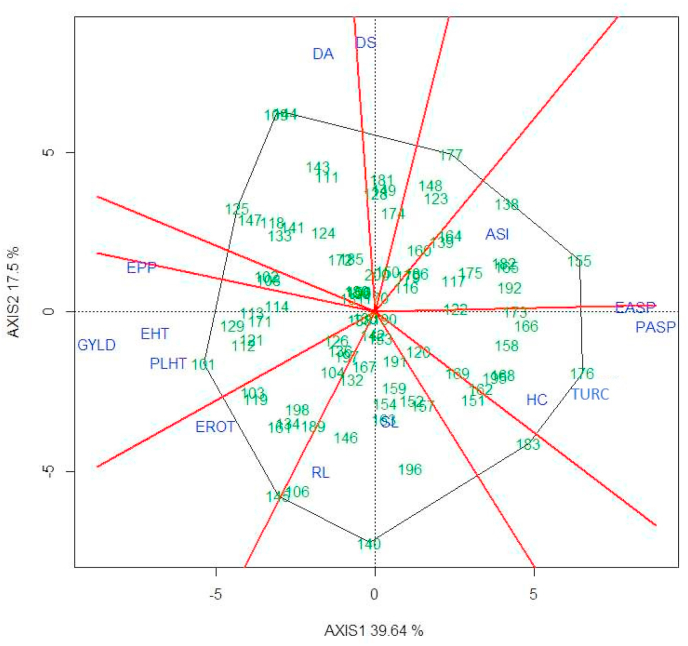
Northern corn leaf blight (NCLB) incited by the fungus is a foliar disease that significantly limits maize production and productivity in West and Central Africa (WCA), particularly in the mid-altitudes but during the last decade it has become a menace in lowland agro-ecologies. The most economical and environmentally friendly disease management strategy is the cultivation of maize varieties resistant or tolerant to NCLB. However, no early maturing (EM) and extra-early maturing (EEM) NCLB resistant varieties are commercially available in WCA. One hundred inbred lines each of EM and EEM derived from tropical maize germplasm were inoculated with a virulent isolate of at five locations in Nigeria during the 2017 and 2018 growing seasons. The objective of the study was to identify promising NCLB resistant lines and to investigate inter-relationships among the traits. Analysis of variance revealed highly significant genotype and genotype by environment (G × E) interactions for disease severity, grain yield (GYLD), and other agronomic traits. The average disease severity (TURC) values ranged from 1.9 to 5.8 and 2.9 to 5.7 for the EM and EEM inbred lines, respectively. The levels of reaction of the inbred lines to NCLB ranged from highly resistant to highly susceptible. Stepwise regression analysis showed that ears per plant, ear and plant aspects were significantly influenced by the disease scores. Ears per plant, ear and plant aspects, TURC and GYLD traits were employed to develop a base index (BI) for selecting NCLB resistant inbred lines for hybrid development. TZEI 135 and TZEEI 1 were outstanding in GYLD and also had the highest positive BI values in the EM and EEM inbred lines, respectively. The identification of NCLB resistant lines in this study has set the premise for development of NCLB resistant hybrids for WCA as well as the improvement of tropical maize breeding populations for NCLB resistance.
由真菌引起的玉米大斑病(NCLB)是一种叶部病害,严重限制了西非和中非(WCA)的玉米产量和生产力,特别是在中海拔地区,但在过去十年中,它已成为低地农业生态环境中的一大威胁。最经济和环保的病害管理策略是种植对玉米大斑病具有抗性或耐受性的玉米品种。然而,在WCA地区,没有商业化的早熟(EM)和特早熟(EEM)且抗玉米大斑病的品种。在2017年和2018年生长季节,从热带玉米种质中获得的100个EM和EEM自交系在尼日利亚的五个地点接种了一种致病力强的分离株。本研究的目的是鉴定有前景的抗玉米大斑病品系,并研究性状之间的相互关系。方差分析显示,病害严重程度、籽粒产量(GYLD)和其他农艺性状在基因型和基因型与环境互作(G×E)方面具有极显著差异。EM和EEM自交系的平均病害严重程度(TURC)值分别为1.9至5.8和2.9至5.7。自交系对玉米大斑病的反应水平从高抗到高感不等。逐步回归分析表明,每株穗数、穗部和植株性状受病害评分的显著影响。利用每株穗数、穗部和植株性状、TURC和GYLD性状建立了一个基础指数(BI),用于选择抗玉米大斑病的自交系进行杂交种培育。TZEI 135和TZEEI 1在GYLD方面表现突出,在EM和EEM自交系中分别具有最高的正BI值。本研究中抗玉米大斑病品系的鉴定为WCA地区抗玉米大斑病杂交种的培育以及热带玉米育种群体对玉米大斑病抗性的改良奠定了基础。