Gogineni Vinaya, Morand Susan, Staats Hannah, Royfman Rachel, Devanaboyina Monika, Einloth Katelyn, Dever Danielle, Stanbery Laura, Aaron Phylicia, Manning Luisa, Walter Adam, Edelman Gerald, Dworkin Lance, Nemunaitis John
University of Toledo Medical Center, Toledo, OH.
Gradalis, Inc, Carrollton, TX.
J Cancer. 2021 Jan 1;12(1):38-53. doi: 10.7150/jca.49406. eCollection 2021.
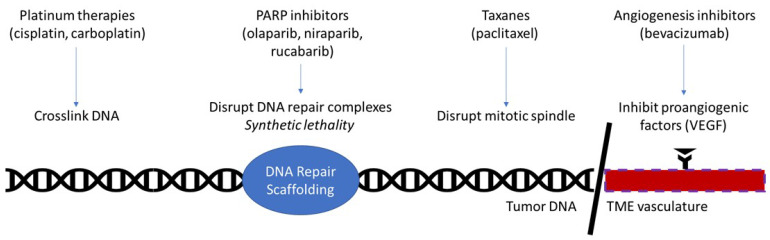
While ovarian cancer typically responds well to front line treatment, many patients will relapse within 5 years. Treatment options are less effective at each recurrence highlighting the need for novel maintenance therapies. PolyADP-ribose polymerase (PARP) inhibitors have recently gained approval in ovarian cancer maintenance. Niraparib was approved regardless of mutation status, however impact on overall survival is limited. Oliparib was approved for mutant and wildtype/homologous recombination deficient patients. This review will focus on current frontline ovarian cancer treatment as well molecularly based approaches to ovarian cancer management.
虽然卵巢癌通常对一线治疗反应良好,但许多患者会在5年内复发。每次复发时治疗选择的效果都会降低,这凸显了新型维持疗法的必要性。聚ADP核糖聚合酶(PARP)抑制剂最近已获批用于卵巢癌维持治疗。尼拉帕尼无论突变状态如何均可获批使用,但其对总生存期的影响有限。奥拉帕尼获批用于BRCA突变和野生型/同源重组缺陷患者。本综述将聚焦于当前卵巢癌的一线治疗以及基于分子的卵巢癌管理方法。