Geoffroy Karen, Viens Mélissa, Kalin Emma Mary, Boudhraa Zied, Roy Dominic Guy, Wu Jian Hui, Provencher Diane, Mes-Masson Anne-Marie, Bourgeois-Daigneault Marie-Claude
Cancer Axis, Centre de Recherche du Centre Hospitalier de l'Université de Montréal and Institut du Cancer de Montréal, Montreal, QC H2X 0A9, Canada.
Department of Microbiology, Infectious Diseases and Immunology, Faculty of Medicine, University of Montreal, Montreal, QC H3T 1J4, Canada.
Pharmaceuticals (Basel). 2024 Dec 10;17(12):1662. doi: 10.3390/ph17121662.
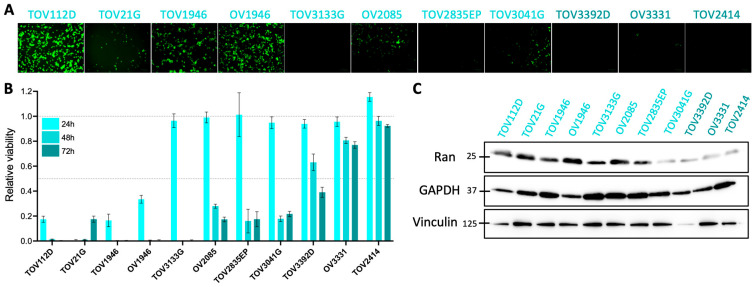
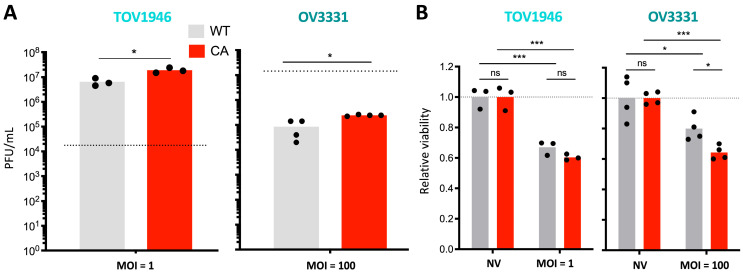
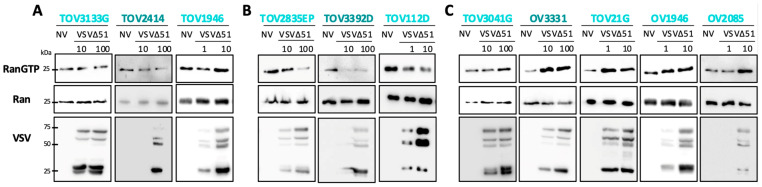
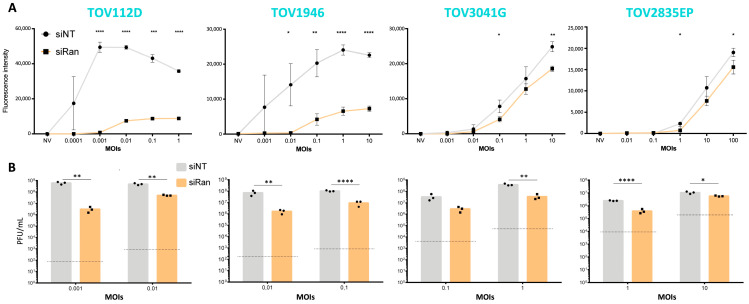
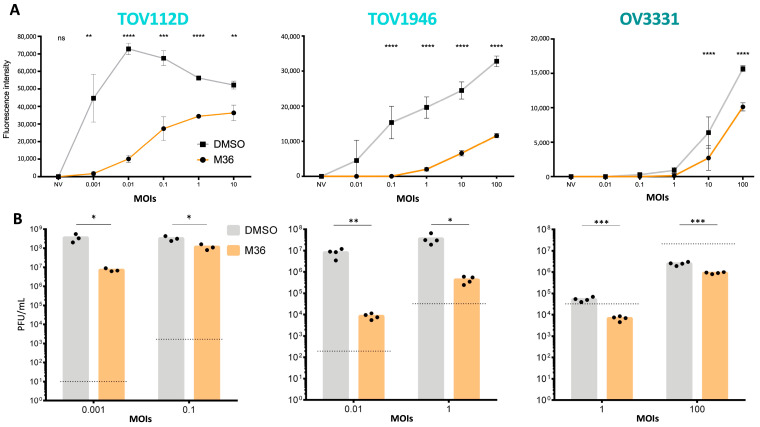
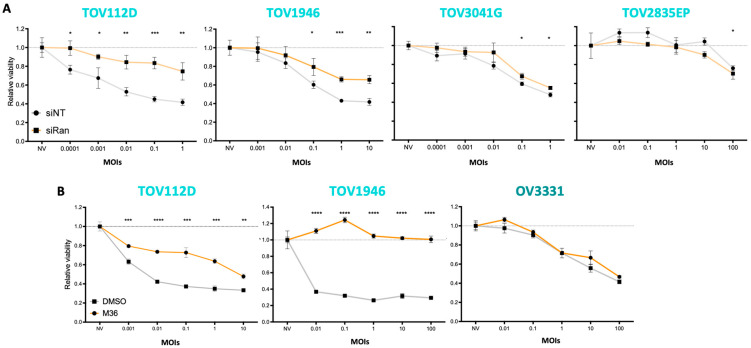
Ovarian cancer is the deadliest gynecologic cancer, and with the majority of patients dying within the first five years of diagnosis, new therapeutic options are required. The small guanosine triphosphatase (GTPase) Ras-related nuclear protein (Ran) has been reported to be highly expressed in high-grade serous ovarian cancers (HGSOCs) and associated with poor outcomes. Blocking Ran function or preventing its expression were shown to be promising treatment strategies, however, there are currently no small molecule inhibitors available to specifically inhibit Ran function. Interestingly, a previous study suggested that the Vesicular stomatitis virus (VSV) could inhibit Ran activity. Given that VSV is an oncolytic virus (OV) and, therefore, has anti-cancer activity, we reasoned that oncolytic VSV (oVSV) might be particularly effective against ovarian cancer via Ran inhibition. : We evaluated the sensitivity of patient-derived ovarian cancer cell lines to oVSV, as well as the impact of oVSV on Ran and vice versa, using overexpression systems, small interfering RNAs (siRNAs), and drug inhibition. : In this study, we evaluated the interplay between oVSV and Ran and found that, although oVSV does not consistently block Ran, increased Ran activation allows for better oVSV replication and tumor cell killing. : Our study reveals a positive impact of Ran on oVSV sensitivity. Given the high expression of Ran in HGSOCs, which are particularly aggressive ovarian cancers, our data suggest that oVSV could be effective against the deadliest form of the disease.
卵巢癌是最致命的妇科癌症,大多数患者在确诊后的头五年内死亡,因此需要新的治疗选择。据报道,小GTP酶(GTPase)Ras相关核蛋白(Ran)在高级别浆液性卵巢癌(HGSOC)中高表达,并与不良预后相关。阻断Ran功能或阻止其表达被证明是有前景的治疗策略,然而,目前尚无特异性抑制Ran功能的小分子抑制剂。有趣的是,先前的一项研究表明,水泡性口炎病毒(VSV)可以抑制Ran活性。鉴于VSV是一种溶瘤病毒(OV),因此具有抗癌活性,我们推断溶瘤性VSV(oVSV)可能通过抑制Ran对卵巢癌特别有效。我们使用过表达系统、小干扰RNA(siRNA)和药物抑制,评估了患者来源的卵巢癌细胞系对oVSV的敏感性,以及oVSV对Ran的影响,反之亦然。在本研究中,我们评估了oVSV与Ran之间的相互作用,发现尽管oVSV并不能持续阻断Ran,但Ran激活的增加能使oVSV更好地复制并杀死肿瘤细胞。我们的研究揭示了Ran对oVSV敏感性有积极影响。鉴于Ran在HGSOC(一种特别侵袭性的卵巢癌)中高表达,我们的数据表明oVSV可能对这种最致命形式的疾病有效。