Department of Nursing and Health Sciences, Fulda University of Applied Sciences, Fulda, Germany.
Centre for Applied Health Science, Leuphana University Lueneburg, Lueneburg, Germany.
J Med Internet Res. 2021 Jan 15;23(1):e24097. doi: 10.2196/24097.
Digital communication technologies are playing an important role in the health communication strategies of governments and public health authorities during the COVID-19 pandemic. The internet and social media have become important sources of health-related information on COVID-19 and on protective behaviors. In addition, the COVID-19 infodemic is spreading faster than the coronavirus itself, which interferes with governmental health-related communication efforts. This jeopardizes national public health containment strategies. Therefore, digital health literacy is a key competence to navigate web-based COVID-19-related information and service environments.
This study aimed to investigate university students' digital health literacy and web-based information-seeking behaviors during the early stages of the COVID-19 pandemic in Germany.
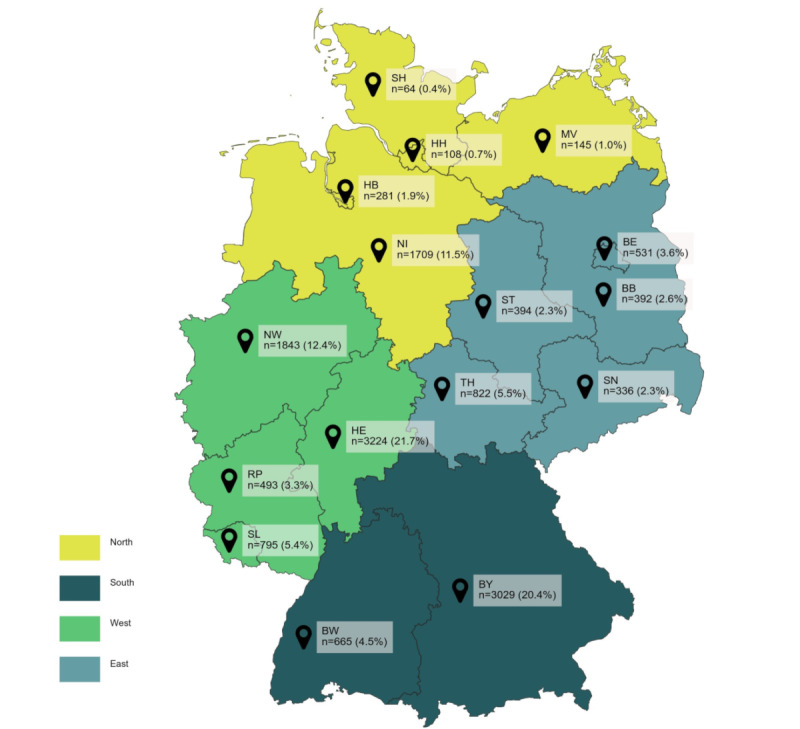
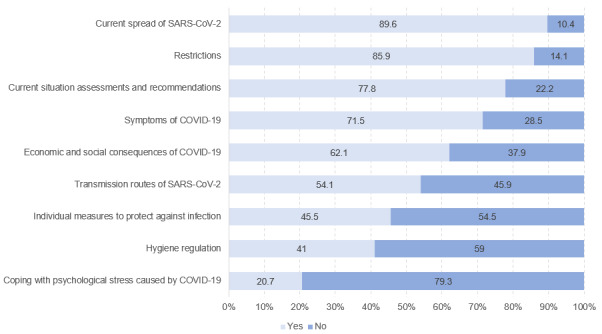
A cross-sectional study among 14,916 university students aged ≥18 years from 130 universities across all 16 federal states of Germany was conducted using a web-based survey. Along with sociodemographic characteristics (sex, age, subjective social status), the measures included five subscales from the Digital Health Literacy Instrument (DHLI), which was adapted to the specific context of the COVID-19 pandemic. Web-based information-seeking behavior was investigated by examining the web-based sources used by university students and the topics that the students searched for in connection with COVID-19. Data were analyzed using univariate and bivariate analyses.
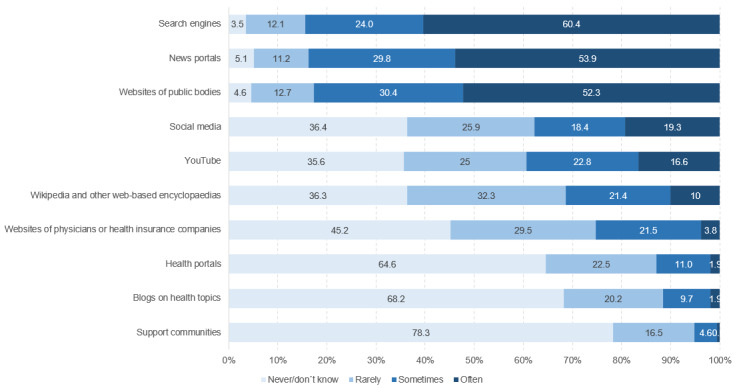
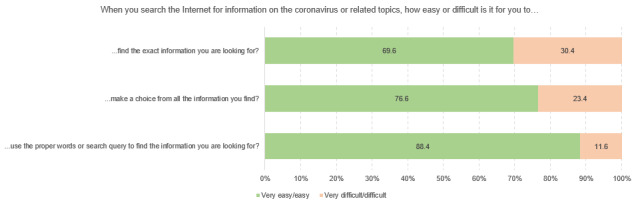
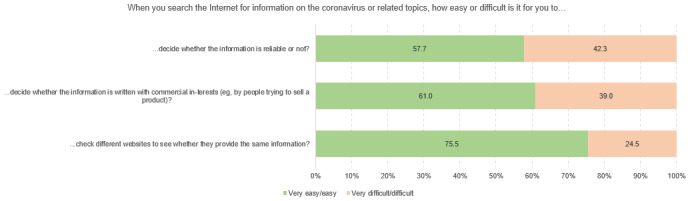
Across digital health literacy dimensions, the greatest difficulties could be found for assessing the reliability of health-related information (5964/14,103, 42.3%) and the ability to determine whether the information was written with a commercial interest (5489/14,097, 38.9%). Moreover, the respondents indicated that they most frequently have problems finding the information they are looking for (4282/14,098, 30.4%). When stratified according to sociodemographic characteristics, significant differences were found, with female university students reporting a lower DHLI for the dimensions of "information searching" and "evaluating reliability." Search engines, news portals, and websites of public bodies were most often used by the respondents as sources to search for information on COVID-19 and related issues. Female students were found to use social media and health portals more frequently, while male students used Wikipedia and other web-based encyclopedias as well as YouTube more often. The use of social media was associated with a low ability to critically evaluate information, while the opposite was observed for the use of public websites.
Although digital health literacy is well developed in university students, a significant proportion of students still face difficulties with certain abilities to evaluate information. There is a need to strengthen the digital health literacy capacities of university students using tailored interventions. Improving the quality of health-related information on the internet is also key.
在 COVID-19 大流行期间,数字通信技术在政府和公共卫生当局的卫生通信策略中发挥着重要作用。互联网和社交媒体已成为有关 COVID-19 和保护行为的重要健康信息来源。此外,COVID-19 信息疫情的传播速度比冠状病毒本身还要快,这干扰了政府的相关卫生通信工作。这危及国家公共卫生遏制战略。因此,数字健康素养是浏览基于网络的 COVID-19 相关信息和服务环境的关键能力。
本研究旨在调查德国 COVID-19 大流行早期阶段大学生的数字健康素养和基于网络的信息搜索行为。
使用基于网络的调查,对来自德国 16 个联邦州的 130 所大学的 14916 名年龄≥18 岁的大学生进行了一项横断面研究。除了社会人口统计学特征(性别、年龄、主观社会地位)外,该措施还包括从数字健康素养工具(DHLI)改编而来的五个子量表,该工具适应了 COVID-19 大流行的具体情况。通过检查大学生使用的基于网络的信息来源以及与 COVID-19 相关的搜索主题,研究了大学生的基于网络的信息搜索行为。使用单变量和双变量分析对数据进行分析。
在数字健康素养的各个维度上,评估健康相关信息的可靠性(5964/14103,42.3%)和确定信息是否带有商业利益的能力(5489/14097,38.9%)方面的困难最大。此外,受访者表示,他们最常遇到寻找所需信息的问题(4282/14098,30.4%)。按照社会人口统计学特征进行分层,发现存在显著差异,女大学生在“信息搜索”和“评估可靠性”维度上的 DHLI 较低。受访者最常使用搜索引擎、新闻门户和公共机构网站作为搜索 COVID-19 和相关问题信息的来源。发现女学生更频繁地使用社交媒体和健康门户网站,而男学生更频繁地使用维基百科和其他基于网络的百科全书以及 YouTube。社交媒体的使用与批判性评估信息的能力较低有关,而公共网站的使用则相反。
尽管大学生的数字健康素养水平较高,但仍有相当一部分学生在某些信息评估能力方面仍面临困难。需要使用针对性的干预措施来增强大学生的数字健康素养能力。提高互联网上健康相关信息的质量也是关键。