Nodelman Ilana M, Bowman Gregory D
T.C. Jenkins Department of Biophysics, Johns Hopkins University, Baltimore, Maryland 21218, USA; email:
Annu Rev Biophys. 2021 May 6;50:73-93. doi: 10.1146/annurev-biophys-082520-080201. Epub 2021 Jan 4.
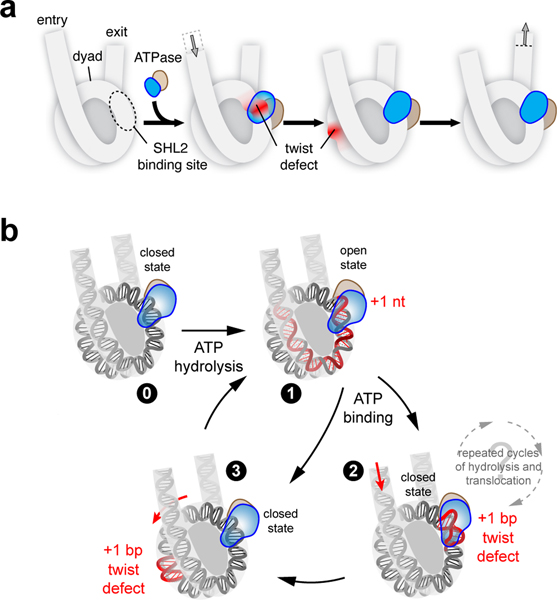
As primary carriers of epigenetic information and gatekeepers of genomic DNA, nucleosomes are essential for proper growth and development of all eukaryotic cells. Although they are intrinsically dynamic, nucleosomes are actively reorganized by ATP-dependent chromatin remodelers. Chromatin remodelers contain helicase-like ATPase motor domains that can translocate along DNA, and a long-standing question in the field is how this activity is used to reposition or slide nucleosomes. In addition to ratcheting along DNA like their helicase ancestors, remodeler ATPases appear to dictate specific alternating geometries of the DNA duplex, providing an unexpected means for moving DNA past the histone core. Emerging evidence supports twist-based mechanisms for ATP-driven repositioning of nucleosomes along DNA. In this review, we discuss core experimental findings and ideas that have shaped the view of how nucleosome sliding may be achieved.
作为表观遗传信息的主要载体和基因组DNA的守护者,核小体对于所有真核细胞的正常生长和发育至关重要。尽管核小体本身具有动态性,但它们会被依赖ATP的染色质重塑因子积极地重新组织。染色质重塑因子包含类似解旋酶的ATP酶运动结构域,该结构域可沿DNA移位,该领域长期存在的一个问题是这种活性如何用于重新定位或滑动核小体。除了像它们的解旋酶祖先一样沿着DNA棘轮运动外,重塑因子ATP酶似乎还决定了DNA双链体的特定交替几何形状,为使DNA绕过组蛋白核心提供了一种意想不到的方式。新出现的证据支持基于扭曲的机制,即ATP驱动核小体沿DNA重新定位。在这篇综述中,我们讨论了一些核心实验结果和观点,这些结果和观点塑造了人们对如何实现核小体滑动的看法。