Department of Physical Therapy, Faculty of Nursing and Rehabilitation, Konan Women's University, Kobe 658-0001, Japan.
Department of Public Health, Kobe University Graduate School of Health Sciences, Kobe 654-0142, Japan.
Int J Environ Res Public Health. 2020 Dec 31;18(1):251. doi: 10.3390/ijerph18010251.
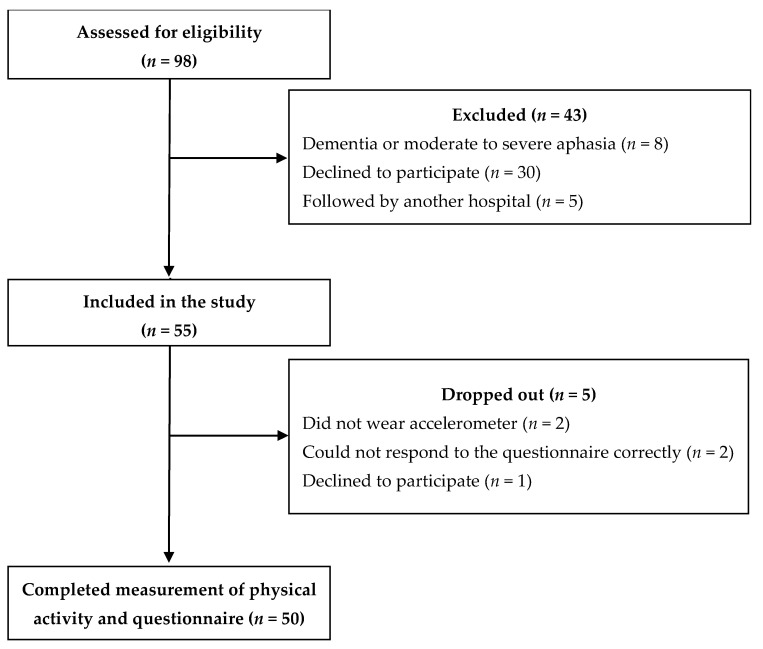
Health-related quality of life (HRQoL) after stroke tends to vary across studies or across stages of stroke. It is useful to use the health utility score to compare HRQoL across studies. Physical activity after stroke also tends to vary similarly. The purpose of the present study was to determine associations between the health utility score and physical activity outcomes in stroke survivors. This cross-sectional study recruited stroke survivors who could ambulate outside, free of assistance. We assessed the health utility score with the EuroQoL 5-Dimension 3-Level questionnaire. The physical activity outcomes were the number of steps taken and duration of moderate-to-vigorous physical activity (MVPA) as measured with an accelerometer. Multiple linear regression analyses were used to determine whether the physical activity outcomes were independently associated with the health utility score. Fifty patients (age: 68.0 years; 40 men, 10 women) were included. Multiple linear regression analysis showed the health utility score to be significantly associated with the number of steps taken (β = 0.304, = 0.035) but not with MVPA. This is the first study to examine the association between the health utility score and objectively measured physical activity in stroke survivors. Promoting physical activity especially by increasing the number of steps taken might be a priority goal in improving a patient's health utility score after stroke.
健康相关生活质量(HRQoL)在中风后往往因研究或中风阶段而异。使用健康效用评分来比较研究间的 HRQoL 是很有用的。中风后身体活动也往往相似。本研究的目的是确定中风幸存者的健康效用评分与身体活动结果之间的关联。这项横断面研究招募了可以在没有帮助的情况下在户外行走的中风幸存者。我们使用欧洲五维健康量表 3 级问卷评估健康效用评分。身体活动结果是通过加速度计测量的步数和中等至剧烈身体活动(MVPA)的持续时间。使用多元线性回归分析来确定身体活动结果是否与健康效用评分独立相关。50 名患者(年龄:68.0 岁;40 名男性,10 名女性)被纳入研究。多元线性回归分析显示,健康效用评分与步数(β=0.304,p=0.035)显著相关,但与 MVPA 无关。这是第一项研究检查中风幸存者的健康效用评分与客观测量的身体活动之间的关联。促进身体活动,特别是增加步数,可能是改善中风后患者健康效用评分的优先目标。