Korea Zoonosis Research Institute, Jeonbuk National University, Iksan, Jeonbuk 54531, Korea.
Department of Bioactive Material Sciences and Institute for Molecular Biology and Genetics, Jeonbuk National University, Jeonju, Jeonbuk 54896, Korea.
Genes (Basel). 2020 Dec 30;12(1):36. doi: 10.3390/genes12010036.
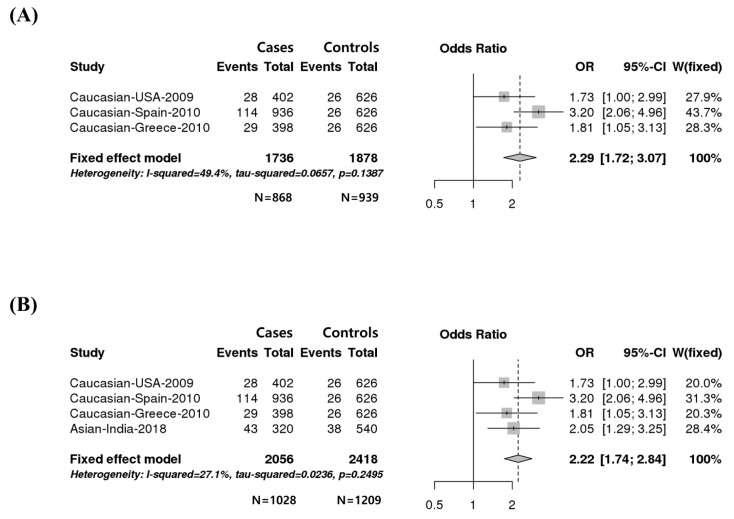
Human immunodeficiency virus (HIV) causes acquired immune deficiency syndrome (AIDS) and enters the host cell via CD4 and either CC-chemokine receptor 5 (CCR) or CXC-chemokine receptor 4 (CXCR4). HIV is directly recognized by toll-like receptor 4 (TLR4) and affects downstream immune-related signal pathways. In addition, stimulated TLR4 inhibits HIV-1 invasion, and the rs4986790 single nucleotide polymorphism (SNP) (D299G) of the gene contributes to the risk of HIV-1 infection in an Indian population. To evaluate whether the rs4986790 SNP of the gene is related to vulnerability to HIV-1 infection, we collected genetic information from HIV-1 patients in previous studies and performed an association analysis with a matched control population obtained from the 1000 Genomes Project. In addition, to strengthen the results of association analysis, we performed a meta-analysis. We identified a strong association between the rs4986791 SNP and susceptibility to HIV infection in HIV-infected patients in previous studies and a matched control population obtained from the 1000 Genomes Project. In addition, we found that the G allele of the rs4986791 SNP in the gene is strongly related to susceptibility to HIV infection in three Caucasian populations (odd ratio = 2.29, 95% confidence interval: 1.72-3.07, = 1.438 × 10) and all four populations (odd ratio = 2.22, 95% confidence interval: 1.74-2.84, = 2 × 10) in a meta-analysis. To the best our knowledge, this was the first meta-analysis on the association between the rs4986791 SNP of the gene and susceptibility to HIV infection.
人类免疫缺陷病毒(HIV)会引起获得性免疫缺陷综合征(AIDS),它通过 CD4 以及 C 型趋化因子受体 5(CCR5)或 CXC 型趋化因子受体 4(CXCR4)进入宿主细胞。HIV 可被 Toll 样受体 4(TLR4)直接识别,并影响下游的免疫相关信号通路。此外,激活的 TLR4 可抑制 HIV-1 的入侵,而 基因中的 rs4986790 单核苷酸多态性(SNP)(D299G)可能会增加印度人群感染 HIV-1 的风险。为了评估 基因中的 rs4986790 SNP 是否与 HIV-1 易感性有关,我们从前瞻性研究的 HIV-1 患者中收集了遗传信息,并与 1000 基因组计划获得的匹配对照人群进行了关联分析。此外,为了加强关联分析的结果,我们进行了荟萃分析。我们发现,先前研究中 HIV-1 感染者和 1000 基因组计划匹配对照人群中 rs4986790 SNP 与 HIV 感染易感性之间存在显著关联。此外,我们发现 基因中的 rs4986791 SNP 的 G 等位基因与三个白种人群(比值比=2.29,95%置信区间:1.72-3.07, = 1.438×10)和所有四个人群(比值比=2.22,95%置信区间:1.74-2.84, = 2×10)感染 HIV 的易感性密切相关。据我们所知,这是首次对 基因中的 rs4986791 SNP 与 HIV 感染易感性之间的关联进行荟萃分析。