Sabaruddin Fatimah Athiyah, Paridah M T, Sapuan S M, Ilyas R A, Lee Seng Hua, Abdan Khalina, Mazlan Norkhairunnisa, Roseley Adlin Sabrina Muhammad, Abdul Khalil H P S
Institute Tropical Forestry and Forest Product (INTROP), Universiti Putra Malaysia, Jalan Asam Jawa, Serdang Selangor 43400, Malaysia.
School of Industrial Technology, Universiti Sains Malaysia, Penang 11800, Malaysia.
Polymers (Basel). 2020 Dec 30;13(1):116. doi: 10.3390/polym13010116.
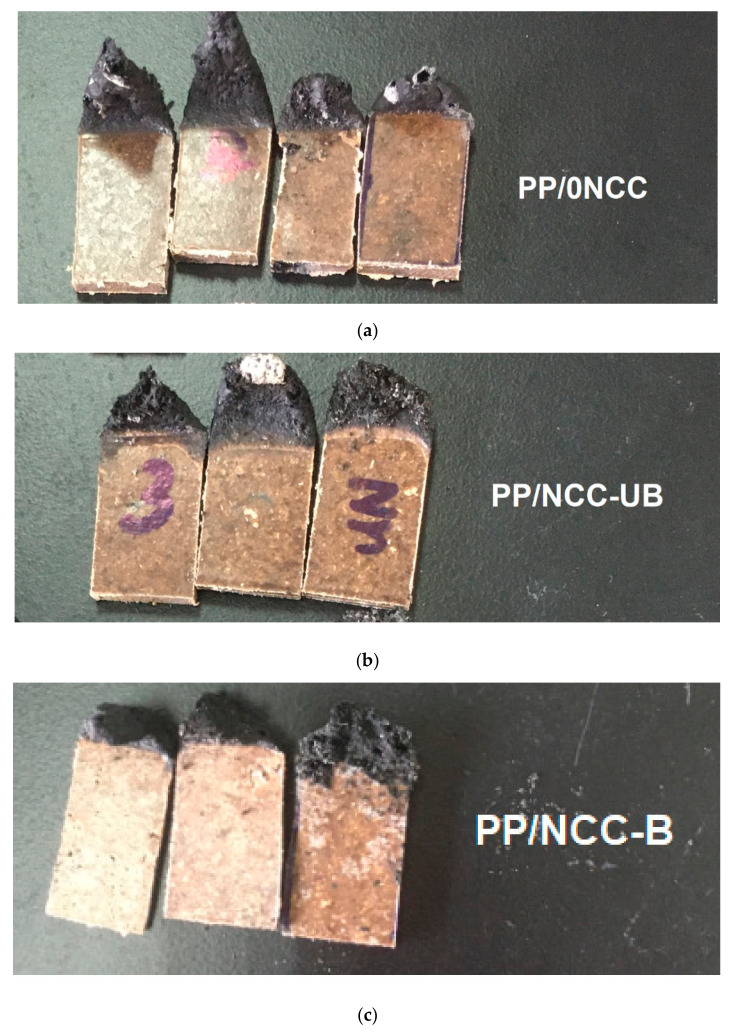
The thermal, thermo-mechanical and flammability properties of kenaf core hybrid polymer nanocomposites reinforced with unbleached and bleached nanocrystalline cellulose (NCC) were studied. The studied chemical composition found that unbleached NCC (NCC-UB) had 90% more lignin content compared to bleached NCC (NCC-B). Nanocelluloses were incorporated within polypropylene (PP) as the matrix, together with kenaf core as a main reinforcement and maleic anhydride grafted polypropylene (MAPP) as a coupling agent via a melt mixing compounding process. The result showed that the thermal stability of the nanocomposites was generally affected by the presence of lignin in NCC-UB and sulfate group on the surface of NCC-B. The residual lignin in NCC-UB appeared to overcome the poor thermal stability of the composites that was caused by sulfation during the hydrolysis process. The lignin helped to promote the late degradation of the nanocomposites, with the melting temperature occurring at a relatively higher temperature of 219.1 °C for PP/NCC-UB, compared to 185.9 °C for PP/NCC-B. Between the two types of nanocomposites, PP/NCC-B had notably lower thermo-mechanical properties, which can be attributed to the poor bonding and dispersion properties of the NCC-B in the nanocomposites blend. The PP/NCC-UB showed better thermal properties due to the effect of residual lignin, which acted as a compatibilizer between NCC-UB and polymer matrix, thus improved the bonding properties. The residual lignin in PP/NCC-UB helped to promote char formation and slowed down the burning process, thus increasing the flame resistance of the nanocomposites. Overall, the residual lignin on the surface of NCC-UB appeared to aid better stability on the thermal and flammability properties of the nanocomposites.
研究了用未漂白和漂白的纳米晶纤维素(NCC)增强的红麻芯杂化聚合物纳米复合材料的热性能、热机械性能和燃烧性能。研究发现,与漂白的NCC(NCC-B)相比,未漂白的NCC(NCC-UB)的木质素含量多90%。通过熔融共混复合工艺,将纳米纤维素与作为基体的聚丙烯(PP)、作为主要增强剂的红麻芯以及作为偶联剂的马来酸酐接枝聚丙烯(MAPP)混合。结果表明,纳米复合材料的热稳定性一般受NCC-UB中木质素的存在以及NCC-B表面硫酸根的影响。NCC-UB中残留的木质素似乎克服了水解过程中硫酸化导致的复合材料热稳定性差的问题。木质素有助于促进纳米复合材料的后期降解,PP/NCC-UB的熔融温度出现在相对较高的219.1℃,而PP/NCC-B为185.9℃。在这两种纳米复合材料中,PP/NCC-B的热机械性能明显较低,这可归因于NCC-B在纳米复合材料共混物中的粘结和分散性能较差。由于残留木质素的作用,PP/NCC-UB表现出更好的热性能,残留木质素作为NCC-UB与聚合物基体之间的增容剂,从而改善了粘结性能。PP/NCC-UB中残留的木质素有助于促进炭的形成并减缓燃烧过程,从而提高纳米复合材料的阻燃性。总体而言,NCC-UB表面的残留木质素似乎有助于提高纳米复合材料在热性能和燃烧性能方面的稳定性。