Pan Youdong, Liu Luzheng, Tian Tian, Zhao Jingxia, Park Chang Ook, Lofftus Serena Y, Stingley Claire A, Yan Yu, Mei Shenglin, Liu Xing, Kupper Thomas S
Department of Dermatology and Harvard Skin Disease Research Center, Brigham and Women's Hospital, Harvard Medical School, Boston, Massachusetts, USA.
Beijing Institute of Traditional Chinese Medicine, Beijing Hospital of Traditional Chinese Medicine, Capital Medical University, Beijing, China.
NPJ Vaccines. 2021 Jan 4;6(1):1. doi: 10.1038/s41541-020-00265-5.
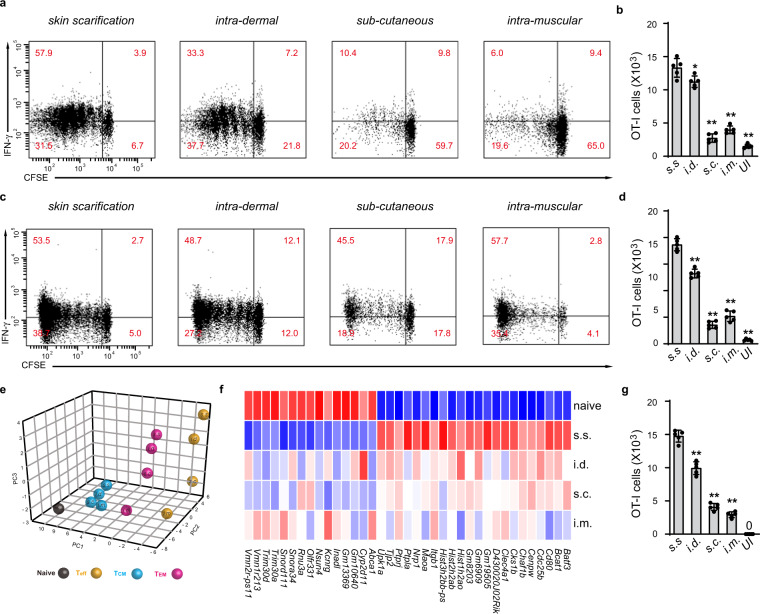
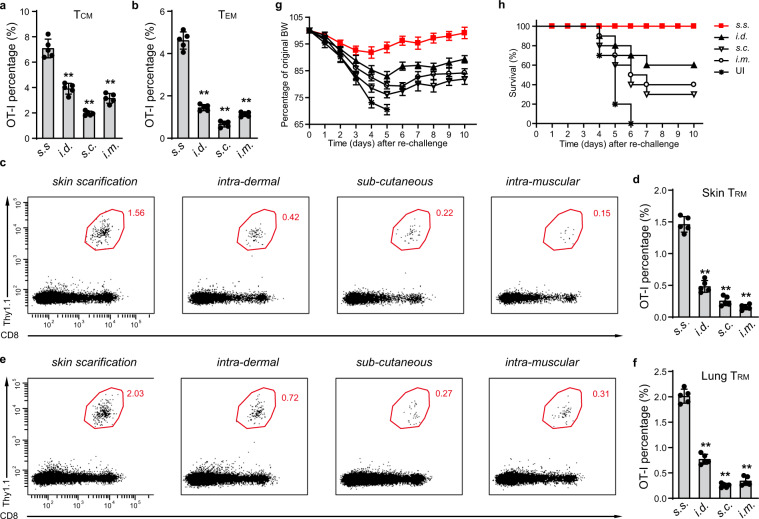
Modified Vaccinia Ankara (MVA) was recently approved as a smallpox vaccine. Variola is transmitted by respiratory droplets and MVA immunization by skin scarification (s.s.) protected mice far more effectively against lethal respiratory challenge with vaccinia virus (VACV) than any other route of delivery, and at lower doses. Comparisons of s.s. with intradermal, subcutaneous, or intramuscular routes showed that MVA s.s.-generated T cells were both more abundant and transcriptionally unique. MVA s.s. produced greater numbers of lung Ova-specific CD8 T and was superior in protecting mice against lethal VACV respiratory challenge. Nearly as many lung T were generated with MVA s.s. immunization compared to intra-tracheal immunization with MVA and both routes vaccination protected mice against lethal pulmonary challenge with VACV. Strikingly, MVA s.s.-generated effector T cells exhibited overlapping gene transcriptional profiles to those generated via intra-tracheal immunization. Overall, our data suggest that heterologous MVA vectors immunized via s.s. are uniquely well-suited as vaccine vectors for respiratory pathogens, which may be relevant to COVID-19. In addition, MVA delivered via s.s. could represent a more effective dose-sparing smallpox vaccine.
改良安卡拉痘苗(MVA)最近被批准作为天花疫苗。天花通过呼吸道飞沫传播,通过皮肤划痕接种(s.s.)进行MVA免疫比任何其他接种途径都能更有效地保护小鼠免受痘苗病毒(VACV)致死性呼吸道攻击,且所需剂量更低。将皮肤划痕接种与皮内、皮下或肌肉注射途径进行比较表明,通过皮肤划痕接种MVA产生的T细胞数量更多且转录特征独特。皮肤划痕接种MVA产生了更多的肺部卵清蛋白特异性CD8 T细胞,在保护小鼠免受致死性VACV呼吸道攻击方面更具优势。与通过气管内接种MVA相比,皮肤划痕接种MVA产生的肺部T细胞数量相近,且两种接种途径都能保护小鼠免受VACV致死性肺部攻击。引人注目的是,皮肤划痕接种MVA产生的效应T细胞与通过气管内接种产生的效应T细胞表现出重叠的基因转录谱。总体而言,我们的数据表明,通过皮肤划痕接种的异源MVA载体作为呼吸道病原体的疫苗载体具有独特的优势,这可能与COVID-19相关。此外,通过皮肤划痕接种的MVA可能是一种更有效的节省剂量的天花疫苗。