Clinical Epidemiology Division, Department of Medicine Solna, Karolinska Institutet, Stockholm, Sweden.
Respiratory Medicine Division, Department of Medicine Solna, Karolinska Institutet, Stockholm, Sweden.
Respirology. 2021 May;26(5):452-460. doi: 10.1111/resp.14001. Epub 2021 Jan 4.
No clinical trial has examined the risk of infection associated methotrexate and azathioprine, two advocated treatments for sarcoidosis. We aimed to compare the 6-month risk of infection after the initiation of methotrexate or azathioprine.
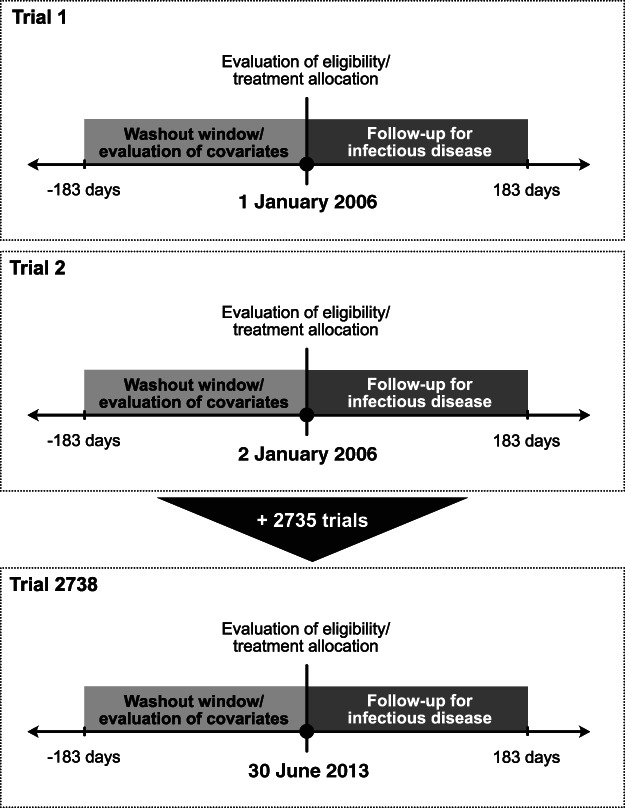
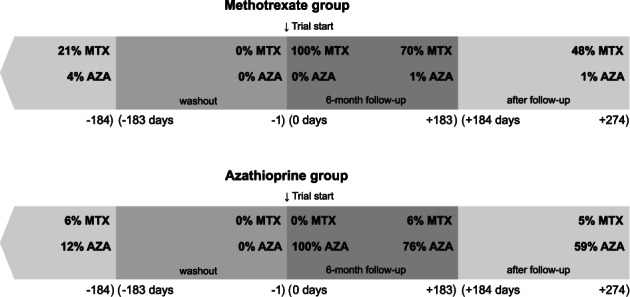
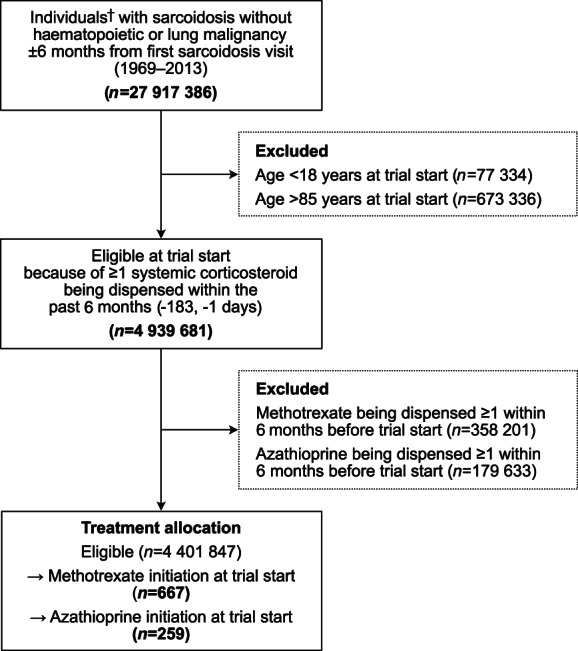
We conducted a retrospective target trial emulation using Swedish pre-existing data. We searched for eligible participants who were dispensed methotrexate or azathioprine in the Prescribed Drug Register (PDR) every day between January 2007 and June 2013. Adults were eligible if they had ≥2 ICD-coded visits for sarcoidosis in the National Patient Register (NPR) and were dispensed ≥1 systemic corticosteroid but no methotrexate or azathioprine in the past 6 months (PDR). Within 6 months of methotrexate or azathioprine initiation, diagnosis of infectious disease was identified (visit in the NPR where infectious disease was the primary diagnosis). We estimated RR and risk differences comparing methotrexate (n = 667) to azathioprine initiations (n = 259) using targeted maximum likelihood estimation (TMLE) adjusting for demographic factors, comorbidity and sarcoidosis severity proxies.
There were 43 infections in the methotrexate group (adjusted 6-month risk 6.8%) and 29 infections in the azathioprine group (12.0%). The RR for infectious disease at 6 months associated with methotrexate compared to azathioprine initiation was 0.57 (95% CI: 0.39, 0.82) and the risk difference was -5.2% (95% CI: -8.5%, -1.8%). The RR at 9 months was attenuated to 0.77 (95% CI: 0.52, 1.14).
Methotrexate appears to be associated with a lower risk of infection in sarcoidosis than azathioprine, but randomized trials should confirm this finding.
没有临床试验研究过甲氨蝶呤和硫唑嘌呤(两种治疗结节病的推荐药物)相关感染的风险。我们旨在比较使用甲氨蝶呤或硫唑嘌呤治疗后 6 个月的感染风险。
我们使用瑞典预先存在的数据进行了回顾性目标试验模拟。我们在全国患者登记处(NPR)中搜索符合条件的参与者,他们在 2007 年 1 月至 2013 年 6 月期间每天都接受甲氨蝶呤或硫唑嘌呤处方。如果患者在 NPR 中有≥2 次因结节病进行 ICD 编码的就诊,并且在过去 6 个月内未使用甲氨蝶呤或硫唑嘌呤(PDR)处方≥1 次全身性皮质类固醇,他们就符合条件。在使用甲氨蝶呤或硫唑嘌呤治疗后 6 个月内,确定感染性疾病的诊断(在 NPR 中,感染性疾病是主要诊断的就诊)。我们使用靶向最大似然估计(TMLE)估计比较甲氨蝶呤(n=667)和硫唑嘌呤(n=259)起始的 RR 和风险差异,调整了人口统计学因素、合并症和结节病严重程度的替代指标。
甲氨蝶呤组有 43 例感染(调整后 6 个月风险为 6.8%),硫唑嘌呤组有 29 例感染(12.0%)。与硫唑嘌呤相比,使用甲氨蝶呤在 6 个月时发生感染性疾病的 RR 为 0.57(95% CI:0.39,0.82),风险差异为-5.2%(95% CI:-8.5%,-1.8%)。在 9 个月时,RR 减弱至 0.77(95% CI:0.52,1.14)。
与硫唑嘌呤相比,甲氨蝶呤似乎与较低的结节病感染风险相关,但应通过随机试验来证实这一发现。