Department of Neurology, Dokkyo Medical University, Mibu, Japan.
Department of Public Health, Dokkyo Medical University School of Medicine, Mibu, Japan.
Brain Behav. 2021 Mar;11(3):e02026. doi: 10.1002/brb3.2026. Epub 2021 Jan 5.
We aimed to evaluate the effect of zonisamide (ZNS) on motor symptoms and nonmotor symptoms such as depressive symptoms and sleep problems in Parkinson's disease (PD) patients with or without tremor.
We conducted a 3-month, open-label study to assess the effects of ZNS on motor symptoms, depressive symptoms and sleep problems. Twenty levodopa-treated PD patients with motor fluctuation completed the study. Patients received 25-50 mg/day of ZNS and were assessed for the Japanese version of the Movement Disorder Society Revision of the Unified PD Rating Scale (MDS-UPDRS) parts I, III, and IV, PD Sleep Scale (PDSS)-2, Beck depression inventory-2 (BDI-II), and PD Questionnaire (PDQ-8) at baseline and after 1, 2 and 3 months of treatment. Patients were categorized into the tremor group and nontremor group to assess changes in clinical parameters.
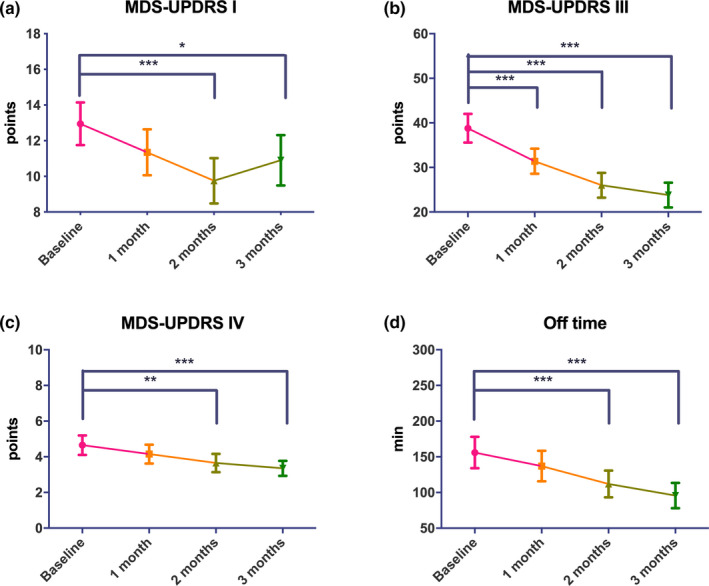
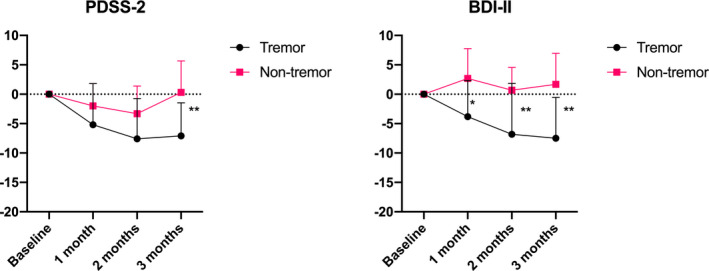
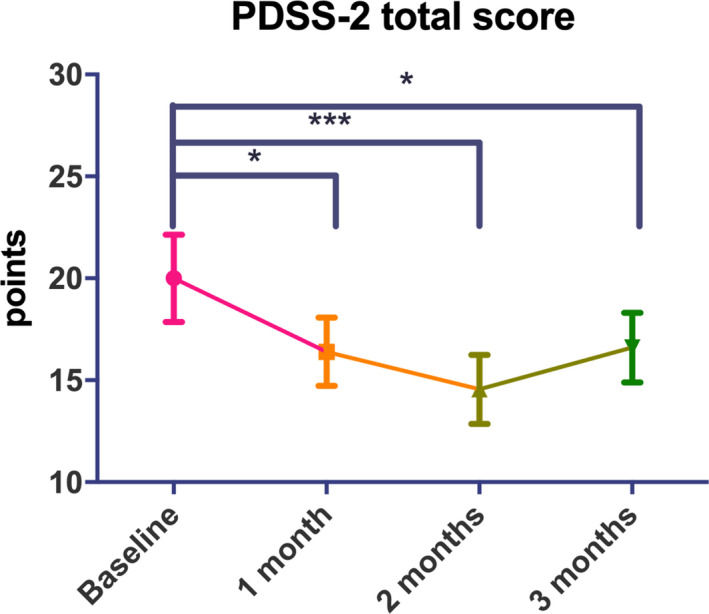
At 3 months, the scores on the MDS-UPDRS parts I, III and IV significantly improved and off-time reduced compared to baseline. Additionally, the PDSS-2 total score significantly decreased at 3 months. Although there were no significant differences in changes in UPDRS part I, III, or IV between the groups after ZNS treatment, the tremor group had significant improvements in PDSS-2 at 3 months and BDI-II at 1, 2 and 3 months compared with the nontremor group.
We showed the beneficial effects of ZNS on motor symptoms and sleep problems in levodopa-treated PD patients with motor fluctuation. ZNS may be more effective for several nonmotor symptoms in PD patients with tremor compared with those without tremor.
我们旨在评估佐米曲普坦(ZNS)对伴有或不伴有震颤的帕金森病(PD)患者的运动症状和非运动症状(如抑郁症状和睡眠问题)的影响。
我们进行了一项为期 3 个月的开放标签研究,以评估 ZNS 对运动症状、抑郁症状和睡眠问题的影响。20 名接受左旋多巴治疗的伴有运动波动的 PD 患者完成了该研究。患者接受 25-50mg/天的 ZNS 治疗,并在基线和治疗后 1、2 和 3 个月时使用日本版运动障碍协会修订的统一 PD 评定量表(MDS-UPDRS)第 I、III 和 IV 部分、PD 睡眠量表(PDSS)-2、贝克抑郁量表-2(BDI-II)和 PD 问卷(PDQ-8)进行评估。患者被分为震颤组和非震颤组,以评估临床参数的变化。
在 3 个月时,与基线相比,MDS-UPDRS 第 I、III 和 IV 部分的评分显著改善,并且关闭时间减少。此外,PDSS-2 的总分在 3 个月时显著下降。尽管在 ZNS 治疗后,两组之间 UPDRS 第 I、III 或 IV 部分的变化没有显著差异,但震颤组在 3 个月时 PDSS-2 和 BDI-II 的评分显著改善,而在 1、2 和 3 个月时非震颤组的评分也有所改善。
我们表明 ZNS 对伴有运动波动的左旋多巴治疗的 PD 患者的运动症状和睡眠问题有有益的影响。与无震颤的 PD 患者相比,ZNS 可能对震颤患者的几种非运动症状更有效。