Department of Clinical Pharmacology and Therapeutics, Ehime University Graduate School of Medicine, Japan.
Department of Neurology, Saiseikai Matsuyama Hospital, Japan.
Intern Med. 2023 Feb 15;62(4):527-531. doi: 10.2169/internalmedicine.0037-22. Epub 2022 Jul 14.
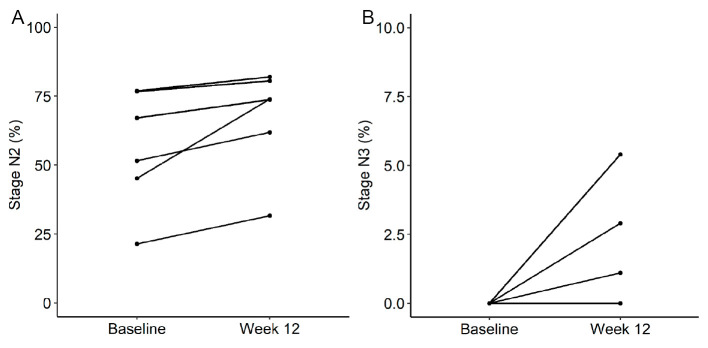
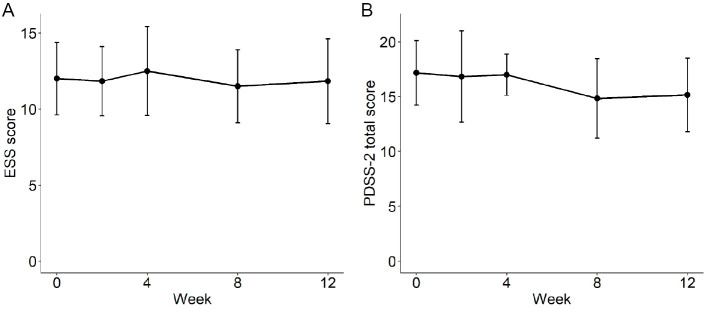
Objective Sleep disturbance is a common nonmotor symptom associated with a decreased quality of life in patients with Parkinson's disease (PD). In this study, we evaluated the effects of zonisamide on motor and non-motor symptomology in patients with PD, especially with respect to objective sleep assessments conducted via polysomnography. Methods We conducted a 12-week, open-label study to assess the effects of zonisamide. The patients received 25 mg/day of zonisamide and underwent overnight polysomnography prior to and after 12 weeks of zonisamide treatment. They were assessed for their cognitive function (Mini-Mental State Examination and the Japanese version of the Montreal Cognitive Assessment), gait function (Timed Up-and-Go Test, 10-m Gait Walk Test), Parkinson's symptomology (Movement Disorder Society Revision of the Unified Parkinson's Disease Rating Scale parts 2 and 3), and self-reported sleep (Epworth Sleepiness Score, Parkinson's Disease Sleep Scale-2). Results Six patients completed the study. Polysomnographic data revealed a statistically significant increase in the percentage of time spent in sleep stage N2 (10.8%±9.2%, p=0.031) and a declining trend in the percentage of time spent in sleep stage N1 (-8.9%±12.7%, p=0.063). Although none of the patients had sleep stage N3 at baseline, 3 of the 6 patients experienced sleep stage N3 (1.1-5.4%) after 12 weeks of zonisamide treatment. The other polysomnographic parameters and clinical scores showed no statistically significant differences. Conclusions This preliminary study demonstrated that zonisamide improved objective sleep parameters measured by polysomnography in patients with PD.
睡眠障碍是帕金森病(PD)患者常见的非运动症状,与生活质量下降有关。本研究评估了佐尼沙胺对 PD 患者运动和非运动症状的影响,特别是通过多导睡眠图进行的客观睡眠评估。
我们进行了一项为期 12 周的开放标签研究,以评估佐尼沙胺的效果。患者每天接受 25 毫克佐尼沙胺治疗,并在接受佐尼沙胺治疗 12 周前后进行了一夜多导睡眠图检查。他们的认知功能(简易精神状态检查和蒙特利尔认知评估的日语版)、步态功能(计时起立行走测试、10 米步行测试)、帕金森病症状(运动障碍协会修订的统一帕金森病评定量表第 2 部分和第 3 部分)和自我报告的睡眠(Epworth 嗜睡量表、帕金森病睡眠量表-2)进行了评估。
6 名患者完成了研究。多导睡眠图数据显示,睡眠阶段 N2 的时间百分比有统计学意义的增加(10.8%±9.2%,p=0.031),睡眠阶段 N1 的时间百分比呈下降趋势(-8.9%±12.7%,p=0.063)。尽管所有患者基线时均无睡眠阶段 N3,但 6 名患者中有 3 名在接受佐尼沙胺治疗 12 周后出现睡眠阶段 N3(1.1-5.4%)。其他多导睡眠图参数和临床评分无统计学差异。
本初步研究表明,佐尼沙胺改善了 PD 患者多导睡眠图测量的客观睡眠参数。