Vaid Akhil, Jaladanki Suraj K, Xu Jie, Teng Shelly, Kumar Arvind, Lee Samuel, Somani Sulaiman, Paranjpe Ishan, De Freitas Jessica K, Wanyan Tingyi, Johnson Kipp W, Bicak Mesude, Klang Eyal, Kwon Young Joon, Costa Anthony, Zhao Shan, Miotto Riccardo, Charney Alexander W, Böttinger Erwin, Fayad Zahi A, Nadkarni Girish N, Wang Fei, Glicksberg Benjamin S
The Hasso Plattner Institute for Digital Health at Mount Sinai, Icahn School of Medicine at Mount Sinai, New York, NY, United States.
The Mount Sinai Clinical Intelligence Center, New York, NY, United States.
JMIR Med Inform. 2021 Jan 27;9(1):e24207. doi: 10.2196/24207.
Machine learning models require large datasets that may be siloed across different health care institutions. Machine learning studies that focus on COVID-19 have been limited to single-hospital data, which limits model generalizability.
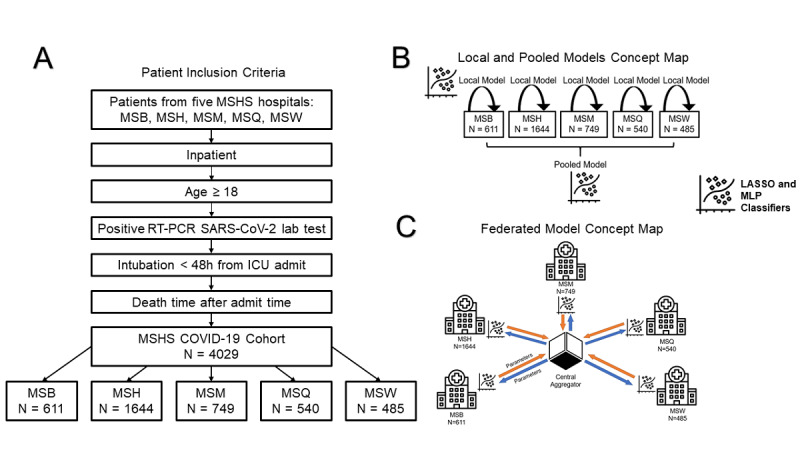
We aimed to use federated learning, a machine learning technique that avoids locally aggregating raw clinical data across multiple institutions, to predict mortality in hospitalized patients with COVID-19 within 7 days.
Patient data were collected from the electronic health records of 5 hospitals within the Mount Sinai Health System. Logistic regression with L1 regularization/least absolute shrinkage and selection operator (LASSO) and multilayer perceptron (MLP) models were trained by using local data at each site. We developed a pooled model with combined data from all 5 sites, and a federated model that only shared parameters with a central aggregator.
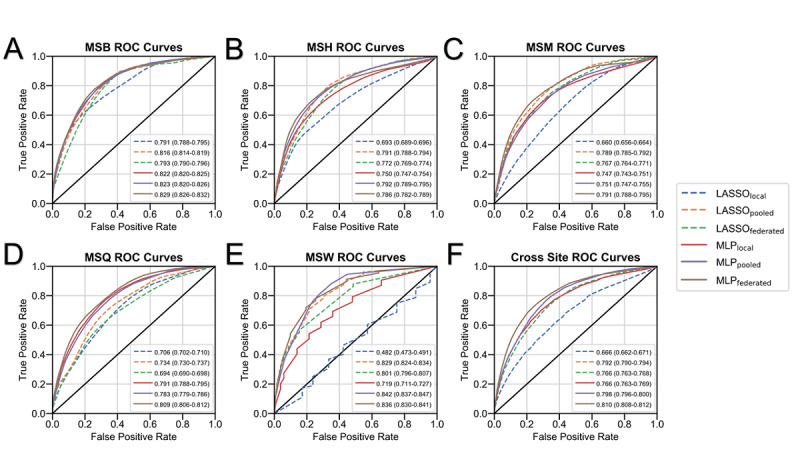
The LASSO model outperformed the LASSO model at 3 hospitals, and the MLP model performed better than the MLP model at all 5 hospitals, as determined by the area under the receiver operating characteristic curve. The LASSO model outperformed the LASSO model at all hospitals, and the MLP model outperformed the MLP model at 2 hospitals.
The federated learning of COVID-19 electronic health record data shows promise in developing robust predictive models without compromising patient privacy.
机器学习模型需要可能分散在不同医疗保健机构的大型数据集。专注于新型冠状病毒肺炎(COVID-19)的机器学习研究仅限于单家医院的数据,这限制了模型的通用性。
我们旨在使用联邦学习,一种避免跨多个机构本地汇总原始临床数据的机器学习技术,来预测COVID-19住院患者7天内的死亡率。
从西奈山医疗系统内5家医院的电子健康记录中收集患者数据。使用每个站点的本地数据训练带有L1正则化/最小绝对收缩和选择算子(LASSO)的逻辑回归模型和多层感知器(MLP)模型。我们开发了一个合并所有5个站点数据的汇总模型,以及一个仅与中央聚合器共享参数的联邦模型。
根据受试者工作特征曲线下面积确定,LASSO模型在3家医院的表现优于LASSO模型,MLP模型在所有5家医院的表现均优于MLP模型。LASSO模型在所有医院的表现优于LASSO模型,MLP模型在2家医院的表现优于MLP模型。
COVID-19电子健康记录数据的联邦学习在不损害患者隐私的情况下开发强大的预测模型方面显示出前景。