Acute Febrile Illnesses Laboratory, Evandro Chagas National Institute of Infectious Diseases, Oswaldo Cruz Foundation, Rio de Janeiro, Brazil.
Department of Sexual and Reproductive Health and Research, World Health Organization, Geneva, Switzerland.
PLoS One. 2021 Jan 5;16(1):e0244981. doi: 10.1371/journal.pone.0244981. eCollection 2021.
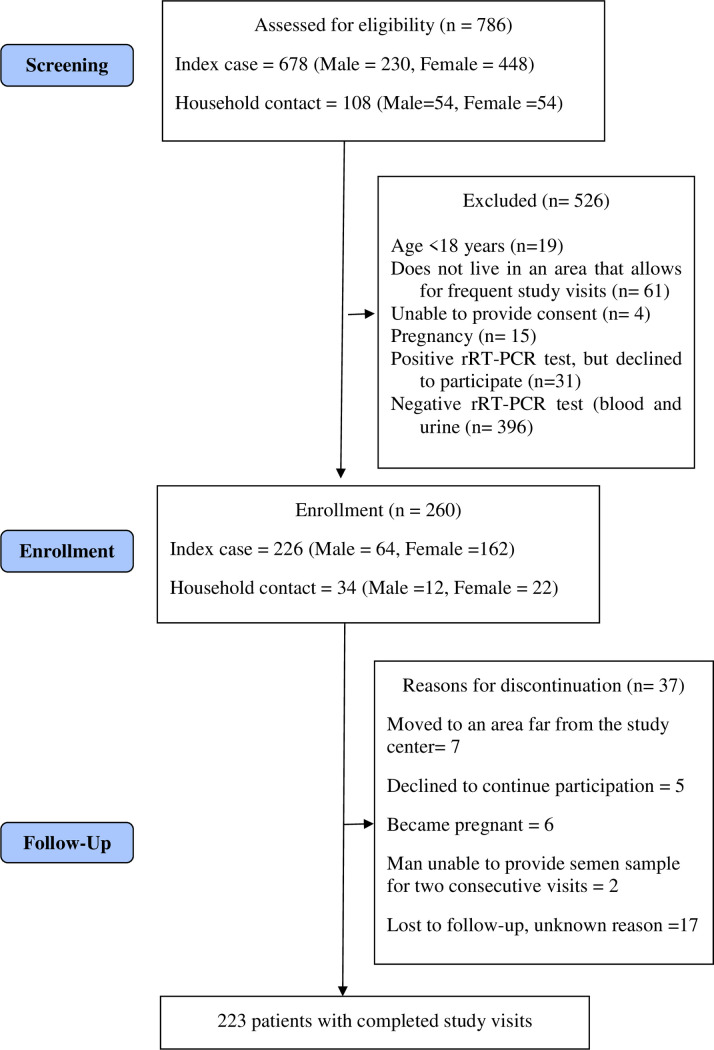
Zika virus (ZIKV) has been detected in blood, urine, semen, cerebral spinal fluid, saliva, amniotic fluid, and breast milk. In most ZIKV infected individuals, the virus is detected in the blood to one week after the onset of symptoms and has been found to persist longer in urine and semen. To better understand virus dynamics, a prospective cohort study was conducted in Brazil to assess the presence and duration of ZIKV and related markers (viral RNA, antibodies, T cell response, and innate immunity) in blood, semen, saliva, urine, vaginal secretions/menstrual blood, rectal swab and sweat. The objective of the current manuscript is to describe the cohort, including an overview of the collected data and a description of the baseline characteristics of the participants. Men and women ≥ 18 years with acute illness and their symptomatic and asymptomatic household contacts with positive reverse transcriptase-polymerase chain reaction test for ZIKV in blood and/or urine were included. All participants were followed up for 12 months. From July 2017 to June 2019, a total of 786 participants (284 men, 502 women) were screened. Of these, 260 (33.1%) were enrolled in the study; index cases: 64 men (24.6%), 162 (62.3%) women; household contacts: 12 men (4.6%), 22 (8.5%) women. There was a statistically significant difference in age and sex between enrolled and not enrolled participants (p<0.005). Baseline sociodemographic and medical data were collected at enrollment from all participants. The median and interquartile range (IQR) age was 35 (IQR; 25.3, 43) for men and 36.5 years (IQR; 28, 47) for women. Following rash, which was one of the inclusion criteria for index cases, the most reported symptoms in the enrollment visit since the onset of the disease were fever, itching, arthralgia with or without edema, non-purulent conjunctivitis, headache, and myalgia. Ten hospitalizations were reported by eight patients (two patients were hospitalized twice) during follow up, after a median of 108 days following symptom onset (range 7 to 266 days) and with a median of 1.5 days (range 1 to 20 days) of hospital stay. A total of 4,137 visits were performed, 223 (85.8%) participants have attended all visits and 37 (14.2%) patients were discontinued.
寨卡病毒 (ZIKV) 已在血液、尿液、精液、脑脊液、唾液、羊水和母乳中被检测到。在大多数感染寨卡病毒的个体中,病毒在症状出现后一周内可在血液中被检测到,并已发现其在尿液和精液中持续时间更长。为了更好地了解病毒动力学,巴西开展了一项前瞻性队列研究,以评估血液、精液、唾液、尿液、阴道分泌物/月经血、直肠拭子和汗液中寨卡病毒和相关标志物(病毒 RNA、抗体、T 细胞反应和先天免疫)的存在和持续时间。本文的目的是描述该队列,包括对所收集数据的概述以及对参与者基线特征的描述。纳入年龄≥18 岁的急性疾病男性和女性及其有症状和无症状的家庭接触者,这些人在血液和/或尿液中通过逆转录-聚合酶链反应检测到寨卡病毒呈阳性。所有参与者均随访 12 个月。从 2017 年 7 月至 2019 年 6 月,共筛选出 786 名参与者(284 名男性,502 名女性)。其中,260 名(33.1%)被纳入研究;指数病例:64 名男性(24.6%),162 名女性(62.3%);家庭接触者:12 名男性(4.6%),22 名女性(8.5%)。纳入和未纳入研究的参与者在年龄和性别方面存在统计学差异(p<0.005)。所有参与者在入组时均收集了社会人口统计学和基线医疗数据。男性的中位年龄和四分位距(IQR)为 35(IQR;25.3,43)岁,女性为 36.5 岁(IQR;28,47)岁。在出现皮疹(这是纳入指数病例的标准之一)后,在发病以来的入组就诊中,报告最多的症状是发热、瘙痒、关节痛伴或不伴肿胀、非化脓性结膜炎、头痛和肌痛。在随访期间,有 8 名患者(2 名患者住院 2 次)报告了 10 次住院治疗,中位时间为症状出现后 108 天(范围为 7 至 266 天),中位住院时间为 1.5 天(范围为 1 至 20 天)。共进行了 4137 次就诊,223 名(85.8%)参与者完成了所有就诊,37 名(14.2%)参与者退出。