Department of Internal Medicine, Affiliated Cancer Hospital of Zhengzhou University, Henan Cancer Hospital, Zhengzhou, China; Duke Cancer Institute, Duke University Medical Center, Durham, North Carolina; Department of Population Health Sciences, Duke University School of Medicine, Durham, North Carolina.
Duke Cancer Institute, Duke University Medical Center, Durham, North Carolina; Department of Population Health Sciences, Duke University School of Medicine, Durham, North Carolina.
Transl Res. 2021 Jul;233:92-103. doi: 10.1016/j.trsl.2020.12.009. Epub 2021 Jan 2.
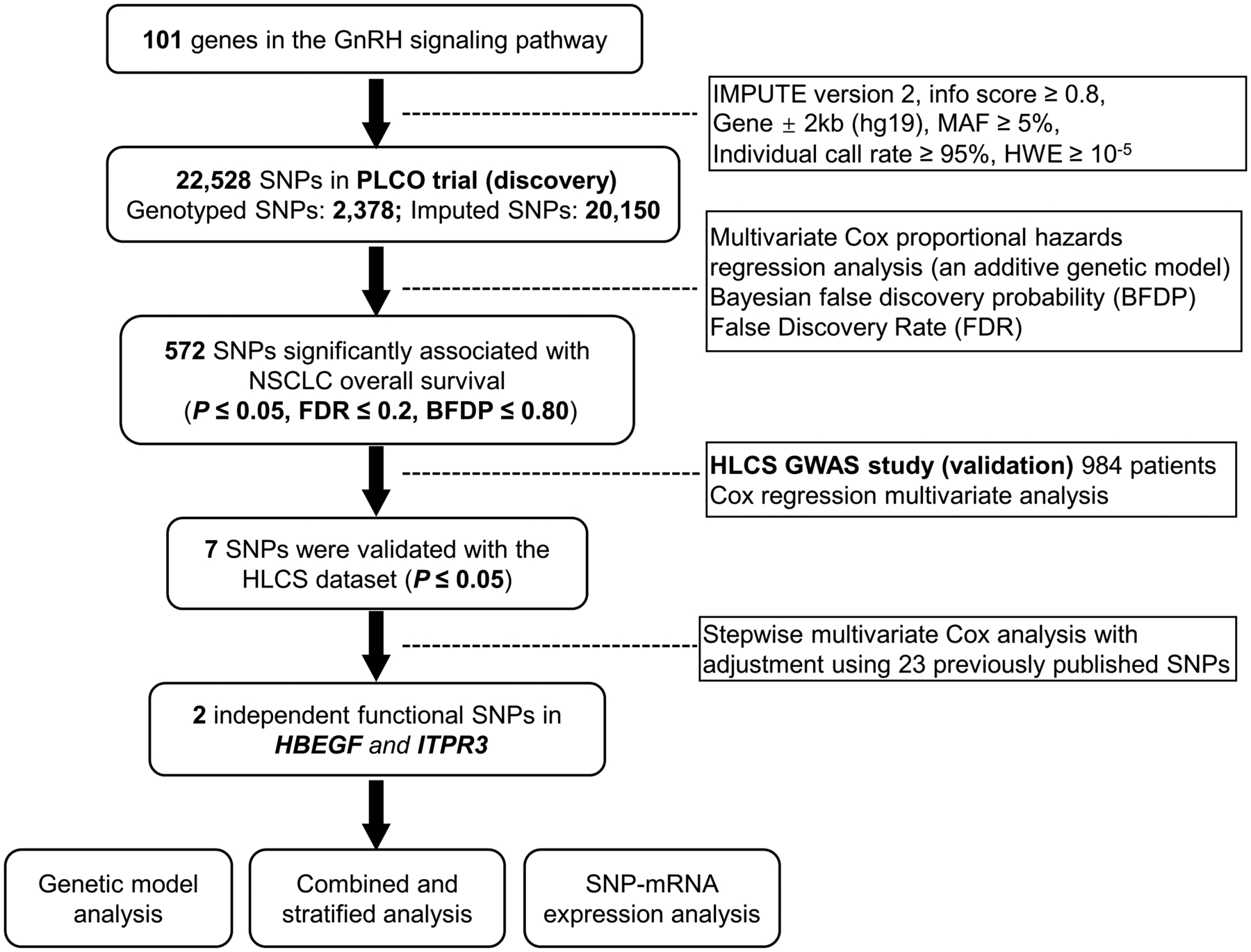
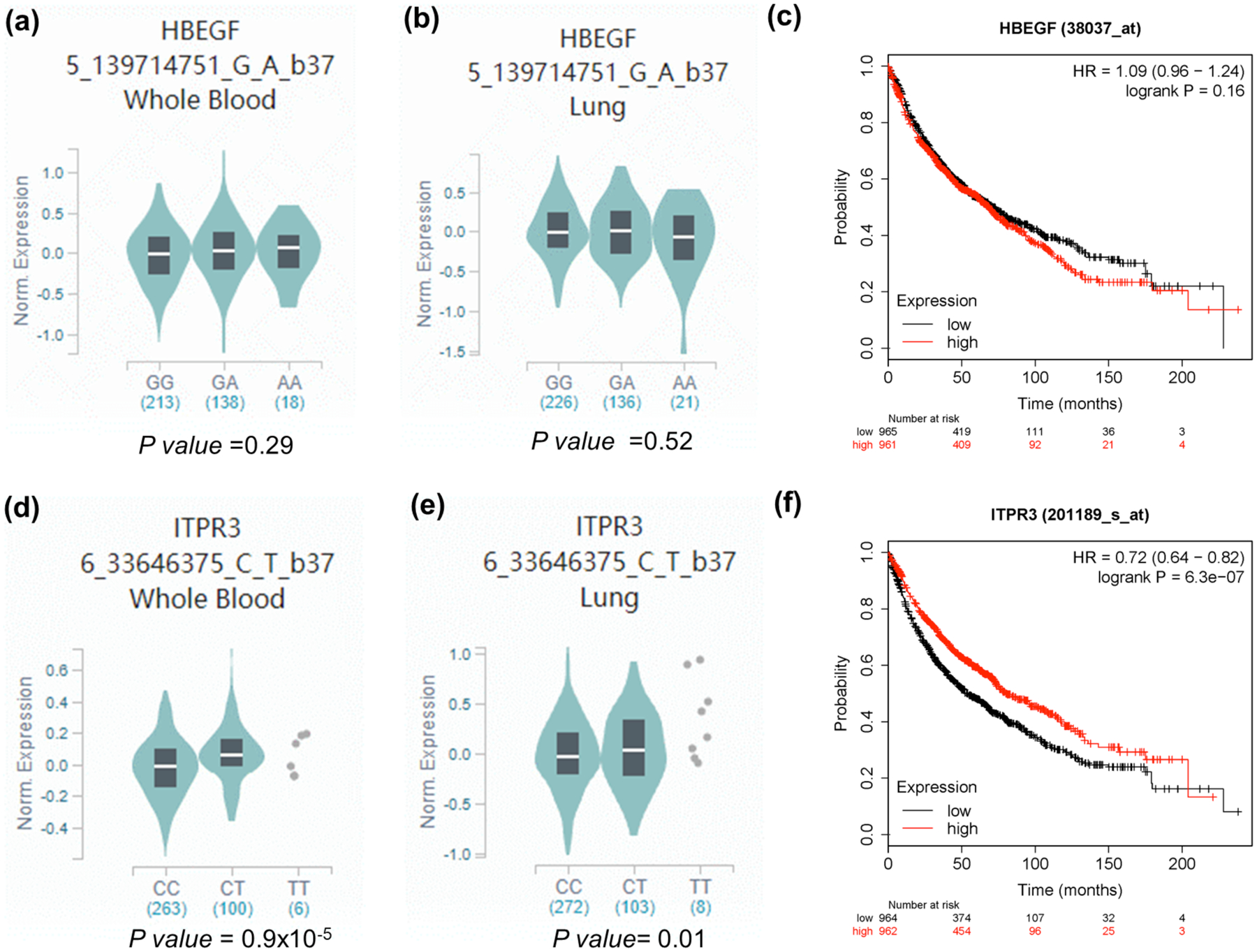
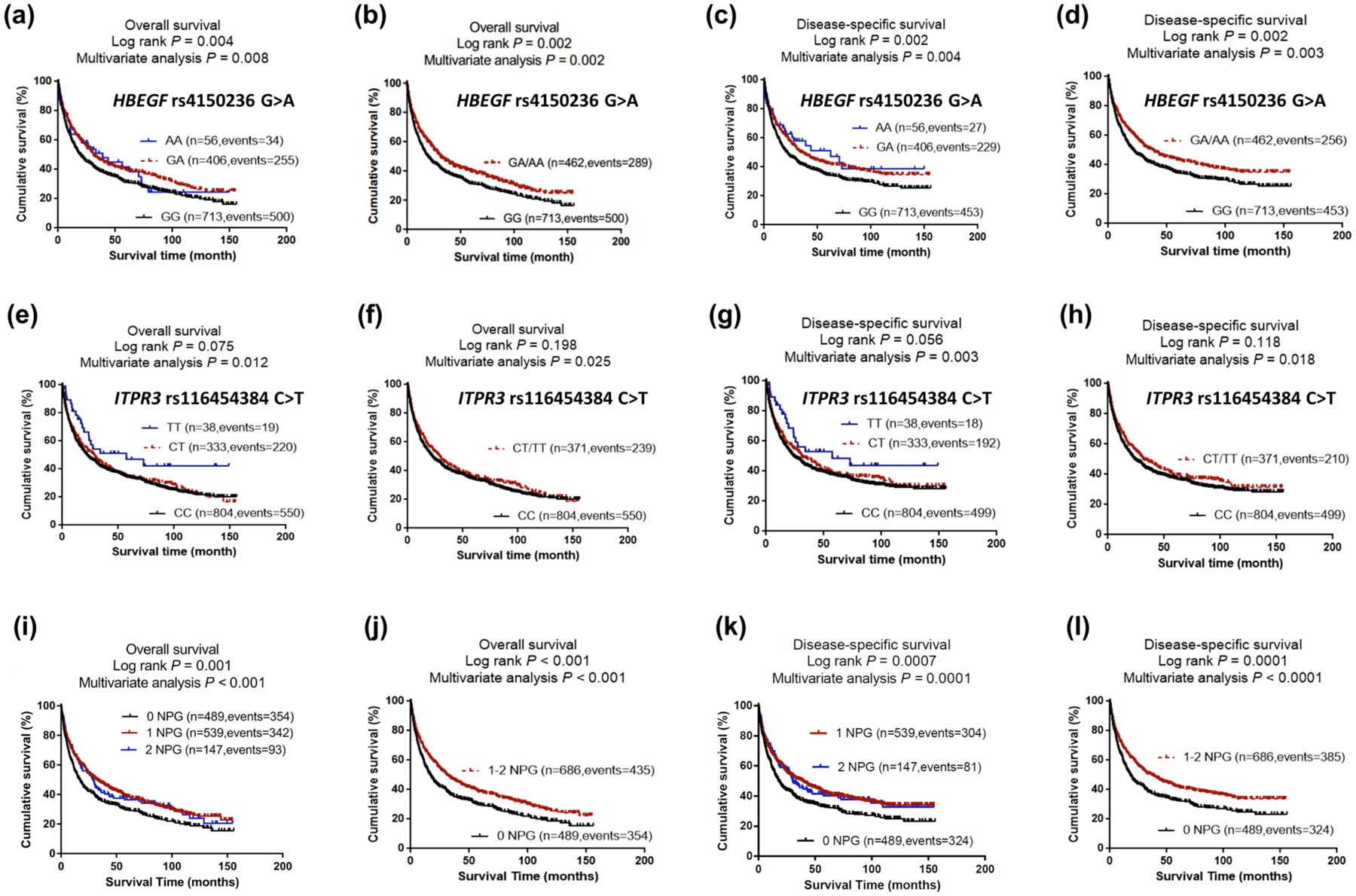
The gonadotropin-releasing hormone (GnRH) signaling pathway controls reproductive functions and cancer growth and progression. However, few studies investigated roles of genetic variants of GnRH pathway genes in survival of patients with non-small cell lung cancer (NSCLC). Therefore, we first evaluated associations between 22,528 single-nucleotide polymorphisms (SNPs) in 101 GnRH pathway genes and survival of 1185 NSCLC patients using a dataset from Prostate, Lung, Colorectal and Ovarian Cancer Screening Trial. We found 572 SNPs to be significantly associated with overall survival (OS) of NSCLC (P ≤ 0.05, Bayesian false discovery probability ≤0.80). We then validated these SNPs in another dataset with 984 NSCLC patients from the Harvard Lung Cancer Susceptibility Study. Finally, two independent SNPs (HBEGF rs4150236G>A and ITPR3 rs116454384C>T) remained significantly associated with NSCLC OS in the combined analysis with hazards ratios of 0.84 (95% confidence interval = 0.76-0.92, P = 0.0003) and 0.85 (0.78-0.94, 0.0012), respectively; their genetic score (the number of protective genotypes) was associated with a better OS and disease-specific survival (P = 0.0002 and 0.0001, respectively). Further expression quantitative trail loci analysis showed a significant correlation between ITPR3 rs116454384 T allele and an increased mRNA expression level in both whole blood and normal lung tissue, and high ITPR3 mRNA expression levels in tumors were associated with a better survival of NSCLC patients. Because ITPR3 mutations were rare in tumors, ITPR3 rs116454384C>T likely had an effect on cancer progression by regulating the gene expression. Therefore, genetic variants of HBEGF rs4150236G>A and ITPR3 rs116454384C>T may be predictors for NSCLC survival, but HBEGF rs4150236G>A functional relevance remains to be determined.
促性腺激素释放激素(GnRH)信号通路控制生殖功能和癌症的生长和进展。然而,很少有研究调查 GnRH 通路基因的遗传变异在非小细胞肺癌(NSCLC)患者生存中的作用。因此,我们首先使用来自前列腺癌、肺癌、结直肠癌和卵巢癌筛查试验的数据集,评估了 101 个 GnRH 通路基因中的 22528 个单核苷酸多态性(SNP)与 1185 例 NSCLC 患者生存之间的关系。我们发现 572 个 SNP 与 NSCLC 的总生存(OS)显著相关(P≤0.05,贝叶斯错误发现概率≤0.80)。然后,我们在哈佛肺癌易感性研究中的另一个包含 984 例 NSCLC 患者的数据集上验证了这些 SNP。最后,两个独立的 SNP(HBEGF rs4150236G>A 和 ITPR3 rs116454384C>T)在合并分析中与 NSCLC OS 显著相关,风险比分别为 0.84(95%置信区间为 0.76-0.92,P=0.0003)和 0.85(0.78-0.94,0.0012);它们的遗传评分(保护性基因型的数量)与更好的 OS 和疾病特异性生存相关(P=0.0002 和 0.0001)。进一步的表达数量性状基因座分析显示,ITPR3 rs116454384T 等位基因与全血和正常肺组织中 ITPR3 mRNA 表达水平的显著相关性,以及肿瘤中 ITPR3 mRNA 表达水平的升高与 NSCLC 患者的更好生存相关。由于肿瘤中 ITPR3 突变很少,因此 ITPR3 rs116454384C>T 可能通过调节基因表达对癌症进展产生影响。因此,HBEGF rs4150236G>A 和 ITPR3 rs116454384C>T 的遗传变异可能是 NSCLC 生存的预测因子,但 HBEGF rs4150236G>A 的功能相关性仍有待确定。