College of Nursing and Health Sciences, Optometry and Vision Science, Sturt North, Flinders University, Sturt Rd, Bedford Park, SA 5042, Australia; Caring Futures Institute, Flinders University, Sturt Rd, Bedford Park, SA 5042, Australia.
Contact Lens and Visual Optics Laboratory, School of Optometry and Vision Science, Queensland University of Technology, Victoria Park Road, Kelvin Grove 4059, Brisbane, QLD, Australia.
J Optom. 2022 Apr-Jun;15(2):112-121. doi: 10.1016/j.optom.2020.12.001. Epub 2021 Jan 2.
The intrinsically photosensitive retinal ganglion cells (ipRGCs) signal environmental light, with axons projected to the midbrain that control pupil size and circadian rhythms. Post-illumination pupil response (PIPR), a sustained pupil constriction after short-wavelength light stimulation, is an indirect measure of ipRGC activity. Here, we measured the PIPR in young adults with various refractive errors using a custom-made optical system.
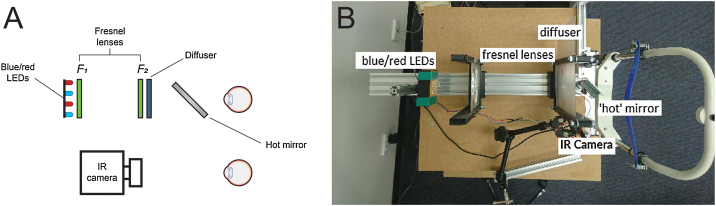
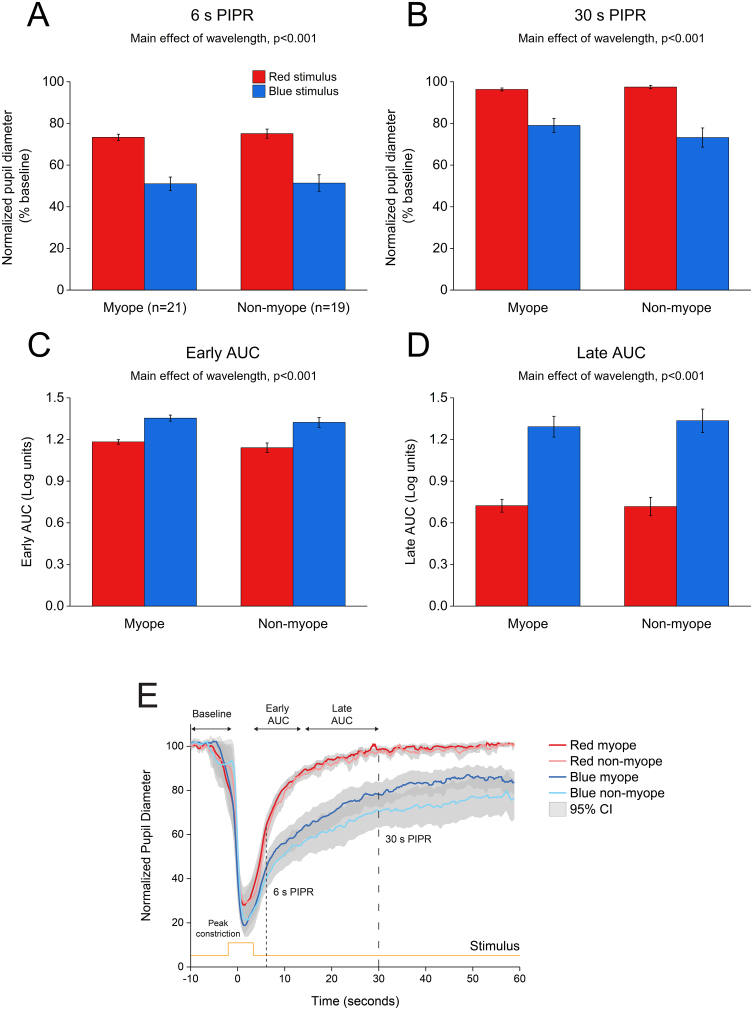
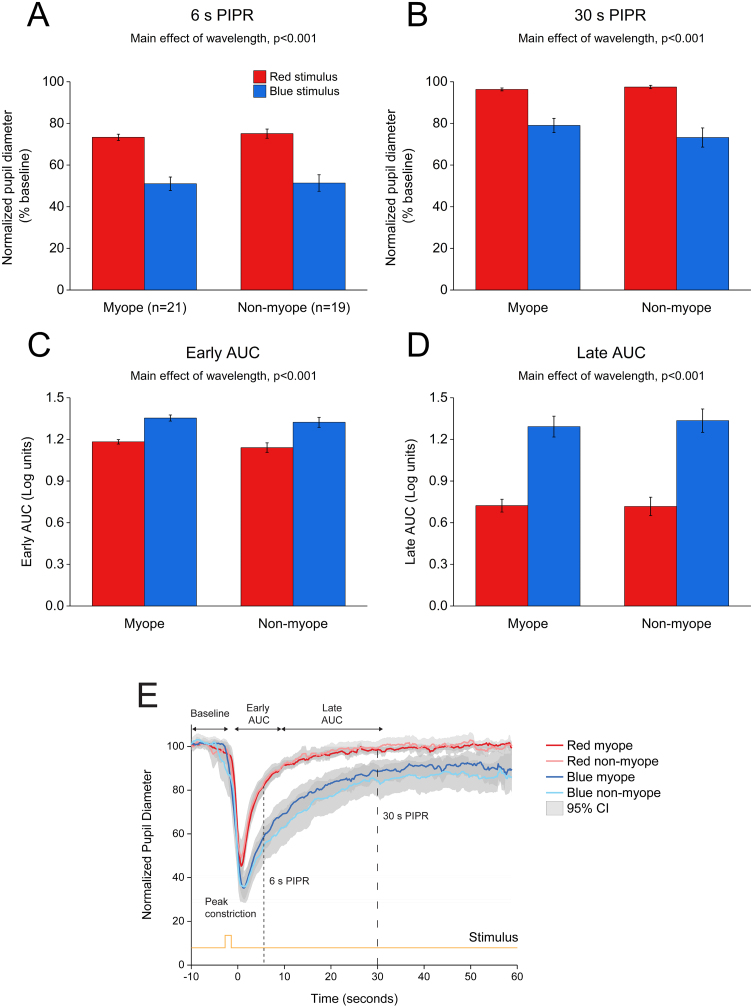
PIPR was measured on myopic (-3.50 ± 1.82 D, n = 20) and non-myopic (+0.28 ± 0.23 D, n = 19) participants (mean age, 23.36 ± 3.06 years). The right eye was dilated and presented with long-wavelength (red, 625 nm, 3.68 × 10 photons/cm/s) and short-wavelength (blue, 470 nm, 3.24 × 10 photons/cm/s) 1 s and 5 s pulses of light, and the consensual response was measured in the left eye for 60 s following light offset. The 6 s and 30 s PIPR and early and late area under the curve (AUC) for 1 and 5 s stimuli were calculated.
For most subjects, the 6 s and 30 s PIPR were significantly lower (p < 0.001), and the early and late AUC were significantly larger for 1 s blue light compared to red light (p < 0.001), suggesting a strong ipRGC response. The 5 s blue stimulation induced a slightly stronger melanopsin response, compared to 1 s stimulation with the same wavelength. However, none of the PIPR metrics were different between myopes and non-myopes for either stimulus duration (p > 0.05).
We confirm previous research that there is no effect of refractive error on the PIPR.
光感受器神经节细胞(ipRGC)对环境光敏感,其轴突投射到中脑,控制瞳孔大小和昼夜节律。光刺激后瞳孔反应(PIPR)是一种短波长光刺激后持续的瞳孔收缩,是 ipRGC 活性的间接测量。本研究使用定制的光学系统测量了不同屈光不正的年轻人的 PIPR。
对近视(-3.50±1.82 D,n=20)和非近视(+0.28±0.23 D,n=19)受试者进行 PIPR 测量(平均年龄 23.36±3.06 岁)。右眼散瞳,呈现长波长(红色,625nm,3.68×10 光子/cm/s)和短波长(蓝色,470nm,3.24×10 光子/cm/s)1s 和 5s 脉冲光,用光关闭后 60s 测量左眼的共响应。计算 6s 和 30s 的 PIPR 以及 1s 和 5s 刺激的早期和晚期 AUC。
对于大多数受试者,6s 和 30s 的 PIPR 明显较低(p<0.001),1s 蓝光的早期和晚期 AUC 明显大于红光(p<0.001),提示 ipRGC 反应强烈。与 1s 刺激相比,5s 蓝光刺激引起的黑视素反应略强。然而,对于两种刺激持续时间,近视和非近视受试者的 PIPR 指标均无差异(p>0.05)。
本研究证实了先前的研究结果,即屈光不正对 PIPR 没有影响。