Department of Biochemistry and Molecular Biology, The University of Chicago, Chicago, IL, 60637, USA.
Tsinghua-Peking Center for Life Sciences, Department of Chemistry, Tsinghua University, 100084, Beijing, China.
Nat Commun. 2021 Jan 5;12(1):121. doi: 10.1038/s41467-020-20359-x.
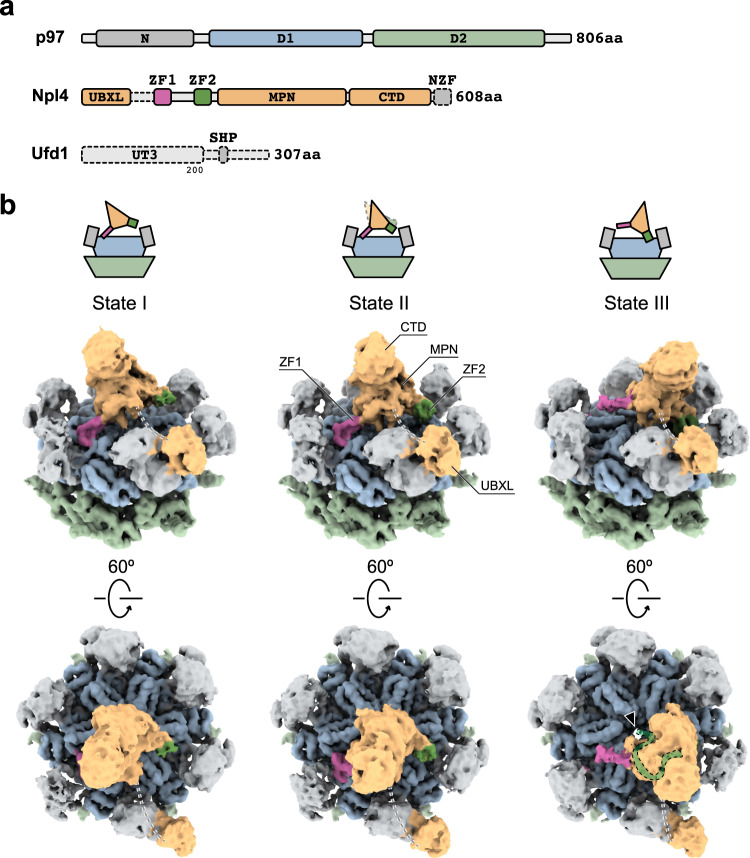
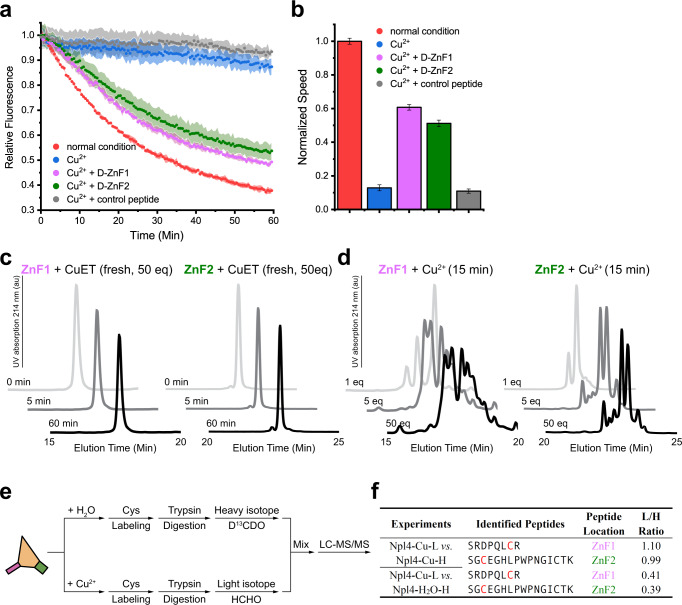
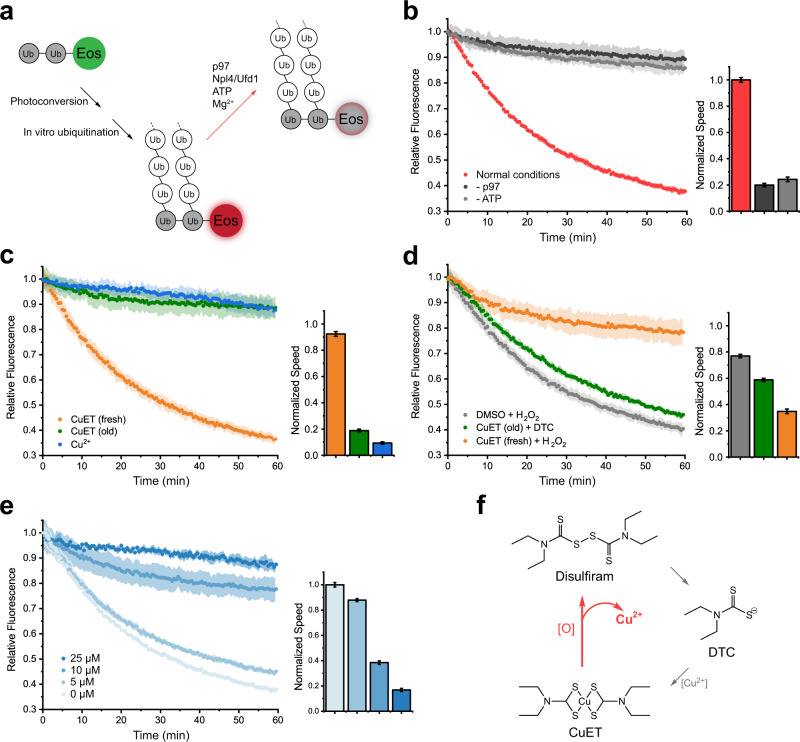
p97, also known as valosin-containing protein (VCP) or Cdc48, plays a central role in cellular protein homeostasis. Human p97 mutations are associated with several neurodegenerative diseases. Targeting p97 and its cofactors is a strategy for cancer drug development. Despite significant structural insights into the fungal homolog Cdc48, little is known about how human p97 interacts with its cofactors. Recently, the anti-alcohol abuse drug disulfiram was found to target cancer through Npl4, a cofactor of p97, but the molecular mechanism remains elusive. Here, using single-particle cryo-electron microscopy (cryo-EM), we uncovered three Npl4 conformational states in complex with human p97 before ATP hydrolysis. The motion of Npl4 results from its zinc finger motifs interacting with the N domain of p97, which is essential for the unfolding activity of p97. In vitro and cell-based assays showed that the disulfiram derivative bis-(diethyldithiocarbamate)-copper (CuET) can bypass the copper transporter system and inhibit the function of p97 in the cytoplasm by releasing cupric ions under oxidative conditions, which disrupt the zinc finger motifs of Npl4, locking the essential conformational switch of the complex.
p97,也被称为泛素结合酶 E1(ubiquitin-conjugating enzyme E1)或 CDC48,在细胞蛋白稳态中发挥核心作用。人类 p97 突变与几种神经退行性疾病有关。靶向 p97 及其辅助因子是癌症药物开发的一种策略。尽管对真菌同源物 CDC48 有了显著的结构见解,但对于人类 p97 如何与其辅助因子相互作用知之甚少。最近,抗酒精滥用药物双硫仑被发现通过 p97 的辅助因子 Npl4 靶向癌症,但分子机制仍不清楚。在这里,我们使用单颗粒冷冻电镜(cryo-EM)技术,在 ATP 水解之前,揭示了三种与人类 p97 结合的 Npl4 构象状态。Npl4 的运动是由于其锌指结构域与 p97 的 N 结构域相互作用所致,这对于 p97 的展开活性至关重要。体外和基于细胞的测定表明,双硫仑衍生物双(二乙基二硫代氨基甲酸盐)-铜(CuET)可以绕过铜转运体系统,并在氧化条件下释放铜离子来抑制细胞质中 p97 的功能,这破坏了 Npl4 的锌指结构域,锁定了复合物的基本构象开关。