Clinical Research Center, University Medical Center Ljubljana, Vrazov trg 1, Ljubljana, Slovenia.
Stem Cell Rev Rep. 2021 Feb;17(1):278-284. doi: 10.1007/s12015-020-10101-x. Epub 2021 Jan 5.
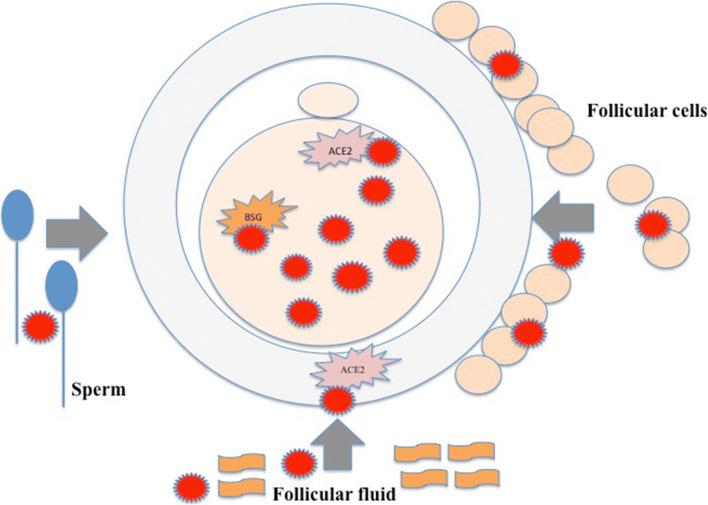
In addition to a number of scientific and medical questions about SARS-CoV-2 infection that still need to be answered, there is also the question of how this highly virulent virus and COVID-19 disease affect gametogenesis in humans. Even more important is the question of whether the virus can also enter and infect oocytes and possibly alter them in an unknown way, which could also affect the development and status of the human embryo. The answers to these questions are still poorly known, so we reviewed the human oocyte transcriptome and proteome obtained in our previous studies and found that human oocytes from the in vitro fertilization program expressed both the ACE2 and BSG genes and the corresponding ACE2 and BSG proteins. This means that human oocytes possess the molecular 'machinery' to facilitate SARS-CoV-2 entrance and infection. According to various studies, especially in animal models, different viruses can infect oocytes, so infection of the oocyte with SARS-Cov-2 cannot be completely ruled out. A hypothetical model of human oocyte infection with this virus has been proposed.
除了许多关于 SARS-CoV-2 感染的科学和医学问题仍需要回答外,还有一个问题是这种高毒性病毒和 COVID-19 疾病如何影响人类的配子发生。更重要的是,病毒是否也可以进入并感染卵母细胞,并以未知的方式对其进行改变,这也可能影响人类胚胎的发育和状态。这些问题的答案还知之甚少,因此我们回顾了之前研究中获得的人类卵母细胞转录组和蛋白质组,发现体外受精计划中的人类卵母细胞既表达 ACE2 和 BSG 基因,也表达相应的 ACE2 和 BSG 蛋白。这意味着人类卵母细胞拥有促进 SARS-CoV-2 进入和感染的分子“机制”。根据各种研究,特别是动物模型的研究,不同的病毒可以感染卵母细胞,因此不能完全排除 SARS-Cov-2 感染卵母细胞的可能性。已经提出了一种关于这种病毒感染人类卵母细胞的假设模型。