Cheng Wei, Lindholm Jerry, Holmboe Michael, Luong N Tan, Shchukarev Andrey, Ilton Eugene S, Hanna Khalil, Boily Jean-François
University Rennes, École Nationale Supérieure de Chimie de Rennes, CNRS, UMR 6226, 11 Allée de Beaulieu, 35708 Rennes, France.
Department of Chemistry, Umeå University, SE-901 87 Umeå, Sweden.
Langmuir. 2021 Jan 19;37(2):666-674. doi: 10.1021/acs.langmuir.0c02592. Epub 2021 Jan 6.
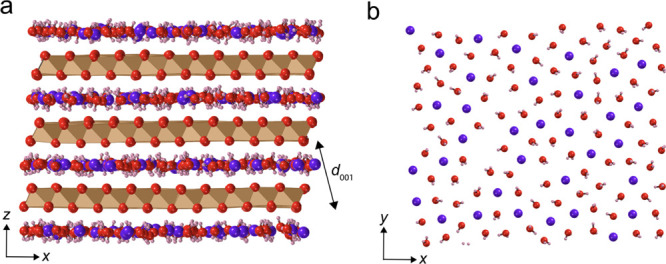
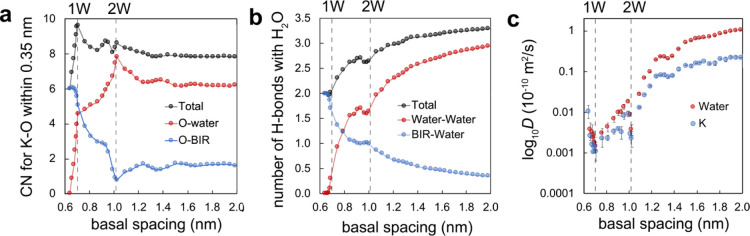
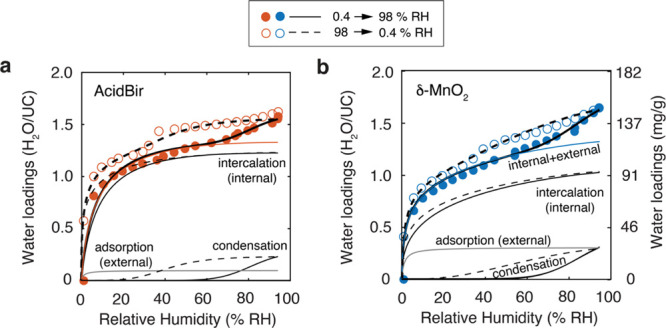
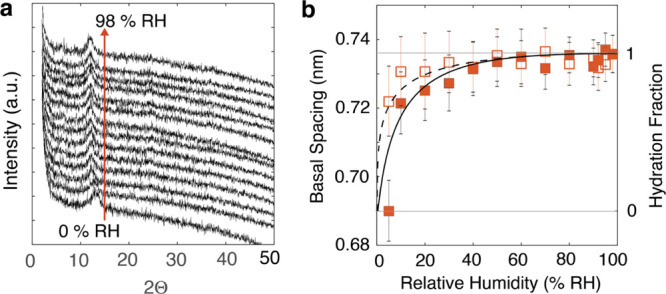
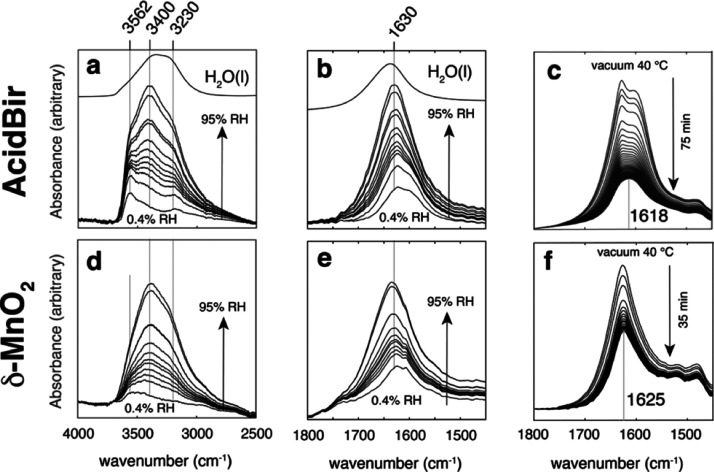
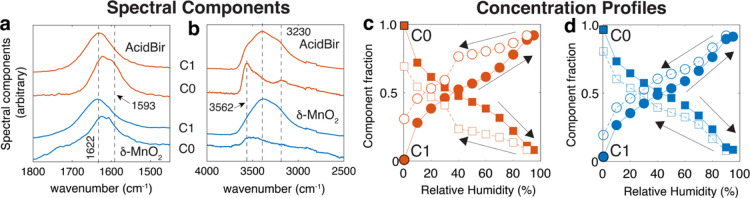
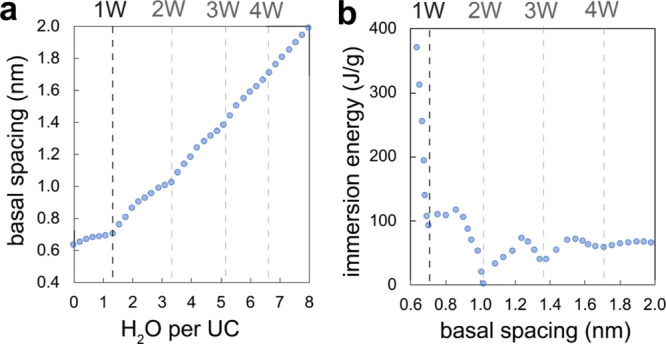
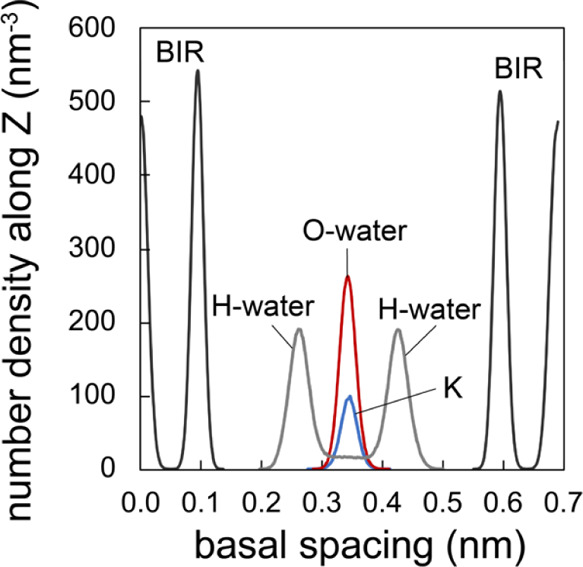
Birnessite is a layered MnO mineral capable of intercalating nanometric water films in its bulk. With its variable distributions of Mn oxidation states (Mn, Mn, and Mn), cationic vacancies, and interlayer cationic populations, birnessite plays key roles in catalysis, energy storage solutions, and environmental (geo)chemistry. We here report the molecular controls driving the nanoscale intercalation of water in potassium-exchanged birnessite nanoparticles. From microgravimetry, vibrational spectroscopy, and X-ray diffraction, we find that birnessite intercalates no more than one monolayer of water per interlayer when exposed to water vapor at 25 °C, even near the dew point. Molecular dynamics showed that a single monolayer is an energetically favorable hydration state that consists of 1.33 water molecules per unit cell. This monolayer is stabilized by concerted potassium-water and direct water-birnessite interactions, and involves negligible water-water interactions. Using our composite model, we predicted humidity-dependent water loadings in terms of water in the internal and at external basal faces, the proportions of which vary with particle size. The model also accounts for additional populations on and between particles. By describing the nanoscale hydration of birnessite, our work secures a path for understanding the water-driven catalytic chemistry that this important layered manganese oxide mineral can host in natural and technological settings.
水钠锰矿是一种层状MnO矿物,能够在其主体中嵌入纳米级水膜。由于其锰氧化态(Mn²⁺、Mn³⁺和Mn⁴⁺)、阳离子空位和层间阳离子数量的可变分布,水钠锰矿在催化、储能解决方案和环境(地球)化学中发挥着关键作用。我们在此报告了驱动钾交换水钠锰矿纳米颗粒中纳米级水嵌入的分子控制因素。通过微量重力测量、振动光谱和X射线衍射,我们发现,在25°C下暴露于水蒸气时,即使接近露点,水钠锰矿每层间嵌入的水不超过一个单层。分子动力学表明,单个单层是一种能量有利的水合状态,每个晶胞由1.33个水分子组成。这个单层通过钾-水和直接的水-水钠锰矿相互作用协同稳定,并且涉及可忽略不计的水-水相互作用。使用我们的复合模型,我们根据内部和外部基面中的水预测了湿度依赖性水负载,其比例随颗粒大小而变化。该模型还考虑了颗粒上和颗粒之间的额外数量。通过描述水钠锰矿的纳米级水合作用,我们的工作为理解这种重要的层状锰氧化物矿物在自然和技术环境中可能承载的水驱动催化化学开辟了一条道路。