Department of Sociology, Wayne State University, Detroit, MI, United States of America.
Department of Sociology, University of California Los Angeles, Los Angeles, CA, United States of America.
PLoS One. 2021 Jan 6;16(1):e0244747. doi: 10.1371/journal.pone.0244747. eCollection 2021.
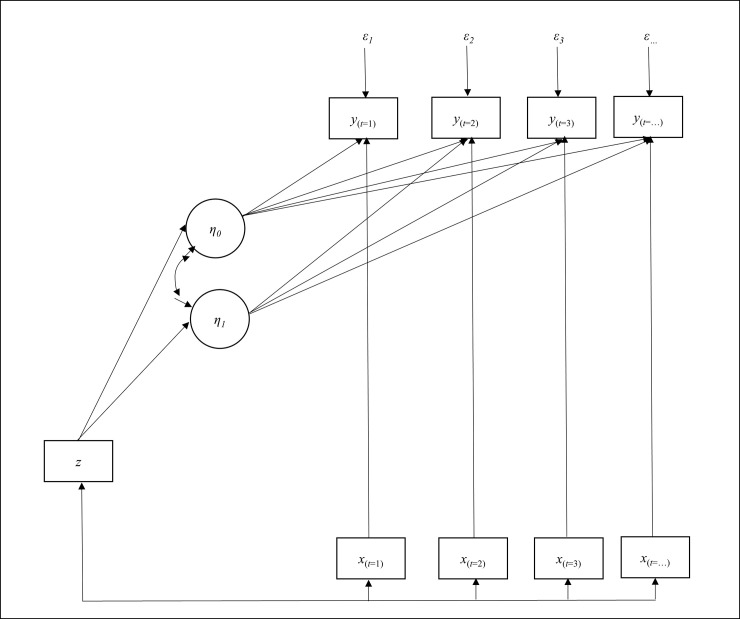
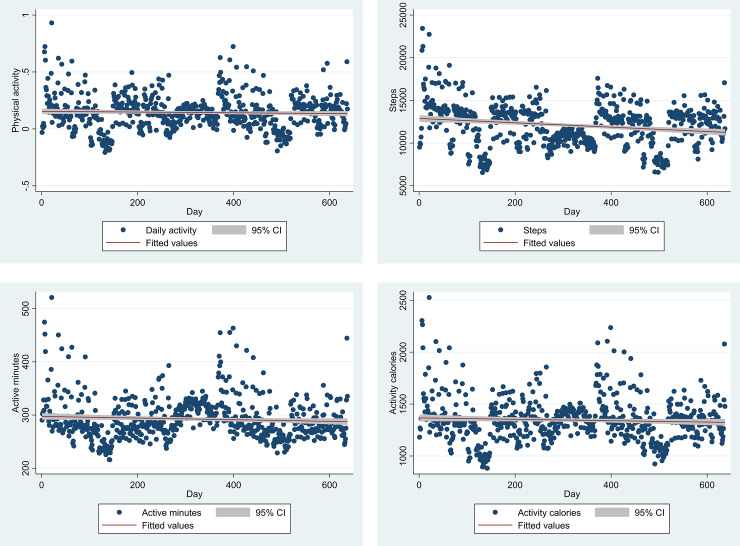
To date, the effect of both fixed and time-varying individual, social, psychological, environmental, and behavioral characteristics on temporal growth trends in physical activity (PA) among younger individuals remains an under-studied topic. In this paper, we address this gap in previous work by examining how temporal growth trends in PA respond to changing social, environmental, and behavioral characteristics using a large sample of college students (N = 692) who participated in the NetHealth project at the University of Notre Dame and from which fine-grained longitudinal data on physical activity and social interaction were collected unobtrusively via the use of wearables for 637 days (August 16, 2015 to May 13, 2017). These data are augmented by periodic survey data on fixed sociodemographic and psychological variables. We estimate latent growth-curve models for daily activity status, steps, active minutes, and activity calories. We find evidence of both a generalized friendship paradox and a peer effect for PA, with the average PA level of study participants' contacts being on average larger than their own, and with this average level exerting a statistically significant effect on individual PA levels. Notably, there was limited evidence of temporal growth in PA across the 637 days of observation with null temporal effects for three out of the four PA indicators, except for daily steps taken. Finally, we find that social, psychological, and behavioral factors (e.g., large network size, high extroversion levels, and more courses taken) are systematically associated with higher PA levels in this sample. Overall, our findings highlight the importance of social, environmental, and behavioral factors (such as peer networks and daily sociability) in modulating the dynamics of PA levels among college students.
迄今为止,个体、社会、心理、环境和行为特征的固定和时变效应对年轻人身体活动(PA)的时间增长趋势的影响仍然是一个研究不足的课题。在本文中,我们通过检查 PA 的时间增长趋势如何响应不断变化的社会、环境和行为特征,利用参加圣母大学 NetHealth 项目的大量大学生(N=692)的样本,解决了之前工作中的这一差距,其中通过使用可穿戴设备收集了 637 天(2015 年 8 月 16 日至 2017 年 5 月 13 日)的关于身体活动和社交互动的细粒度纵向数据,对身体活动和社交互动进行了非侵入式收集。这些数据通过定期调查数据补充了固定的社会人口学和心理变量。我们对日常活动状态、步数、活跃分钟数和活动卡路里进行潜在增长曲线模型估计。我们发现 PA 存在普遍的友谊悖论和同伴效应的证据,研究参与者的联系人的平均 PA 水平平均高于他们自己的水平,并且这个平均水平对个体 PA 水平产生了统计上显著的影响。值得注意的是,在 637 天的观察中,PA 几乎没有证据表明存在时间增长,除了每天走的步数之外,四个 PA 指标中有三个的时间效应为零。最后,我们发现,社会、心理和行为因素(例如,大的网络规模、高外向水平和更多的课程)与该样本中的更高的 PA 水平系统相关。总体而言,我们的研究结果强调了社会、环境和行为因素(例如同伴网络和日常社交能力)在调节大学生 PA 水平动态方面的重要性。