Saw Swee Hock School of Public Health, National University of Singapore, National University Health System, Singapore, Singapore.
Yong Loo Lin School of Medicine, National University of Singapore, National University Health System, Singapore, Singapore.
JMIR Mhealth Uhealth. 2020 Feb 4;8(2):e12665. doi: 10.2196/12665.
Mobile health (mHealth) approaches are growing in popularity as a means of addressing low levels of physical activity (PA).
This study aimed to determine the validity of wearables in measuring step count and floor count per day and assess the feasibility and effects of a 6-week team challenge intervention delivered through smartphone apps.
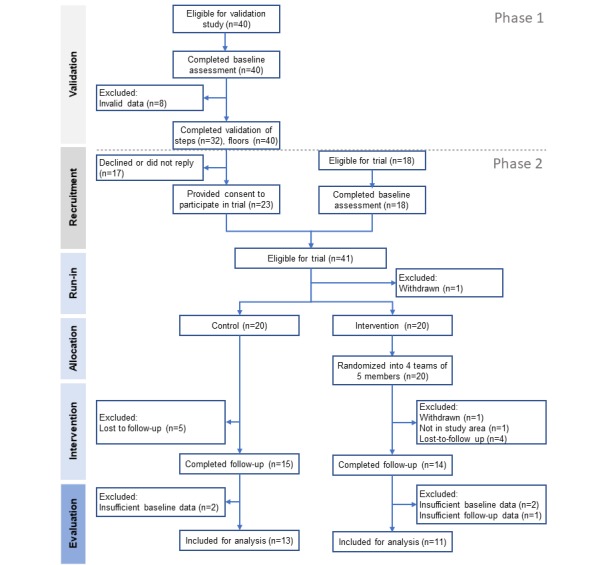
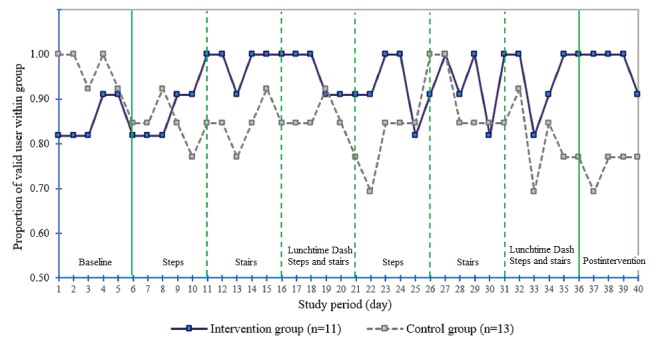
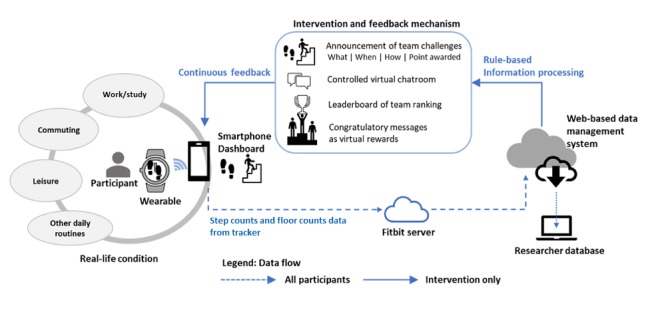
Staff and students from a public university were recruited between 2015 and 2016. In phase 1, everyone wore a Fitbit tracker (Charge or Charge HR) and an ActiGraph for 7 days to compare daily step count estimated by the two devices under free-living conditions. They were also asked to climb 4 bouts of floors in an indoor stairwell to measure floor count which was compared against direct observation. In phase 2, participants were allocated to either a control or intervention group and received a Fitbit tracker synced to the Fitbit app. Furthermore, the intervention group participants were randomized to 4 teams and competed in 6 weekly (Monday to Friday) real-time challenges. A valid day was defined as having 1500 steps or more per day. The outcomes were as follows: (1) adherence to wearing the Fitbit (ie, number of days in which all participants in each group were classified as valid users aggregated across the entire study period), (2) mean proportion of valid participants over the study period, and (3) the effects of the intervention on step count and floor count determined using multiple linear regression models and generalized estimating equations (GEEs) for longitudinal data analysis.
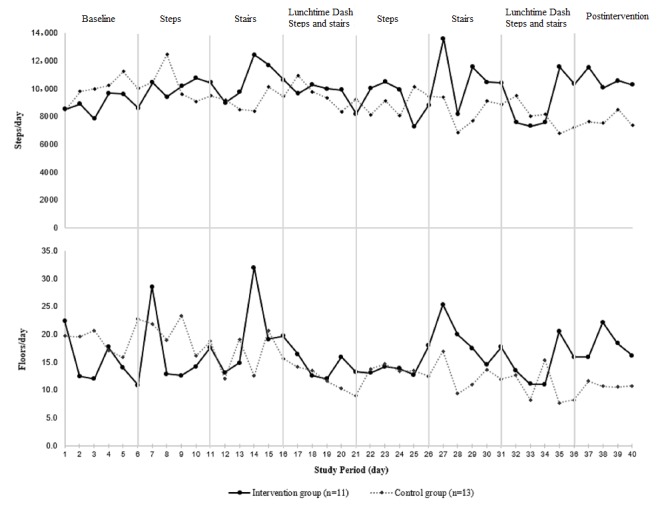
In phase 1, 32 of 40 eligible participants provided valid step count data, whereas all 40 participants provided valid floor count data. The Fitbit trackers demonstrated high correlations (step count: Spearman ρ=0.89; P<.001; floor count: Spearman ρ=0.98; P<.001). The trackers overestimated step count (median absolute error: 17%) but accurately estimated floor count. In phase 2, 20 participants each were allocated to an intervention or control group. Overall, 24 participants provided complete covariates and valid PA data for analyses. Multiple linear regressions revealed that the average daily steps was 15.9% higher for the intervention group (95% CI -8.9 to 47.6; P=.21) during the final two intervention weeks; the average daily floors climbed was 39.4% higher (95% CI 2.4 to 89.7; P=.04). GEE results indicated no significant interaction effects between groups and the intervention week for weekly step count, whereas a significant effect (P<.001) was observed for weekly floor count.
The consumer wearables used in this study provided acceptable validity in estimating stepping and stair climbing activities, and the mHealth-based team challenge interventions were feasible. Compared with the control group, the participants in the intervention group climbed more stairs, so this can be introduced as an additional PA promotion target in the context of mHealth strategies. Methodologically rigorous studies are warranted to further strengthen this study's findings.
移动健康(mHealth)方法作为提高身体活动(PA)水平的一种手段越来越受欢迎。
本研究旨在确定可穿戴设备在测量每日步数和楼层数方面的有效性,并评估通过智能手机应用程序进行的为期 6 周团队挑战干预的可行性和效果。
2015 年至 2016 年期间,从一所公立大学招募了员工和学生。在第 1 阶段,所有人都佩戴 Fitbit 追踪器(Charge 或 Charge HR)和 ActiGraph 7 天,以在自由生活条件下比较两种设备估计的每日步数。他们还被要求在室内楼梯间爬 4 次楼层,以测量楼层数,并与直接观察进行比较。在第 2 阶段,参与者被分配到对照组或干预组,并收到同步到 Fitbit 应用程序的 Fitbit 追踪器。此外,干预组参与者被随机分为 4 个团队,并参加 6 个每周(周一至周五)实时挑战。有效的一天被定义为每天有 1500 步或更多。结果如下:(1)佩戴 Fitbit 的依从性(即,每个组中所有参与者在整个研究期间被归类为有效用户的天数总和),(2)研究期间有效参与者的平均比例,以及(3)使用多线性回归模型和广义估计方程(GEE)对步长和楼层数进行的干预效果分析。
在第 1 阶段,40 名符合条件的参与者中有 32 名提供了有效的步长数据,而所有 40 名参与者均提供了有效的楼层数数据。追踪器显示出高度的相关性(步长:Spearman ρ=0.89;P<.001;楼层数:Spearman ρ=0.98;P<.001)。追踪器高估了步长(中位数绝对误差:17%),但准确估计了楼层数。在第 2 阶段,每组各有 20 名参与者被分配到干预组或对照组。总体而言,有 24 名参与者提供了完整的协变量和有效的 PA 数据进行分析。多元线性回归显示,干预组在最后两周的平均每日步数增加了 15.9%(95%CI -8.9 至 47.6;P=.21);平均每日爬楼数增加了 39.4%(95%CI 2.4 至 89.7;P=.04)。GEE 结果表明,组间和干预周之间每周步长没有显著的交互效应,而每周楼层数则存在显著效应(P<.001)。
本研究中使用的消费者可穿戴设备在估计踏步和爬楼梯活动方面具有可接受的有效性,基于 mHealth 的团队挑战干预措施是可行的。与对照组相比,干预组的参与者爬楼梯更多,因此可以将其作为 mHealth 策略背景下额外的 PA 促进目标引入。需要进行方法严谨的研究来进一步加强本研究的发现。