Institute of Electronic and Sensor Materials, Faculty of Materials Science and Materials Technology, TU Bergakademie Freiberg, 09599 Freiberg, Germany.
UFZ-Helmholtz Centre for Environmental Research, Department Monitoring and Exploration Technologies, 04318 Leipzig, Germany.
Sensors (Basel). 2021 Jan 4;21(1):296. doi: 10.3390/s21010296.
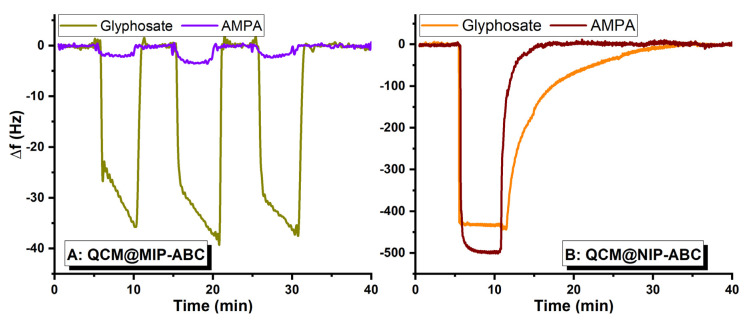
Molecularly imprinted polymers have emerged as cost-effective and rugged artificial selective sorbents for combination with different sensors. In this study, quaternary ammonium cations, as functional monomers, were systematically evaluated to design imprinted polymers for glyphosate as an important model compound for electrically charged and highly water-soluble chemical compounds. To this aim, a small pool of monomers were used including (3-acrylamidopropyl)trimethylammonium chloride, [2-(acryloyloxy)ethyl]trimethylammonium chloride, and diallyldimethylammonium chloride. The simultaneous interactions between three positively charged monomers and glyphosate were preliminary evaluated using statistical design of the experiment method. Afterwards, different polymers were synthesized at the gold surface of the quartz crystal microbalance sensor using optimized and not optimized glyphosate-monomers ratios. All synthesized polymers were characterized using atomic force microscopy, contact angle, Fourier-transform infrared, and X-ray photoelectron spectroscopy. Evaluated functional monomers showed promise as highly efficient functional monomers, when they are used together and at the optimized ratio, as predicted by the statistical method. Obtained results from the modified sensors were used to develop a simple model describing the binding characteristics at the surface of the different synthesized polymers. This model helps to develop new synthesis strategies for rational design of the highly selective imprinted polymers and to use as a sensing platform for water soluble and polar targets.
分子印迹聚合物作为一种具有成本效益和坚固耐用的人工选择性吸附剂,已与不同的传感器结合使用。在这项研究中,季铵阳离子作为功能单体被系统地评估,以设计用于草甘膦的印迹聚合物,草甘膦是一种重要的模型化合物,用于带电荷和高水溶性化合物。为此,使用了一小部分单体,包括(3-丙烯酰胺丙基)三甲基氯化铵、[2-(丙烯酰氧基)乙基]三甲基氯化铵和二烯丙基二甲基氯化铵。使用实验设计的统计方法初步评估了三种带正电荷单体与草甘膦之间的同时相互作用。之后,使用优化和未优化的草甘膦-单体比在石英晶体微天平传感器的金表面上合成不同的聚合物。使用原子力显微镜、接触角、傅里叶变换红外光谱和 X 射线光电子能谱对所有合成聚合物进行了表征。评估的功能单体表现出作为高效功能单体的潜力,当它们一起使用并按照统计方法预测的优化比例使用时。从修饰后的传感器获得的结果用于开发一个简单的模型,描述不同合成聚合物表面的结合特性。该模型有助于开发高度选择性印迹聚合物的合理设计的新合成策略,并用作水溶性和极性靶标的传感平台。