Abteilung Für Molekulare Genetik, Institut Für Mikrobiologie Und Genetik, Göttinger Zentrum Für Molekulare Biowissenschaften (GZMB), Georg-August Universität Göttingen, Göttingen, Germany.
RNA Biol. 2021 Oct;18(10):1390-1407. doi: 10.1080/15476286.2020.1851506. Epub 2021 Jan 7.
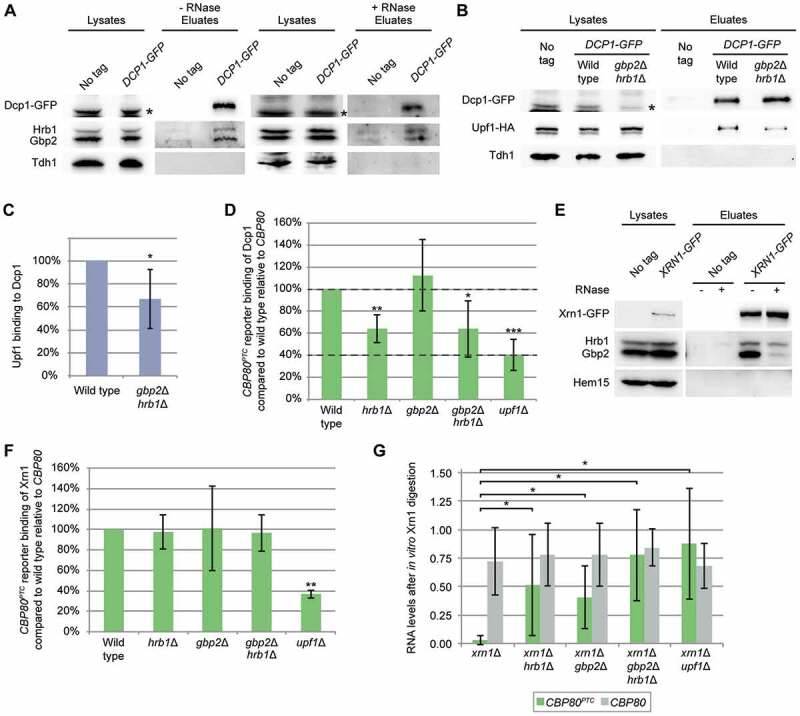
One important task of eukaryotic cells is to translate only mRNAs that were correctly processed to prevent the production of truncated proteins, found in neurodegenerative diseases and cancer. Nuclear quality control of splicing requires the SR-like proteins Gbp2 and Hrb1 in , where they promote the degradation of faulty pre-mRNAs. Here we show that Gbp2 and Hrb1 also function in nonsense mediated decay (NMD) of spliced premature termination codon (PTC)-containing mRNAs. Our data support a model in which they are in a complex with the Upf-proteins and help to transmit the Upf1-mediated PTC recognition to the transcripts ends. Most importantly they appear to promote translation repression of spliced transcripts that contain a PTC and to finally facilitate degradation of the RNA, presumably by supporting the recruitment of the degradation factors. Therefore, they seem to control mRNA quality beyond the nuclear border and may thus be global surveillance factors. Identification of SR-proteins as general cellular surveillance factors in yeast will help to understand the complex human system in which many diseases with defects in SR-proteins or NMD are known, but the proteins were not yet recognized as general RNA surveillance factors.
真核细胞的一个重要任务是只翻译那些经过正确加工的 mRNA,以防止产生截短的蛋白质,这些蛋白质存在于神经退行性疾病和癌症中。核剪接质量控制需要在 中具有 SR 样蛋白 Gbp2 和 Hrb1,它们在那里促进有缺陷的前体 mRNA 的降解。在这里,我们表明 Gbp2 和 Hrb1 也在剪接的终止密码子提前含有无意义介导的衰变 (NMD) 的 mRNA 中发挥作用。我们的数据支持这样一个模型,即它们与 Upf 蛋白形成复合物,并有助于将 Upf1 介导的 PTC 识别传递到转录本的末端。最重要的是,它们似乎促进了含有 PTC 的剪接转录本的翻译抑制,最终通过支持降解因子的募集来促进 RNA 的降解,推测它们支持降解因子的募集。因此,它们似乎控制了核边界以外的 mRNA 质量,并且可能是全球监测因子。在酵母中鉴定出 SR 蛋白作为一般细胞监测因子,将有助于理解具有 SR 蛋白或 NMD 缺陷的许多疾病的复杂人类系统,但这些蛋白质尚未被认为是一般的 RNA 监测因子。