The Nephrology Department of Xijing Hospital, The Fourth Military Medical University, No. 127 Changle West, Road, Xi'an, 710032, China.
State Key Laboratory of Kidney Disease, Department of Nephrology, Chinese People's Liberation Army General Hospital and Military Medical Postgraduate College, 28th Fuxing Road, Beijing, 100853, China.
BMC Cardiovasc Disord. 2021 Jan 6;21(1):16. doi: 10.1186/s12872-020-01830-5.
Hyperbilirubinemia after heart valve surgery (HVS) with cardiopulmonary bypass is frequently observed and associated with worse outcomes. We investigated the characteristics and prognosis of patients with severe hyperbilirubinemia after HVS for rheumatic heart disease (RHD) to identify the clinical outcomes and potential risk factors.
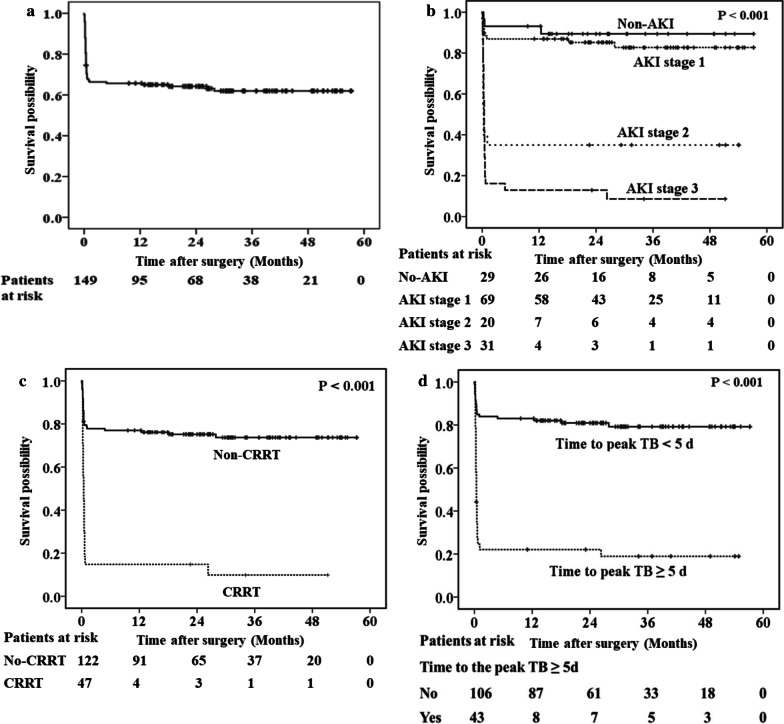
Between 2015 and 2018, patients who underwent HVS in the cardiac surgery intensive care unit of our hospital were retrospectively screened. Risk factors for acute kidney injury (AKI), the requirement for continuous renal replacement therapy (CRRT), and in-hospital and long-term mortality were identified by univariate and multivariate analyses. The patient survival proportion was graphically presented with the Kaplan-Meier method.
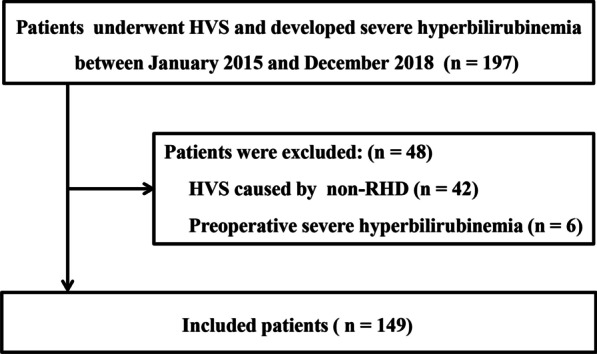
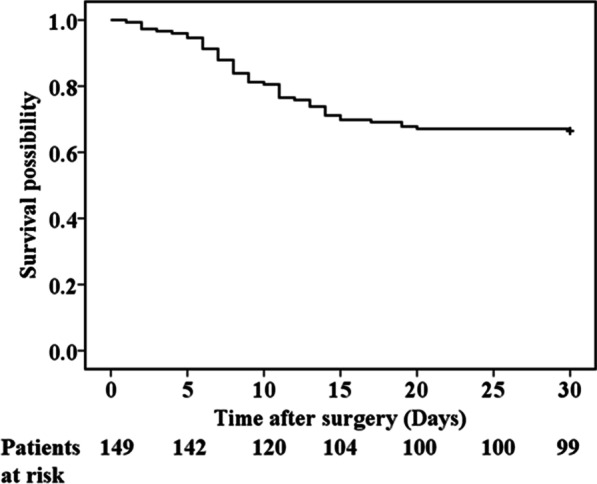
A total of 149 patients who underwent HVS for RHD and had severe postoperative hyperbilirubinemia were included. Of the included patients, 80.5% developed postoperative AKI, and 18.1% required CRRT. The in-hospital mortality was 30.2%. Backward logistic regression analysis showed that the time to peak TB concentration (odds ratio [OR] 1.557, 95% confidence interval [CI] 1.259-1.926; P < 0.001) and advanced AKI (stage 2 and 3 AKI) (OR 19.408, 95% CI 6.553-57.482; P < 0.001) were independent predictors for in-hospital mortality. The cutoff value of the time to peak TB levels for predicting in-hospital mortality was 5 postoperative days.
Severe postoperative hyperbilirubinemia is a life-threatening complication in patients who undergo HVS for RHD. Patients whose bilirubin levels continued to increase past the 5th postoperative day and who had advanced AKI (stages 2 and 3) were associated with a higher risk of mortality.
体外循环心脏瓣膜手术后(HVS)出现高胆红素血症较为常见,且与预后不良相关。我们研究了风湿性心脏病(RHD)患者 HVS 后严重高胆红素血症的特征和预后,以确定临床结局和潜在的危险因素。
回顾性筛选了 2015 年至 2018 年期间在我院心脏外科重症监护病房接受 HVS 的患者。通过单因素和多因素分析确定急性肾损伤(AKI)、持续肾脏替代治疗(CRRT)的需求以及院内和长期死亡率的危险因素。采用 Kaplan-Meier 方法绘制患者生存比例图。
共纳入 149 例因 RHD 接受 HVS 且术后严重高胆红素血症的患者。纳入患者中 80.5%发生术后 AKI,18.1%需要 CRRT。院内死亡率为 30.2%。向后逐步逻辑回归分析显示,TB 浓度峰值时间(比值比 [OR] 1.557,95%置信区间 [CI] 1.259-1.926;P<0.001)和晚期 AKI(AKI 2 期和 3 期)(OR 19.408,95%CI 6.553-57.482;P<0.001)是院内死亡的独立预测因素。预测院内死亡率的 TB 水平峰值时间的截断值为术后 5 天。
RHD 患者行 HVS 后出现严重的术后高胆红素血症是危及生命的并发症。胆红素水平持续升高至术后第 5 天且 AKI 进展(2 期和 3 期)的患者死亡风险更高。