Bullo Umar Farooq, Mehraj Jaishri, Raza Syed Musa, Rasool Shumaila, Ansari Noreen Naz, Shaikh Ahmed Ali, Phul Zamir Ali, Memon Sohail Ahmed, Baloch Rehan Iqbal, Baloch Zahoor Ahmed, Chandio Shoukat Ali
Emergency Operations Centre for Polio Eradication and Immunization, Government of Sindh, Karachi, Sindh, Pakistan.
Shaheed Zulfikar Ali Bhutto Institute of Science and Technology (SZABIST), Karachi, Sindh, Pakistan.
BMC Public Health. 2021 Jan 6;21(1):44. doi: 10.1186/s12889-020-10041-8.
Inactivated Polio Vaccine (IPV) campaign was conducted in February 2019 in Karachi where needle-free injectors were introduced for the administration of the fractional dose of IPV (fIPV) on a large scale. This study aimed to determine the impact of needle-free injectors on vaccination coverage.
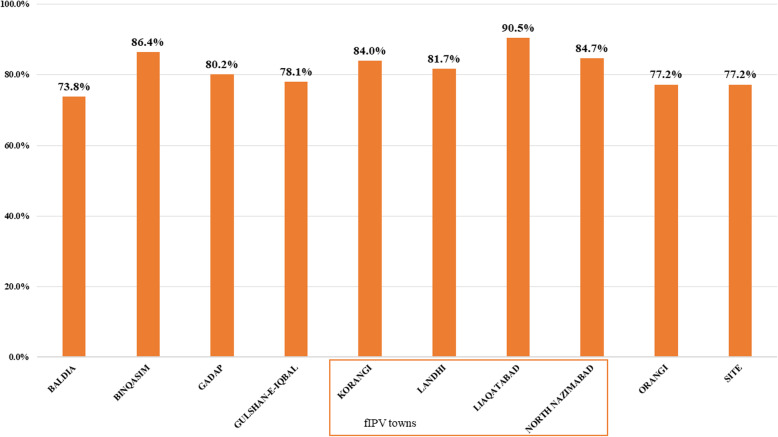
In four towns of Karachi, fIPV was given using needle-free injectors "PharmaJet Tropis ID". Whereas, in six towns full dose of IPV was administered to children of 4-59 months of age. Cluster surveys through rapid convenience assessment method were conducted after the completion of vaccination activity.
A total of 33,815 households' data was analyzed. Among these, 27,650 (82.8%) children were vaccinated. In fIPV areas, 85.3% of children were vaccinated compared to 79.5% in full dose IPV areas. A comparison of reasons for unvaccinated showed that 1.6% of parents do not give importance to vaccination in fIPV areas compared to 4.2% in full IPV areas (p-value < 0.0001). More children were not vaccinated due to fear of injection 1.8% in full IPV areas compared to 0.7% in fIPV areas (p-value < 0.0001). The source of campaign information shows that more frequent mobile miking 3.1% was observed in fIPV areas compared to 0.4% in full IPV areas (p-value < 0.0001).
Our analysis supports the fractional dose of IPV in mass campaigns to achieve good vaccination coverage especially using needle-free injectors "PharmaJet Tropis ID" and vigorous social mobilization activities are expedient in accomplishing high coverage.
2019年2月在卡拉奇开展了灭活脊髓灰质炎疫苗(IPV)接种活动,此次活动大规模引入了无针注射器用于接种小剂量IPV(fIPV)。本研究旨在确定无针注射器对疫苗接种覆盖率的影响。
在卡拉奇的四个城镇,使用无针注射器“PharmaJet Tropis ID”接种fIPV。而在六个城镇,对4至59个月大的儿童接种全剂量IPV。接种活动结束后,通过快速便利评估方法进行整群调查。
共分析了33815户家庭的数据。其中,27650名(82.8%)儿童接种了疫苗。在fIPV地区,85.3%的儿童接种了疫苗,而全剂量IPV地区为79.5%。未接种疫苗原因的比较显示,fIPV地区1.6%的家长不重视疫苗接种,而全剂量IPV地区为4.2%(p值<0.0001)。全剂量IPV地区因害怕打针而未接种疫苗的儿童更多,为1.8%,而fIPV地区为0.7%(p值<0.0001)。活动信息来源显示,fIPV地区更频繁地进行流动宣传(3.1%),而全剂量IPV地区为0.4%(p值<0.0001)。
我们的分析支持在大规模活动中使用小剂量IPV以实现良好的疫苗接种覆盖率,特别是使用无针注射器“PharmaJet Tropis ID”,并且积极的社会动员活动有助于实现高覆盖率。