Hartley April, Hardcastle Sarah A, Frysz Monika, Parkinson Jon, Paternoster Lavinia, McCloskey Eugene, Poole Kenneth E S, Javaid Muhammad K, Aye Mo, Moss Katie, Williams Martin, Tobias Jon H, Gregson Celia L
Musculoskeletal Research Unit, Translational Health Sciences, Bristol Medical School, University of Bristol, Bristol, UK.
MRC Integrative Epidemiology Unit, Population Health Sciences, Bristol Medical School, University of Bristol, Bristol, UK.
Arthritis Res Ther. 2021 Jan 6;23(1):4. doi: 10.1186/s13075-020-02371-0.
Individuals with high bone mass (HBM) have a greater odds of prevalent radiographic hip osteoarthritis (OA), reflecting an association with bone-forming OA sub-phenotypes (e.g. osteophytosis, subchondral sclerosis). As the role of bone mineral density (BMD) in hip OA progression is unclear, we aimed to determine if individuals with HBM have increased incidence and/or progression of bone-forming OA sub-phenotypes.
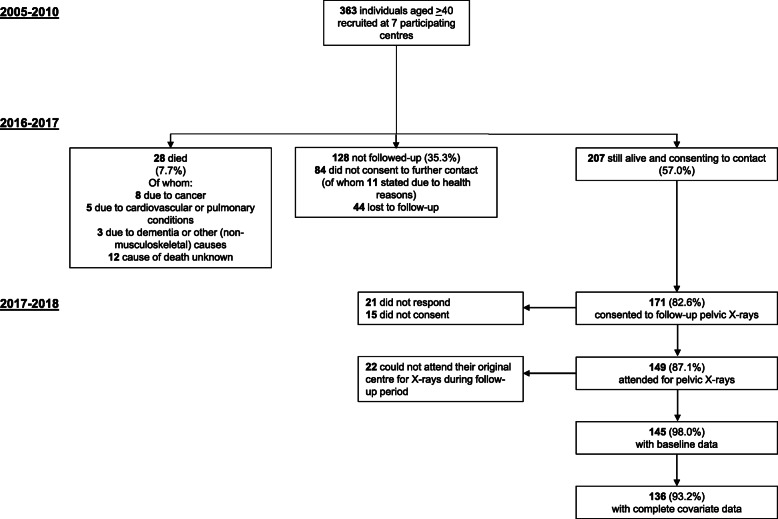
We analysed an adult cohort with and without HBM (L1 and/or total hip BMD Z-score > + 3.2) with pelvic radiographs collected at baseline and 8-year follow-up. Sub-phenotypes were graded using the OARSI atlas. Superior/inferior acetabular/femoral osteophyte and medial/superior joint space narrowing (JSN) grades were summed and Δosteophyte and ΔJSN derived. Pain and functional limitations were quantified using the WOMAC questionnaire. Associations between HBM status and change in OA sub-phenotypes were determined using multivariable linear/logistic regression, adjusting for age, sex, height, total body fat mass, follow-up time and baseline sub-phenotype grade. Generalised estimating equations accounted for individual-level clustering.
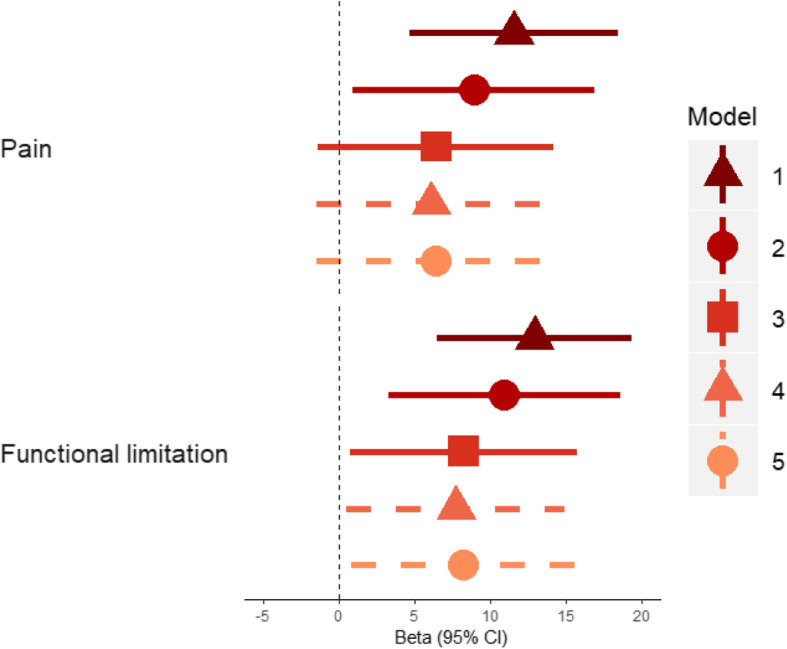
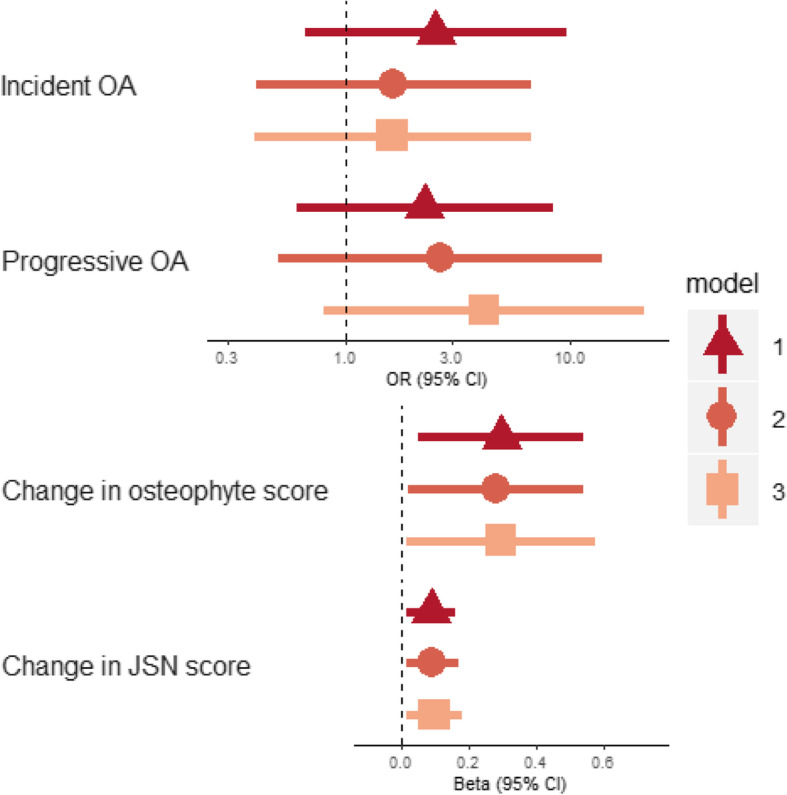
Of 136 individuals, 62% had HBM at baseline, 72% were female and mean (SD) age was 59 (10) years. HBM was positively associated with both Δosteophytes and ΔJSN (adjusted mean grade differences between individuals with and without HBM β = 0.30 [0.01, 0.58], p = 0.019 and β = 0.10 [0.01, 0.18], p = 0.019). Incident subchondral sclerosis was rare. HBM individuals had higher WOMAC hip functional limitation scores (β = 8.3 [0.7, 15.98], p = 0.032).
HBM is associated with the worsening of hip osteophytes and JSN over an average of 8 years, as well as increased hip pain and functional limitation.
高骨量(HBM)个体患髋部影像学骨关节炎(OA)的几率更高,这反映出其与骨形成型OA亚表型(如骨赘形成、软骨下硬化)有关。由于骨密度(BMD)在髋部OA进展中的作用尚不清楚,我们旨在确定HBM个体骨形成型OA亚表型的发病率和/或进展是否增加。
我们分析了一个有或无HBM(L1和/或全髋BMD Z评分> +3.2)的成年队列,该队列在基线和8年随访时均拍摄了骨盆X光片。使用OARSI图谱对亚表型进行分级。将髋臼/股骨上下骨赘和内侧/上关节间隙变窄(JSN)分级相加,并得出Δ骨赘和Δ JSN。使用WOMAC问卷对疼痛和功能受限情况进行量化。使用多变量线性/逻辑回归确定HBM状态与OA亚表型变化之间的关联,并对年龄、性别、身高以及全身脂肪量、随访时间和基线亚表型分级进行校正。广义估计方程考虑了个体水平的聚类情况。
在136名个体中,62%在基线时患有HBM,72%为女性,平均(标准差)年龄为59(10)岁。HBM与Δ骨赘和Δ JSN均呈正相关(有和无HBM个体之间的校正平均分级差异β = 0.30 [0.01, 0.58],p = 0.019;β = 0.10 [0.01, 0.18],p = 0.019)。软骨下硬化的发生率较低。HBM个体的WOMAC髋部功能受限评分更高(β = 8.3 [0.7, 15.98],p = 0.032)。
HBM与平均8年期间髋部骨赘和JSN的恶化有关,同时也与髋部疼痛和功能受限增加有关。