Zhuang Liying, Ni Huafu, Wang Junyang, Liu Xiaoyan, Lin Yajie, Su Yujie, Zhang Kan, Li Yaguo, Peng Guoping, Luo Benyan
Department of Neurology, First Affiliated Hospital, Zhejiang University School of Medicine, Hangzhou, China.
Department of Neurology, Zhejiang Hospital, Hangzhou, China.
Front Aging Neurosci. 2020 Dec 21;12:604246. doi: 10.3389/fnagi.2020.604246. eCollection 2020.
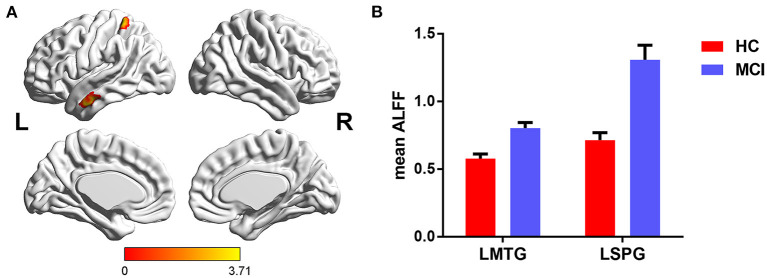
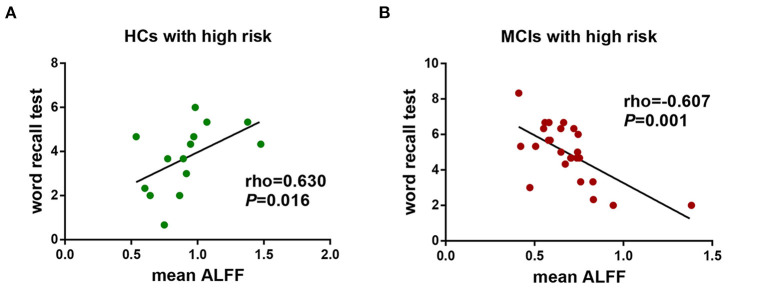
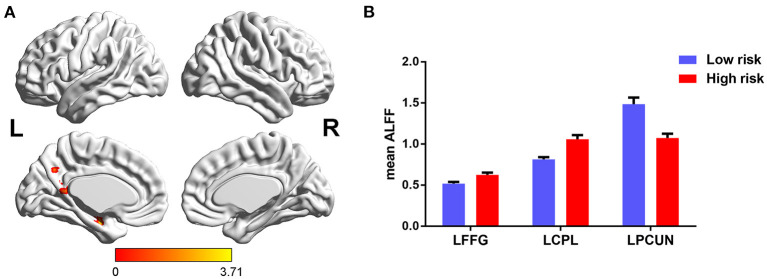
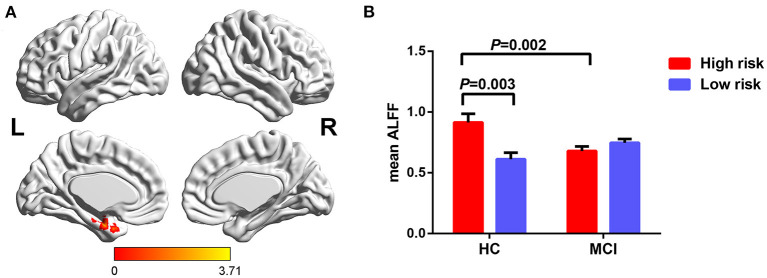
Several vascular risk factors, including hypertension, diabetes, body mass index, and smoking status are found to be associated with cognitive decline and the risk of Alzheimer's disease (AD). We aimed to investigate whether an aggregation of vascular risk factors modulates the amplitude of low-frequency fluctuation (ALFF) in patients with mild cognitive impairment (MCI). Forty-three MCI patients and twenty-nine healthy controls (HCs) underwent resting-state functional MRI scans, and spontaneous brain activity was measured by the ALFF technique. The vascular risk profile was represented with the Framingham Heart Study general cardiovascular disease (FHS-CVD) risk score, and each group was further divided into high and low risk subgroups. Two-way ANOVA was performed to explore the main effects of diagnosis and vascular risk and their interaction on ALFF. The main effect of diagnosis on ALFF was found in left middle temporal gyrus (LMTG) and left superior parietal gyrus (LSPG), and the main effect of risk on ALFF was detected in left fusiform gyrus (LFFG), left precuneus (LPCUN), and left cerebellum posterior lobe (LCPL). Patients with MCI exhibited increased ALFF in the LMTG and LSPG than HCs, and participants with high vascular risk showed increased ALFF in the LFFG and LCPL, while decreased ALFF in the LPCUN. An interaction between diagnosis (MCI vs. HC) and FHS-CVD risk (high vs. low) regarding ALFF was observed in the left hippocampus (LHIP). HCs with high vascular risk showed significantly increased ALFF in the LHIP than those with low vascular risk, while MCI patients with high vascular risk showed decreased ALFF in the LHIP than HCs with high vascular risk. Interestingly, the mean ALFF of LHIP positively correlated with word recall test in HCs with high vascular risk (rho = 0.630, = 0.016), while negatively correlated with the same test in MCI patients with high vascular risk (rho = -0.607, = 0.001). This study provides preliminary evidence highlighting that the aggregation of vascular risk factors modulates the spontaneous brain activity in MCI patients, and this may serve as a potential imaging mechanism underlying vascular contribution to AD.
研究发现,包括高血压、糖尿病、体重指数和吸烟状况在内的多种血管危险因素与认知能力下降及患阿尔茨海默病(AD)的风险相关。我们旨在研究血管危险因素的聚集是否会调节轻度认知障碍(MCI)患者的低频振幅(ALFF)。43例MCI患者和29名健康对照者(HCs)接受了静息态功能磁共振成像扫描,并采用ALFF技术测量自发脑活动。用弗雷明汉心脏研究一般心血管疾病(FHS-CVD)风险评分来表示血管风险状况,每组再进一步分为高风险和低风险亚组。采用双向方差分析来探讨诊断和血管风险及其交互作用对ALFF的主要影响。发现诊断对ALFF的主要影响出现在左侧颞中回(LMTG)和左侧顶上小叶(LSPG),风险对ALFF的主要影响在左侧梭状回(LFFG)、左侧楔前叶(LPCUN)和左侧小脑后叶(LCPL)检测到。与HCs相比,MCI患者在LMTG和LSPG中的ALFF增加,血管风险高的参与者在LFFG和LCPL中的ALFF增加,而在LPCUN中的ALFF降低。在左侧海马体(LHIP)观察到诊断(MCI与HC)和FHS-CVD风险(高与低)在ALFF方面的交互作用。血管风险高的HCs在LHIP中的ALFF显著高于血管风险低的HCs,而血管风险高的MCI患者在LHIP中的ALFF低于血管风险高的HCs。有趣的是,血管风险高的HCs中LHIP的平均ALFF与单词回忆测试呈正相关(rho = 0.630,P = 0.016),而在血管风险高的MCI患者中与相同测试呈负相关(rho = -0.607,P = 0.001)。本研究提供了初步证据,突出表明血管危险因素的聚集调节了MCI患者的自发脑活动,这可能是血管因素对AD影响的潜在成像机制。