Zhou Chen, Shi Qin, Liu Jiacheng, Huang Songjiang, Yang Chongtu, Xiong Bin
Department of Radiology Union Hospital Tongji Medical College, Huazhong University of Science and Technology, Wuhan, Hubei, 430022, People's Republic of China.
Hubei Province Key Laboratory of Molecular Imaging, Wuhan, Hubei, 430022, People's Republic of China.
J Hepatocell Carcinoma. 2020 Dec 31;7:447-456. doi: 10.2147/JHC.S282209. eCollection 2020.
Transcatheter arterial embolization (TAE) is widely used in hepatocellular carcinoma (HCC) therapy. Tumor hypoxia often correlates with the recurrence and metastasis of the tumor and is the critical factor limiting the treatment effect of TAE.
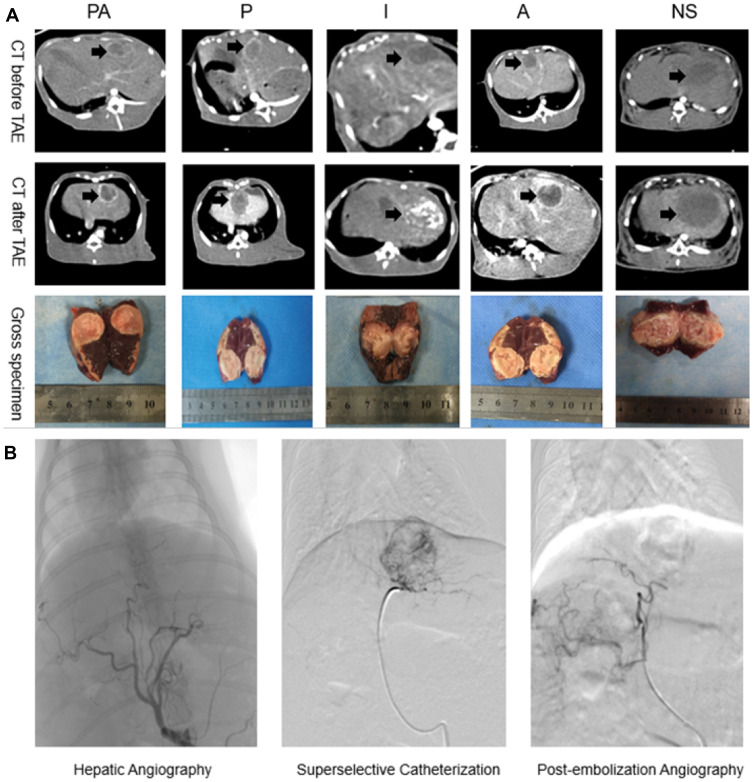
To investigate the underlying mechanism and therapeutic potential of TAE combined with apatinib-loaded p(-isopropyl-acrylamide--butyl methyl acrylate) temperature-sensitive (PIB) nanogel for the suppression of rabbit VX2 liver tumor growth.
Sixty-five VX2 tumor-burdened rabbits were randomly divided into five groups and treated transarterially with apatinib-loaded PIB (Group PA, 0.4 mL, n=13), PIB alone (Group P, 0.4 mL, n=13), iodized oil alone (Group I, 0.4 mL, n=13), apatinib solution (Group A, 0.4 mL, n=13) or saline (Group NS, 0.4 mL, n=13). The dose of apatinib was 2 mg/kg. Tumors were harvested, sectioned and immunohistochemically stained, and the tumor growth rates and survival times in each group were measured. Blood samples and liver tissues were collected for pharmacokinetic analysis.
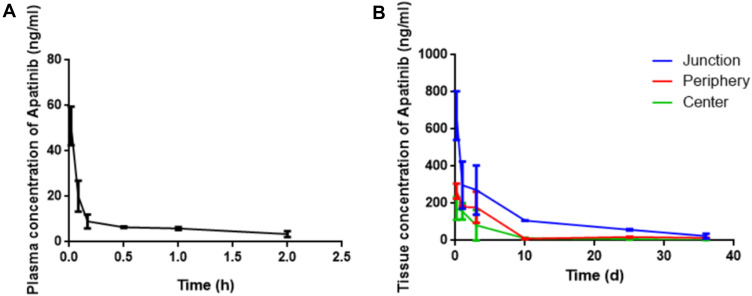
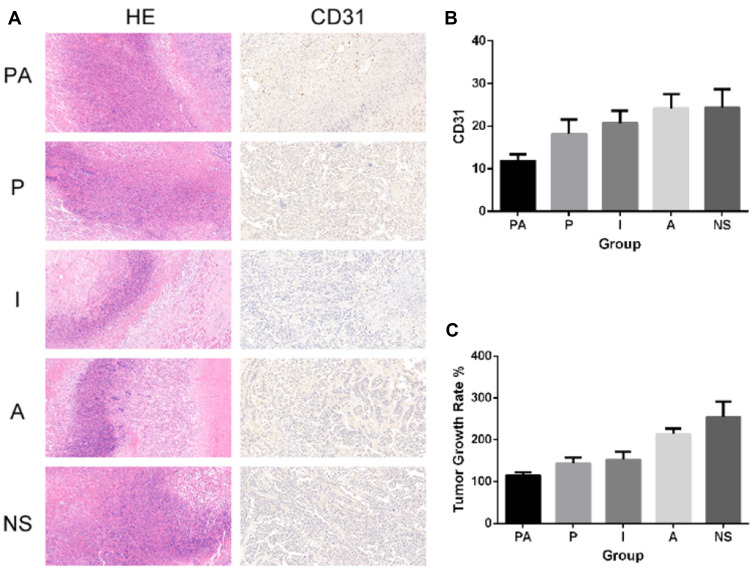
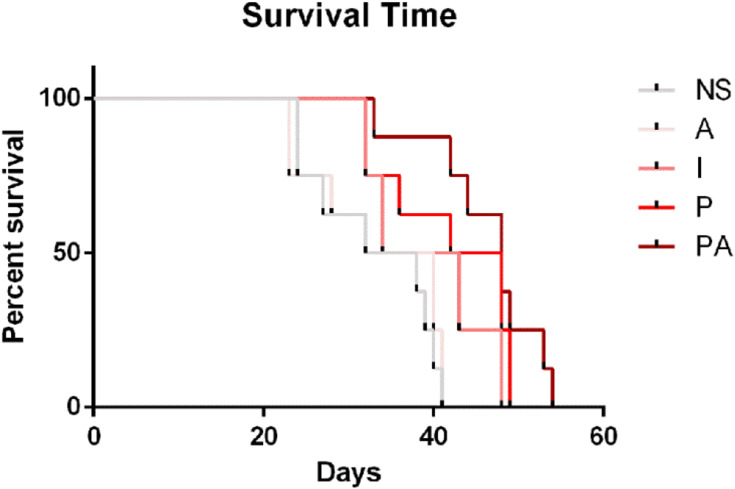
The tumor growth rate in Group PA was considerably lower than the other four groups (P=0.000<0.01), and the survival time was significantly prolonged (P=0.000<0.01). The immunohistochemistry results showed that CD31 expression was significantly lower in Group PA than that of the other four groups (P=0.000<0.01). The apatinib concentration in the blood fell below 10 ng/mL within 10 min after TAE and dropped below 1 ng/mL after 8 h. The drug was released continuously in the liver for 36 days, with the highest concentration at the tumor junction (P=0.045<0.05).
PIB effectively targeted apatinib to HCC tissues, achieved a slow and sustained release of the drug in the tumor and considerably reduced the systemic drug concentration. Further experiments showed significantly prolonged survival times and an inhibitory effect on tumor growth.
经导管动脉栓塞术(TAE)广泛应用于肝细胞癌(HCC)治疗。肿瘤缺氧常与肿瘤复发和转移相关,是限制TAE治疗效果的关键因素。
探讨TAE联合载阿帕替尼的聚(对异丙基丙烯酰胺-丙烯酸丁酯甲基酯)温度敏感(PIB)纳米凝胶抑制兔VX2肝肿瘤生长的潜在机制及治疗潜力。
将65只荷VX2肿瘤的兔随机分为五组,经动脉给予载阿帕替尼的PIB(PA组,0.4 mL,n = 13)、单纯PIB(P组,0.4 mL,n = 13)、单纯碘化油(I组,0.4 mL,n = 13)、阿帕替尼溶液(A组,0.4 mL,n = 13)或生理盐水(NS组,0.4 mL,n = 13)。阿帕替尼剂量为2 mg/kg。收获肿瘤,切片并进行免疫组织化学染色,测量每组肿瘤生长率和生存时间。采集血样和肝组织进行药代动力学分析。
PA组肿瘤生长率明显低于其他四组(P = 0.000 < 0.01),生存时间显著延长(P = 0.000 < 0.01)。免疫组织化学结果显示,PA组CD31表达明显低于其他四组(P = 0.000 < 0.01)。TAE后10分钟内血中阿帕替尼浓度降至10 ng/mL以下,8小时后降至1 ng/mL以下。药物在肝脏中持续释放36天,肿瘤交界处浓度最高(P = 0.045 < 0.05)。
PIB有效地将阿帕替尼靶向至HCC组织,实现药物在肿瘤中的缓慢持续释放,并显著降低全身药物浓度。进一步实验显示生存时间显著延长且对肿瘤生长有抑制作用。