Human Environments Analysis Laboratory, Western University, Room 2432, SSC, London, ON, N6A 5C2, Canada.
Children's Health Research Institute, London, ON, N6C 2V5, Canada.
Can J Public Health. 2021 Jun;112(3):440-448. doi: 10.17269/s41997-020-00453-9. Epub 2021 Jan 6.
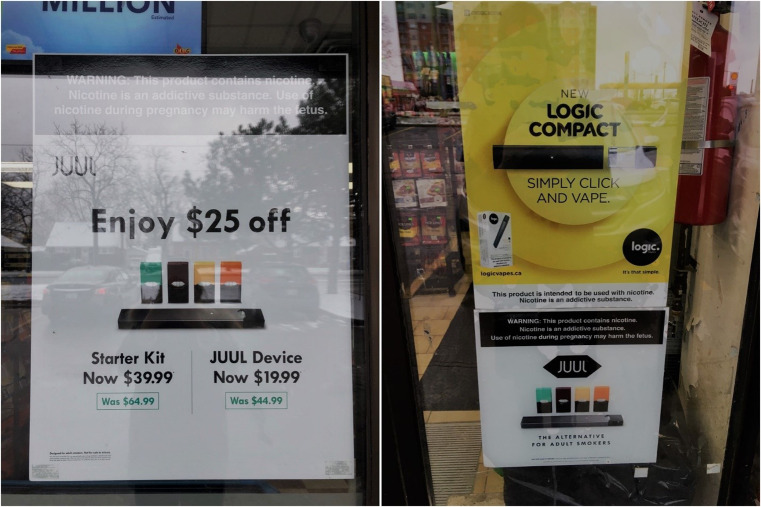
On January 1, 2020, the Government of Ontario passed a regulation banning vaping advertisements by retailers, apart from specialty shops. A motivation for this ban was to limit youth exposure to vaping advertisements. The primary goal of this research was to evaluate the impact of this ban on the number and density of vaping advertisements surrounding secondary schools. Additionally, we examined whether the number of vaping advertisements varied by school socio-demographic characteristics.
This study used a pre-post design. Audits were conducted December 2019 (pre-ban) and again January to February 2020 (post-ban), to identify vaping advertisements within 800 m surrounding secondary schools (n = 18) in London, Ontario.
Prior to the ban, there were 266 vaping advertisements within 800 m of secondary schools. After the ban, this was reduced to 58, a 78.2% reduction. The mean number of vaping advertisements surrounding schools significantly decreased from 18.1 before the ban to 3.6 after the ban (p < 0.001). A significant positive correlation was found, prior to the ban, between the number of vaping advertisements surrounding schools and school-level residential instability (r = 0.42, p = 0.02). After the ban, no significant correlations were found between the number of vaping advertisements and school socio-demographic characteristics.
The provincial ban of vaping advertisements in select retail settings significantly reduced the number of vaping advertisements in the areas surrounding secondary schools in London, Ontario. The ban also reduced socio-demographic inequities in youths' potential exposure to marketing of vaping products. Continued monitoring of the geographic accessibility and promotion of vaping products is warranted.
2020 年 1 月 1 日,安大略省政府通过了一项规定,禁止零售商(除专卖店外)发布电子烟广告。这一禁令的动机是限制年轻人接触电子烟广告。本研究的主要目的是评估该禁令对中学周围电子烟广告数量和密度的影响。此外,我们还研究了电子烟广告的数量是否因学校社会人口统计学特征而异。
本研究采用了前后设计。2019 年 12 月(禁令前)和 2020 年 1 月至 2 月(禁令后)进行了审计,以确定安大略省伦敦市中学周围 800 米范围内的电子烟广告(n=18)。
禁令前,中学周围 800 米范围内有 266 个电子烟广告。禁令后,这一数字减少到 58 个,减少了 78.2%。禁令前,学校周围电子烟广告的平均数量为 18.1 个,禁令后为 3.6 个,显著减少(p<0.001)。禁令前,学校周围电子烟广告数量与学校层面住宅不稳定呈显著正相关(r=0.42,p=0.02)。禁令后,学校周围电子烟广告数量与学校社会人口统计学特征之间没有显著相关性。
在安大略省的某些零售场所禁止电子烟广告,显著减少了安大略省伦敦市中学周围地区的电子烟广告数量。该禁令还减少了年轻人接触电子烟产品营销的社会人口统计学上的不平等。有必要继续监测电子烟产品的地理可及性和促销情况。