The Margaret and Wallace McCain Centre for Child, Youth and Family Mental Health, Centre for Addiction and Mental Health, Toronto, Ontario, Canada.
The Western Centre for Public Health and Family Medicine, Western University, London, Ontario, Canada.
BMC Psychiatry. 2021 Jan 7;21(1):13. doi: 10.1186/s12888-020-03005-0.
Suicide and risk management protocols in mental health research aim to ensure patient safety, provide vital information on how to assess suicidal ideation, manage risk, and respond to unexpected and expected situations. However, there is a lack of literature that identifies specific components and strategies to include in suicide and risk management protocols (SRMPs) for mental health research. The goal of this scoping review was to review academic and grey literature to determine core components and associated strategies, which can be used to inform SRMPs in mental health research.
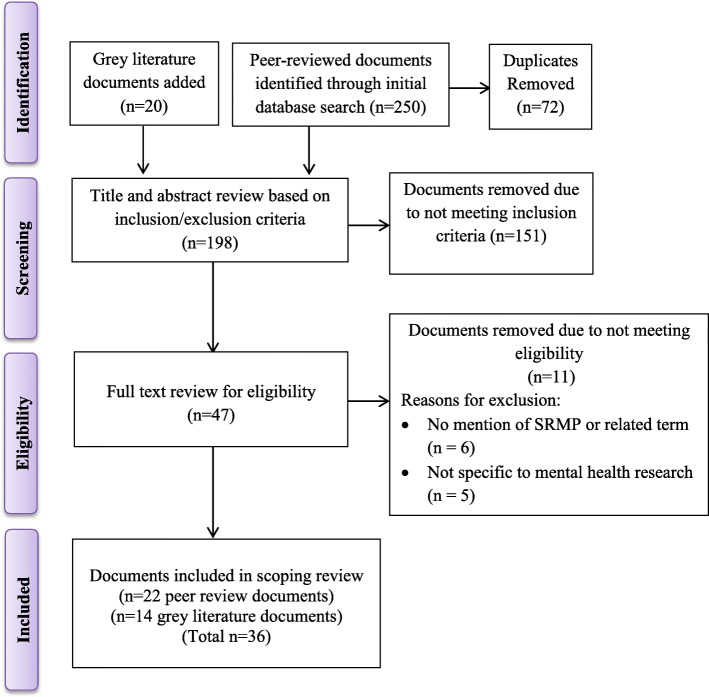
The methodological framework outlined by Arksey and O'Malley was used for this scoping review. The search strategy, conducted by a medical librarian, was multidisciplinary and included seven databases. Two reviewers independently assessed eligibility criteria in each document and used a standardized charting form to extract relevant data. The extracted data were then examined using qualitative content analysis. Specifically, summative content analysis was used to identify the core components and strategies used in SRMPs. The data synthesis process was iterative.
This review included 36 documents, specifically 22 peer-reviewed articles and 14 documents from the grey literature. Five core components of SRMPs emerged from the reviewed literature including: training; educational resources for research staff; educational resources for research participants; risk assessment and management strategies; and clinical and research oversight. Potentials strategies for risk mitigation within each of the core components are outlined.
The five core components and associated strategies for inclusion in SRMPs will assist mental health researchers in conducting research safely and rigorously. Findings can inform the development of SRMPs and how to tailor them across various research contexts.
精神健康研究中的自杀和风险管理方案旨在确保患者安全,提供有关如何评估自杀意念、管理风险以及应对意外和预期情况的重要信息。然而,缺乏确定精神健康研究中的自杀和风险管理方案(SRMP)中应包含的具体内容和策略的文献。本次范围综述的目的是审查学术和灰色文献,以确定核心内容和相关策略,从而为精神健康研究中的 SRMP 提供信息。
本范围综述采用了 Arksey 和 O'Malley 概述的方法框架。由医学图书馆员进行的搜索策略是多学科的,包括七个数据库。两名评审员独立评估每份文件的资格标准,并使用标准化图表表格提取相关数据。然后使用定性内容分析检查提取的数据。具体来说,采用总结性内容分析来确定 SRMP 中使用的核心内容和策略。数据综合过程是迭代的。
本次综述包括 36 篇文献,具体为 22 篇同行评审文章和 14 篇灰色文献。从审查文献中出现了五个 SRMP 的核心内容,包括:培训;研究人员教育资源;研究参与者教育资源;风险评估和管理策略;临床和研究监督。概述了每个核心内容中潜在的风险缓解策略。
SRMP 中包含的五个核心内容和相关策略将帮助精神健康研究人员安全严谨地进行研究。研究结果可以为 SRMP 的制定以及如何根据不同的研究背景进行调整提供信息。