Department of Conservative Dentistry and Pedodontics, Wroclaw Medical University, Krakowska 26, 50-425, Wrocław, Poland.
Department and Clinic of Pediatric Nephrology, Wroclaw Medical University, Borowska 213, 50-556, Wrocław, Poland.
BMC Oral Health. 2021 Jan 7;21(1):17. doi: 10.1186/s12903-020-01375-1.
Disturbances in the levels of serum constituents occurring in chronic renal diseases can be reflected in the saliva composition. The aim of this study was to assess some selected salivary components in children suffering from idiopathic steroid-sensitive nephrotic syndrome (iNS).
A case-control study was performed on iNS and healthy participants. In unstimulated mixed saliva, pH, buffer capacity, total protein, α-amylase, peroxidase, calcium, magnesium, inorganic phosphate, fluoride, urea, uric acid and salivary flow rate were measured. Oral condition was assessed using dmft, DMFT, API and GI indices, usage of fluoride specimens and frequency of tooth brushing. Statistical analysis was performed by Shapiro-Wilk, Brown-Forsythe, Student's t, ANOVA, Tukey's and Pearson's chi-square tests, Pearson's and Spearman's correlations, logistic regression and receiver operating characteristic (ROC) curve analysis.
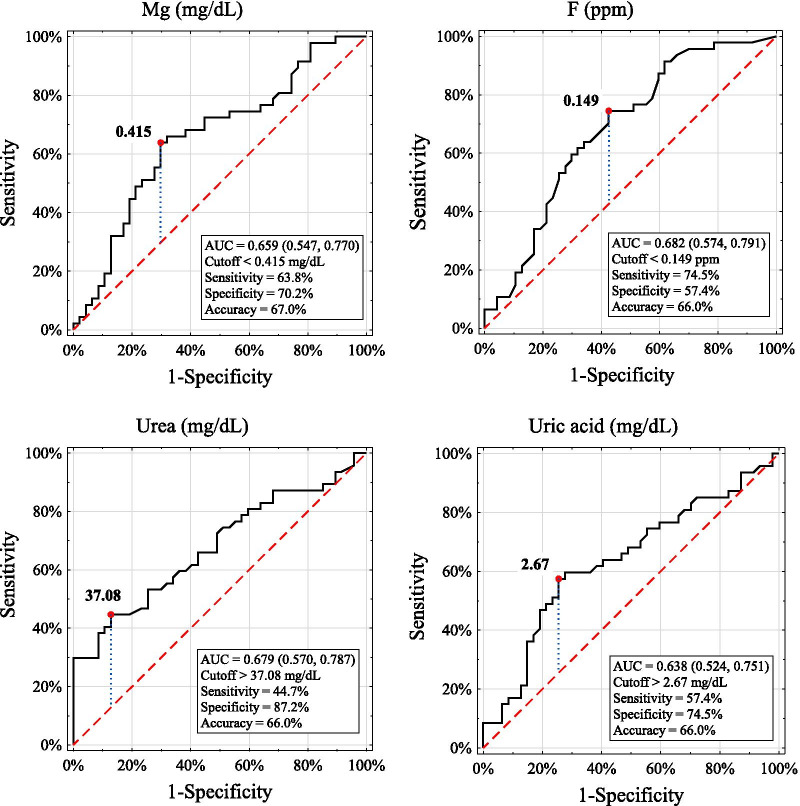
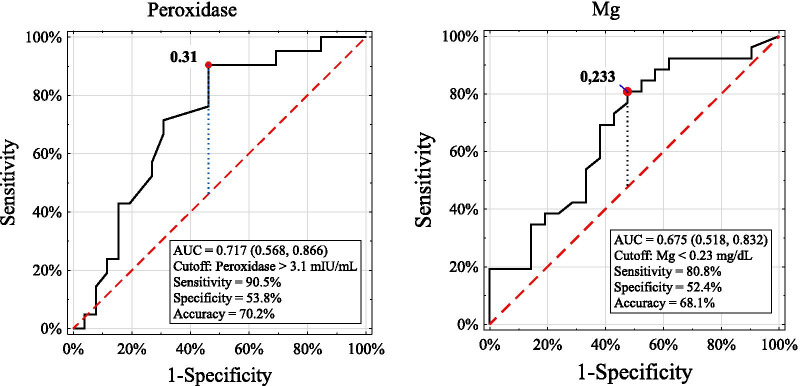
The study involved 94 participants of both genders aged 4-17 (47 cases in relapse or remission phase of iNS and 47 controls) who were treated in the clinic of pediatric nephrology or outpatient dental clinic. Neither group differed in the number of caries-affected primary and permanent teeth, gingival condition or use of fluoride specimens. The iNS group presented lower levels of magnesium (0.41 ± 0.34 vs. 0.60 ± 0.38 mg/dL, P < 0.05) and fluoride (0.15 ± 0.10 vs. 0.21 ± 0.10 ppm, P < 0.01) and higher contents of urea (35.19 ± 15.55 vs. 25.21 ± 10.78 mg/dL, P < 0.01) and uric acid (2.90 ± 1.23 vs. 2.34 ± 1.04 mg/dL, P < 0.05) than the controls. In the iNS participants with relapse, a higher peroxidase activity and lower magnesium content than in the remission phase were found. ROC analysis showed a weak discriminatory power of these salivary constituents for the differentiation of participants with and without disease (accuracy from 66.0 to 67.0%, area under the ROC curve (AUC) from 0.638 to 0.682) and the relapse and remission phases (accuracy 70.2% and 68.1% and AUC 0.717 and 0.675, respectively).
Levels of urea, uric acid, magnesium and fluoride in saliva can be associated with the course of iNS. Salivary levels of peroxidase and magnesium can be related to the phase of the disease. However, the measurements of these parameters cannot be useful as a noninvasive tool in diagnosing iNS and the phase of the disease.
慢性肾脏疾病患者血清成分水平的紊乱可以反映在唾液成分中。本研究的目的是评估特发性类固醇敏感性肾病综合征(iNS)患儿的一些选定唾液成分。
对 iNS 患儿和健康参与者进行病例对照研究。在非刺激混合唾液中,测量 pH 值、缓冲能力、总蛋白、α-淀粉酶、过氧化物酶、钙、镁、无机磷、氟化物、尿素、尿酸和唾液流量。使用 dmft、DMFT、API 和 GI 指数、氟化物样本的使用情况和刷牙频率评估口腔状况。通过 Shapiro-Wilk、Brown-Forsythe、Student's t、ANOVA、Tukey 和 Pearson 卡方检验、Pearson 和 Spearman 相关性、逻辑回归和接收者操作特征(ROC)曲线分析进行统计分析。
该研究涉及 94 名年龄在 4-17 岁的男女参与者(47 例处于 iNS 复发或缓解期,47 例为对照组),他们在儿科肾病诊所或门诊牙科诊所接受治疗。两组在受龋齿影响的乳牙和恒牙数量、牙龈状况或氟化物样本的使用方面没有差异。iNS 组的镁(0.41 ± 0.34 对 0.60 ± 0.38mg/dL,P<0.05)和氟化物(0.15 ± 0.10 对 0.21 ± 0.10ppm,P<0.01)水平较低,尿素(35.19 ± 15.55 对 25.21 ± 10.78mg/dL,P<0.01)和尿酸(2.90 ± 1.23 对 2.34 ± 1.04mg/dL,P<0.05)含量较高。在 iNS 复发患者中,过氧化物酶活性较高,镁含量较低。ROC 分析显示,这些唾液成分对区分有和无疾病的参与者的区分能力较弱(准确性为 66.0%至 67.0%,ROC 曲线下面积(AUC)为 0.638 至 0.682)和疾病缓解期(准确性分别为 70.2%和 68.1%,AUC 分别为 0.717 和 0.675)。
唾液中尿素、尿酸、镁和氟化物的水平可能与 iNS 的病程有关。唾液中的过氧化物酶和镁水平可能与疾病的阶段有关。然而,这些参数的测量不能作为诊断 iNS 和疾病阶段的非侵入性工具。