PMI VectorWorks Project, Tropical Health LLP, Montagut, Spain.
PMI VectorWorks Project, Tropical Health LLP, Abuja, Nigeria.
Malar J. 2021 Jan 7;20(1):26. doi: 10.1186/s12936-020-03549-2.
Physical durability of long-lasting-insecticidal nets (LLIN) is an important aspect of the effectiveness of LLIN as a malaria prevention tool, but there is limited data on performance across locations and products. This secondary analysis of data from the VectorWorks project from 10 sites in four African countries involving six LLIN brands provides such data.
A total of 4672 campaign nets from 1976 households were recruited into prospective cohort studies 2-6 months after distribution through campaigns and followed for 3 years in Mozambique, Nigeria, DRC and Zanzibar, Tanzania. LLIN products included two 100 denier polyester LLIN (DawaPlus 2.0, PermaNet 2.0) distributed in five sites and four 150 denier polyethylene LLIN (Royal Sentry, MAGNet, DuraNet©, Olyset™ Net) distributed in five sites. Primary outcome was LLIN survival in serviceable condition and median survival in years. Net use environment and net care variables were collected during four household surveys. Determinants of physical durability were explored by survival analysis and Cox regression models with risk of failure starting with the first hanging of the net.
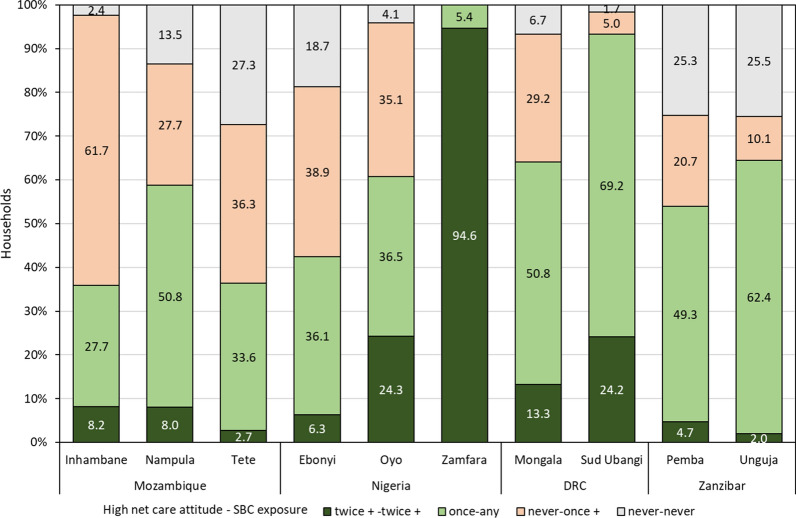
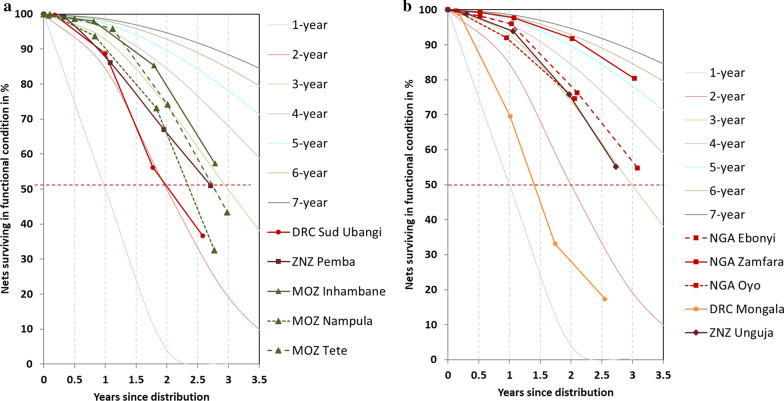
Definite outcomes for physical durability were obtained for 75% of study nets. After 31 to 37 months survival in serviceable condition varied between sites by 63 percentage-points, from 17 to 80%. Median survival varied by 3.7 years, from 1.6 to 5.3 years. Similar magnitude of variation was seen for polyethylene and polyester LLIN and for the same brand. Cox regression showed increasing net care attitude in combination with exposure to net related messages to be the strongest explanatory variable of survival. However, differences between countries also remained significant. In contrast, no difference was seen for LLIN material types.
Variation in net use environment and net care is the main reason for differences in the physical durability of LLIN products in different locations. While some of these factors have been identified to work across countries, other factors remain poorly defined and further investigation is needed in this area. Grouping LLIN brands by similar textile characteristics, such as material or yarn strength, is insufficient to distinguish LLIN product performance suggesting a more differentiated, composite metric is needed.
长效驱虫蚊帐(LLIN)的物理耐久性是 LLIN 作为疟疾预防工具有效性的一个重要方面,但有关不同地点和产品性能的数据有限。本研究对来自非洲 4 个国家 10 个地点的 VectorWorks 项目的数据进行了二次分析,涉及 6 个 LLIN 品牌,提供了此类数据。
共有来自 1976 户家庭的 4672 顶蚊帐通过运动分发后 2-6 个月被招募到前瞻性队列研究中,并在莫桑比克、尼日利亚、刚果民主共和国和坦桑尼亚桑给巴尔进行了 3 年的随访。LLIN 产品包括在 5 个地点分发的两种 100 旦尼尔聚酯 LLIN(DawaPlus 2.0、PermaNet 2.0)和在 5 个地点分发的四种 150 旦尼尔聚乙烯 LLIN(Royal Sentry、MAGNet、DuraNet©、Olyset™ Net)。主要结局是可用状态下的 LLIN 存活率和中位数存活年限。在四次家庭调查中收集了蚊帐使用环境和护理变量。通过生存分析和 Cox 回归模型,从第一次悬挂蚊帐开始,探索了物理耐久性的决定因素。
75%的研究蚊帐获得了明确的物理耐久性结果。31 至 37 个月后,不同地点的可用状态存活率相差 63 个百分点,从 17%到 80%不等。中位数存活年限相差 3.7 年,从 1.6 年到 5.3 年不等。聚乙烯和聚酯 LLIN 以及相同品牌的变化幅度相似。Cox 回归显示,增加对蚊帐的护理态度以及接触与蚊帐相关的信息,是生存的最强解释变量。然而,国家之间的差异仍然显著。相比之下,LLIN 材料类型没有差异。
不同地点 LLIN 产品物理耐久性的差异主要是由于蚊帐使用环境和护理的差异造成的。虽然已经确定了一些在不同国家都有效的因素,但其他因素仍定义不明确,需要在这一领域进一步研究。按类似的纺织特性(如材料或纱线强度)对 LLIN 品牌进行分组不足以区分 LLIN 产品的性能,这表明需要更具差异化的综合指标。