PMI VectorWorks Project, Tropical Health LLP, Abuja, Nigeria.
National Malaria Elimination Programme, Abuja, Nigeria.
Malar J. 2020 Mar 30;19(1):124. doi: 10.1186/s12936-020-03194-9.
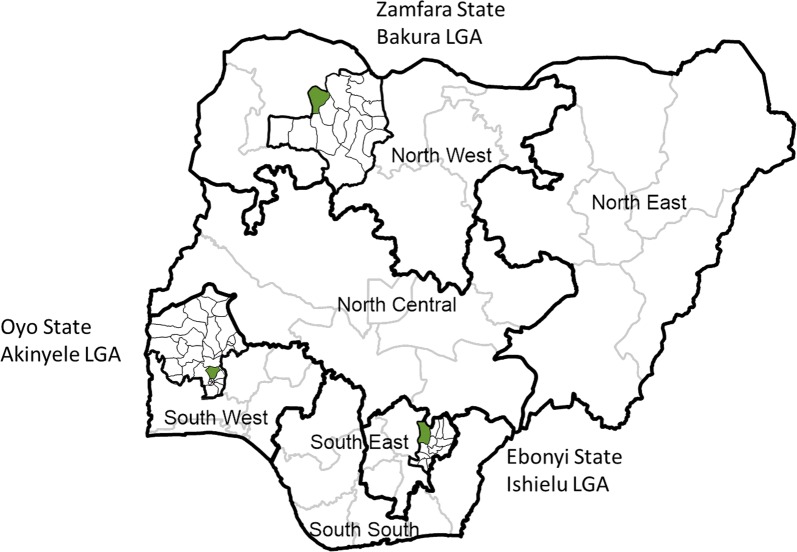
Following guidance from the US President's Malaria Initiative, durability monitoring of DawaPlus 2.0 brand of long-lasting insecticidal net (LLIN) distributed during the 2015/16 mass campaign was set up in three ecologically different states: Zamfara, Ebonyi and Oyo.
This was a prospective cohort study of representative samples of households from each location, recruited at baseline, 1 to 6 months after the mass campaign. All campaign nets in the households were labelled and followed up over a period of 36 months in Zamfara and Ebonyi and 24 months in Oyo. Primary outcome was the "proportion of nets surviving in serviceable condition" based on attrition and integrity measures and the median survival in years. The outcome for insecticidal durability was determined by bio-assay from sub-samples of campaign nets.
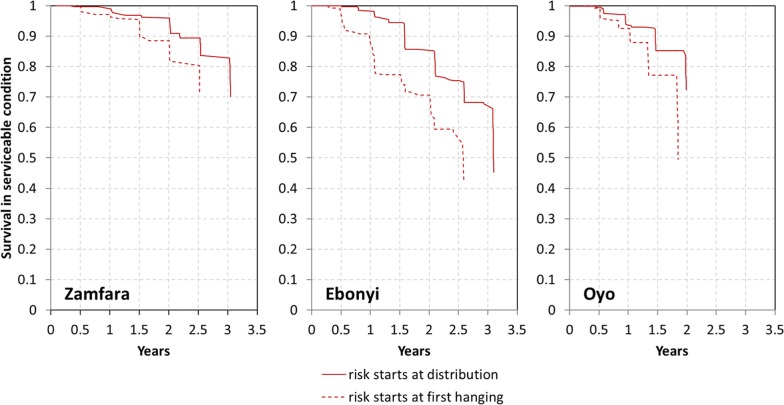
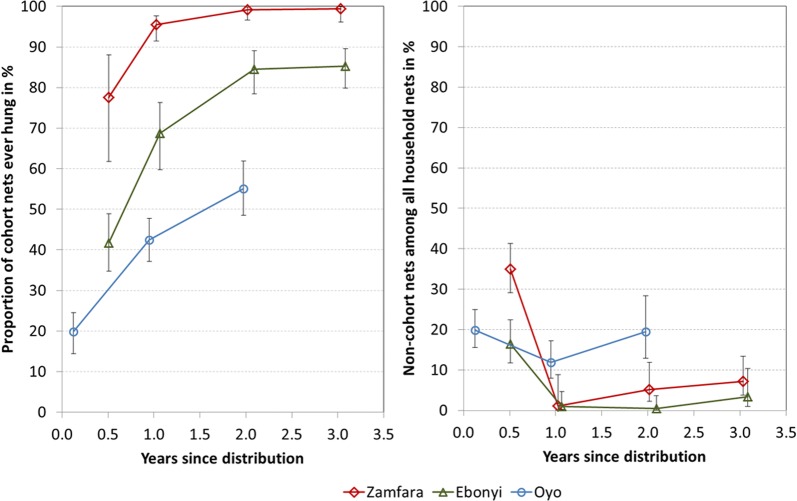
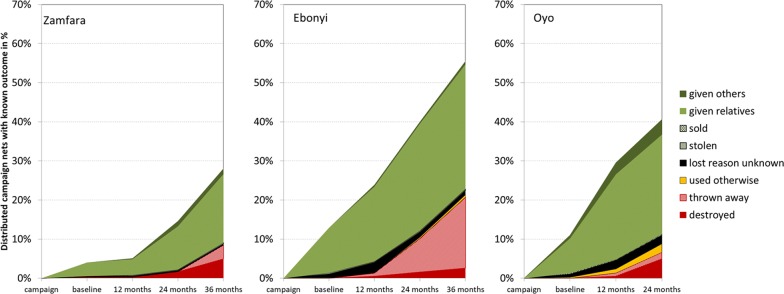
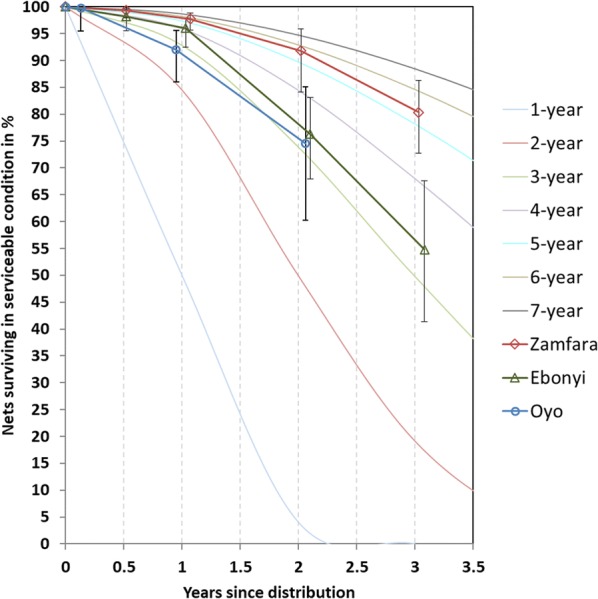
A total of 439 households (98% of target) and 1096 campaign nets (106%) were included in the study. Definite outcomes could be determined for 92% of the cohort nets in Zamfara, 88% in Ebonyi and 75% in Oyo. All-cause attrition was highest in Oyo with 47% no longer present after 24 months, 53% in Ebonyi and 28% in Zamfara after 36 months. Overall only 1% of all campaign nets were used for other purposes. Estimated survival in serviceable condition of the campaign nets was 80% in Zamfara, 55% in Ebonyi (36 months follow-up) and 75% in Oyo (24 months follow-up) corresponding to median survival of 5.3, 3.3, 3.2 years, respectively. Factors associated with better survival were exposure to social messaging combined with a positive net-care attitude and only adult users. Failing to fold the net when hanging and having children under 5 years of age in the household negatively impacted net survival. Insecticidal effectiveness testing at final survey showed knock-down rates of 50-69%, but 24-h mortality above 95% resulting in 100% optimal performance in Ebonyi and Oyo and 97% in Zamfara.
Results confirm the strong influence of net-use environment and behavioural factors in the physical survival of the same LLIN brand, which can increase the time until 50% of nets are no longer serviceable by up to 2 years.
根据美国总统疟疾倡议的指导,在 2015/16 年大规模运动期间分发的 DawaPlus 2.0 牌长效驱虫蚊帐(LLIN)的耐用性监测在三个生态环境不同的州(赞法拉、埃博尼和奥约)设立。
这是一项前瞻性队列研究,代表每个地点的家庭样本,在基线、大规模运动后 1 至 6 个月招募。家庭中的所有运动蚊帐均贴有标签,并在赞法拉和埃博尼的 36 个月和奥约的 24 个月期间进行跟踪。主要结果是根据损耗和完整性测量以及中位数存活年限得出的“仍处于可用状态的蚊帐比例”。昆虫耐久性的结果是通过从运动蚊帐的亚样本进行生物测定来确定的。
共有 439 户家庭(占目标的 98%)和 1096 顶运动蚊帐(占 106%)参与了研究。在赞法拉,92%的队列蚊帐可以确定明确的结果,在埃博尼,88%的队列蚊帐可以确定明确的结果,在奥约,75%的队列蚊帐可以确定明确的结果。在奥约,所有原因的损耗最高,24 个月后不再存在的比例为 47%,36 个月后埃博尼为 53%,赞法拉为 28%。总体而言,只有 1%的所有运动蚊帐用于其他用途。运动蚊帐在可用条件下的估计存活时间为 80%在赞法拉,55%在埃博尼(36 个月随访)和 75%在奥约(24 个月随访),相应的中位存活时间分别为 5.3、3.3、3.2 年。与更好的生存相关的因素是接触社会信息和积极的蚊帐护理态度以及只有成年人使用。挂蚊帐时不折叠和家庭中有 5 岁以下儿童会对蚊帐的生存产生负面影响。最终调查时的杀虫效果测试显示击倒率为 50-69%,但 24 小时死亡率超过 95%,导致在埃博尼和奥约的杀虫效果达到 100%,在赞法拉达到 97%。
结果证实了使用环境和行为因素对同一长效驱虫蚊帐品牌的物理存活的强烈影响,这可以使达到 50%的蚊帐不再可用的时间延长长达 2 年。