PROFITH "PROmoting FITness and Health Through Physical Activity" Research Group, Department of Physical Education and Sport, Faculty of Sport Sciences, University of Granada, Granada, Spain.
Department of Physiology. Faculty of Medicine, University of Granada, Av. Conocimiento S/n, 18011, Granada, Spain.
J Int Soc Sports Nutr. 2021 Jan 7;18(1):5. doi: 10.1186/s12970-020-00400-6.
There is evidence that caffeine increases the maximal fat oxidation rate (MFO) and aerobic capacity, which are known to be lower in the morning than in the afternoon. This paper examines the effect of caffeine intake on the diurnal variation of MFO during a graded exercise test in active men.
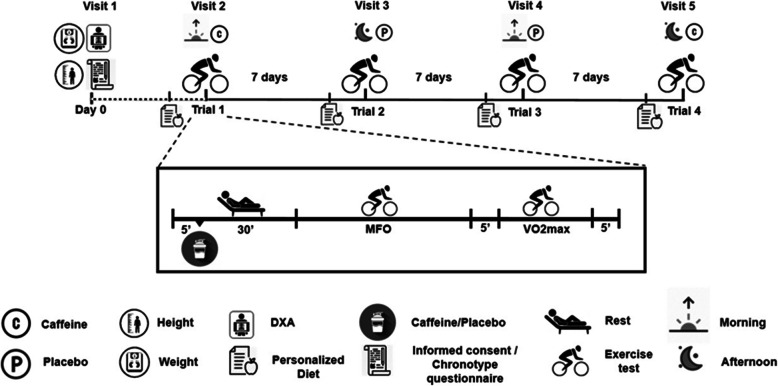
Using a triple-blind, placebo-controlled, crossover experimental design, 15 active caffeine-naïve men (age: 32 ± 7 years) completed a graded exercise test four times at seven-day intervals. The subjects ingested 3 mg/kg of caffeine or a placebo at 8 am in the morning and 5 pm in the afternoon (each subject completed tests under all four conditions in a random order). A graded cycling test was performed. MFO and maximum oxygen uptake (VO) were measured by indirect calorimetry, and the intensity of exercise that elicited MFO (Fat) calculated.
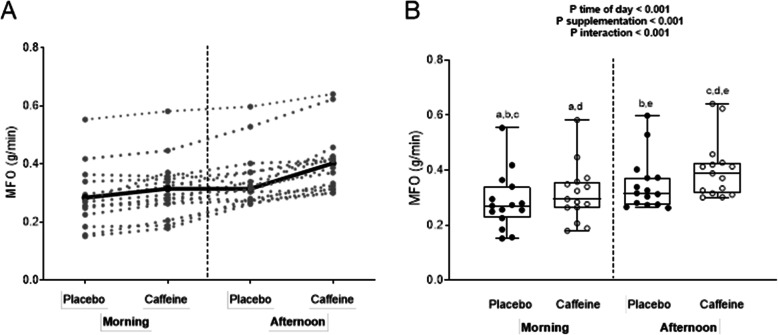
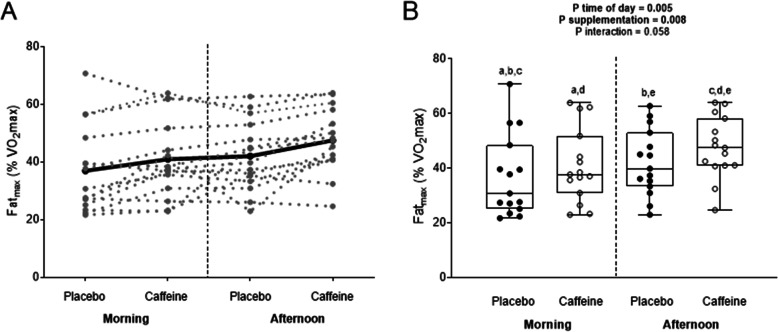
MFO, Fat and VO were significantly higher in the afternoon than in the morning (all P < 0.05). Compared to the placebo, caffeine increased mean MFO by 10.7% (0.28 ± 0.10 vs. 0.31 ± 0.09 g/min respectively, P < 0.001) in the morning, and by a mean 29.0% (0.31 ± 0.09 vs. 0.40 ± 0.10 g/min, P < 0.001) in the afternoon. Caffeine also increased mean Fat by 11.1% (36.9 ± 14.4 [placebo] vs. 41.0 ± 13.1%, P = 0.005) in the morning, and by 13.1% (42.0 ± 11.6 vs. 47.5 ± 10.8%, P = 0.008) in the afternoon.
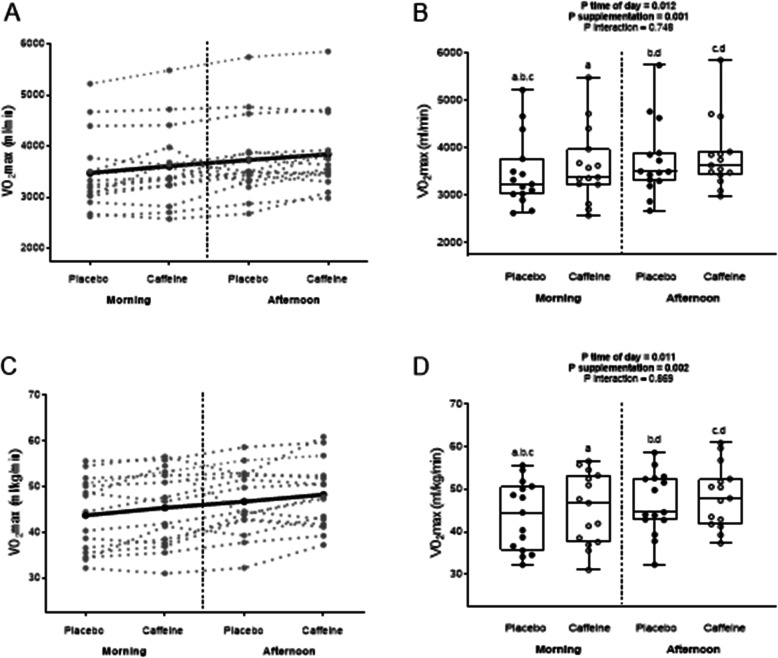
These findings confirm the previously reported diurnal variation in the whole-body fat oxidation rate during graded exercise in active caffeine-naïve men, and indicate that the acute ingestion of 3 mg/kg of caffeine increases MFO, Fat and VO independent of the time of day.
NCT04320446 . Registered 25 March 2020 - Retrospectively registered.
有证据表明,咖啡因可以提高最大脂肪氧化率(MFO)和有氧能力,而这些在早上都比下午低。本文研究了咖啡因摄入对活跃男性在分级运动测试中 MFO 昼夜变化的影响。
采用三盲、安慰剂对照、交叉实验设计,15 名无咖啡因摄入的活跃男性(年龄:32±7 岁)在七天的间隔内四次完成分级运动测试。受试者在早上 8 点和下午 5 点分别摄入 3mg/kg 的咖啡因或安慰剂(每个受试者以随机顺序在所有四种条件下完成测试)。进行分级踏车测试。通过间接测热法测量 MFO 和最大摄氧量(VO),并计算出引起 MFO(Fat)的运动强度。
MFO、Fat 和 VO 下午均显著高于上午(均 P<0.05)。与安慰剂相比,咖啡因使上午的平均 MFO 增加了 10.7%(分别为 0.28±0.10 与 0.31±0.09 g/min,P<0.001),下午增加了 29.0%(分别为 0.31±0.09 与 0.40±0.10 g/min,P<0.001)。咖啡因还使上午的平均 Fat 增加了 11.1%(36.9±14.4[安慰剂]与 41.0±13.1%,P=0.005),下午增加了 13.1%(42.0±11.6 与 47.5±10.8%,P=0.008)。
这些发现证实了之前在无咖啡因摄入的活跃男性进行分级运动时全身脂肪氧化率的昼夜变化,并表明急性摄入 3mg/kg 的咖啡因可独立于时间增加 MFO、Fat 和 VO。
NCT04320446。2020 年 3 月 25 日注册-回顾性注册。