Lux Christian A, Wagner Mackenzie Brett, Johnston James, Zoing Melissa, Biswas Kristi, Taylor Michael W, Douglas Richard G
School of Biological Sciences, University of Auckland, Auckland, New Zealand.
Department of Surgery, School of Medicine, University of Auckland, Auckland, New Zealand.
Front Microbiol. 2020 Dec 22;11:595555. doi: 10.3389/fmicb.2020.595555. eCollection 2020.
Chronic rhinosinusitis (CRS) is a common and debilitating inflammatory condition of the sinuses, afflicting 5% of the general population. Although antibiotics are frequently prescribed for the medical management of CRS, there is surprisingly little evidence to support their efficacy. In this study, we aimed to establish associations between medication usage, the sinus microbiota and patients' clinical outcomes.
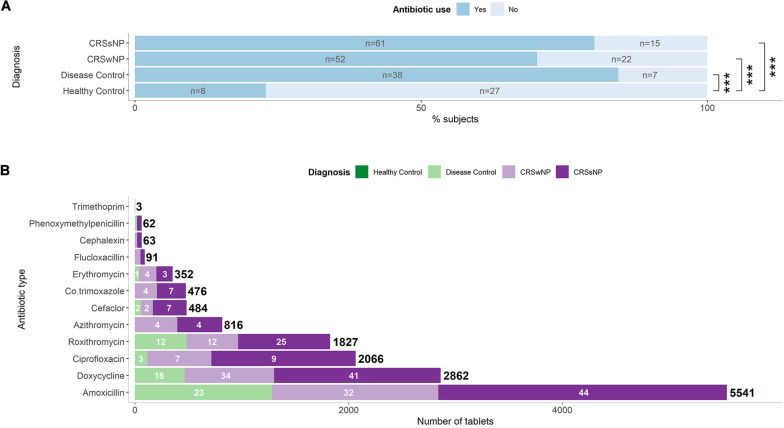
Antibiotic prescription patterns for the year before sample collection of 156 CRS patients, 45 disease control patients (mostly requiring septoplasty and inferior turbinate reduction) and 35 healthy control subjects were examined and analyzed together with previously published bacterial 16S rRNA gene amplicon data from our group.
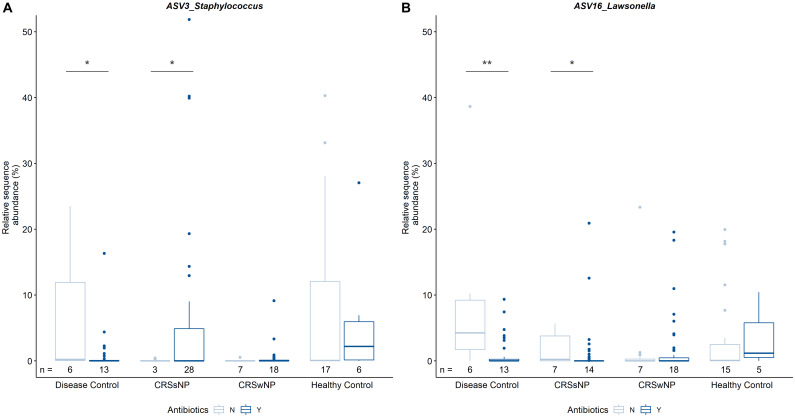
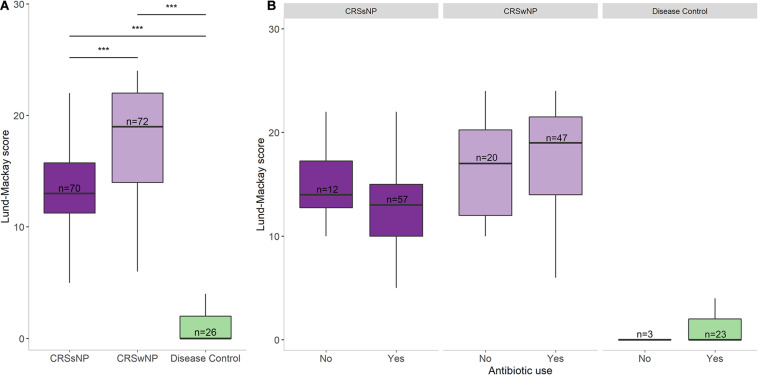
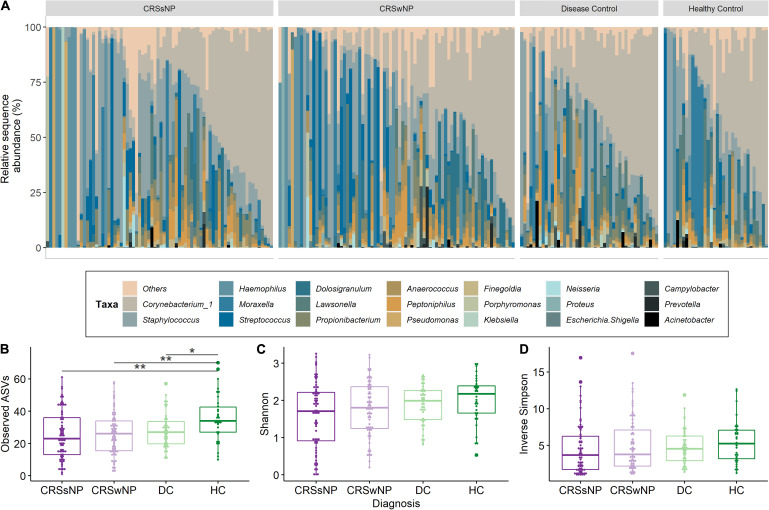
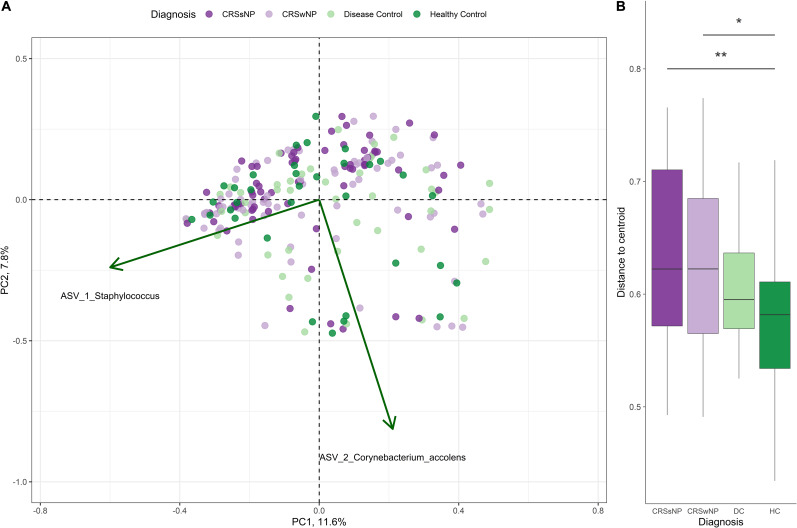
The highest antibiotic usage was observed among the two CRS patient categories. Despite heavy antibiotic usage, CRS patients' clinical outcomes as indicated by patient questionnaires and radiologic scores were similar to those patients that did not receive any antibiotics. The sinus microbiota was dominated by members of the bacterial genera and in all three cohorts. Bacterial community dispersion as measured by principal coordinate analysis was significantly higher in CRS patients compared to healthy control subjects, but not disease control patients. Pairwise comparisons within cohorts revealed differences in the relative 16S rRNA gene sequence abundances of the genera and between antibiotic users and non-users. However, overall antibiotic effects were minimal and unpredictable.
The unpredictable effects of antibiotic treatment on the sinus microbiota found in this study, together with the lack of differences in patients' symptom scores between cohorts, do not support preoperative antibiotic treatment for CRS patients.
慢性鼻-鼻窦炎(CRS)是鼻窦常见且使人衰弱的炎症性疾病,影响着5%的普通人群。尽管抗生素常用于CRS的药物治疗,但令人惊讶的是,几乎没有证据支持其疗效。在本研究中,我们旨在确定药物使用、鼻窦微生物群与患者临床结局之间的关联。
对156例CRS患者、45例疾病对照患者(大多需要鼻中隔成形术和下鼻甲切除术)和35例健康对照受试者在样本采集前一年的抗生素处方模式进行了检查,并与我们团队之前发表的细菌16S rRNA基因扩增子数据一起进行分析。
在两类CRS患者中观察到最高的抗生素使用率。尽管大量使用抗生素,但患者问卷和放射学评分显示,CRS患者的临床结局与未接受任何抗生素治疗的患者相似。在所有三个队列中,鼻窦微生物群均以细菌属的成员为主。通过主坐标分析测量,CRS患者的细菌群落离散度显著高于健康对照受试者,但疾病对照患者并非如此。队列内的成对比较显示,抗生素使用者和非使用者之间,属和属的相对16S rRNA基因序列丰度存在差异。然而,总体抗生素效果微乎其微且不可预测。
本研究中发现抗生素治疗对鼻窦微生物群具有不可预测的影响,且各队列患者症状评分无差异,因此不支持对CRS患者进行术前抗生素治疗。