Neuropsquiatry and Behavior Science Postgraduate Program, Federal University of Pernambuco, Recife, PE, Brazil.
Laboratório de Imunopatologia Keizo Asami-LIKA, University of Pernambuco, Recife, PE, Brazil.
Neural Plast. 2020 Dec 14;2020:8856621. doi: 10.1155/2020/8856621. eCollection 2020.
Physical exercise (PE) has been associated with increase neuroplasticity, neurotrophic factors, and improvements in brain function.
To evaluate the effects of different PE protocols on neuroplasticity components and brain function in a human and animal model.
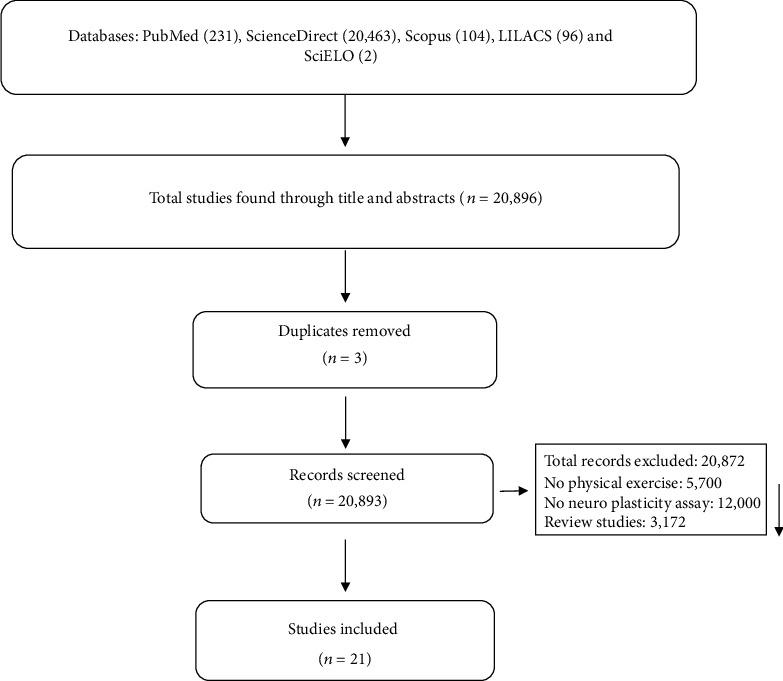
We conducted a systematic review process from November 2019 to January 2020 of the following databases: PubMed, ScienceDirect, SciELO, LILACS, and Scopus. A keyword combination referring to PE and neuroplasticity was included as part of a more thorough search process. From an initial number of 20,782 original articles, after reading the titles and abstracts, twenty-one original articles were included. Two investigators evaluated the abstract, the data of the study, the design, the sample size, the participant characteristics, and the PE protocol.
PE increases neuroplasticity via neurotrophic factors (BDNF, GDNF, and NGF) and receptor (TrkB and P75NTR) production providing improvements in neuroplasticity, and cognitive function (learning and memory) in human and animal models.
PE was effective for increasing the production of neurotrophic factors, cell growth, and proliferation, as well as for improving brain functionality.
体育锻炼(PE)与神经可塑性、神经营养因子的增加以及大脑功能的改善有关。
评估不同体育锻炼方案对人类和动物模型中神经可塑性成分和大脑功能的影响。
我们于 2019 年 11 月至 2020 年 1 月进行了系统的文献检索,检索了以下数据库:PubMed、ScienceDirect、SciELO、LILACS 和 Scopus。关键词组合中包含了体育锻炼和神经可塑性,这是更全面搜索过程的一部分。在最初的 20782 篇原始文章中,经过阅读标题和摘要,我们纳入了 21 篇原始文章。两名研究者评估了摘要、研究数据、设计、样本量、参与者特征和体育锻炼方案。
体育锻炼通过神经营养因子(BDNF、GDNF 和 NGF)和受体(TrkB 和 P75NTR)的产生增加了神经可塑性,从而改善了人类和动物模型中的神经可塑性和认知功能(学习和记忆)。
体育锻炼可有效增加神经营养因子的产生、细胞生长和增殖,改善大脑功能。