Department of Occupational Health Engineering, School of Public Health, Isfahan University of Medical Sciences, Isfahan, Iran.
Department of Chemistry, University of Kentucky, Lexington, KY 40506, USA.
Int J Environ Res Public Health. 2021 Jan 6;18(2):395. doi: 10.3390/ijerph18020395.
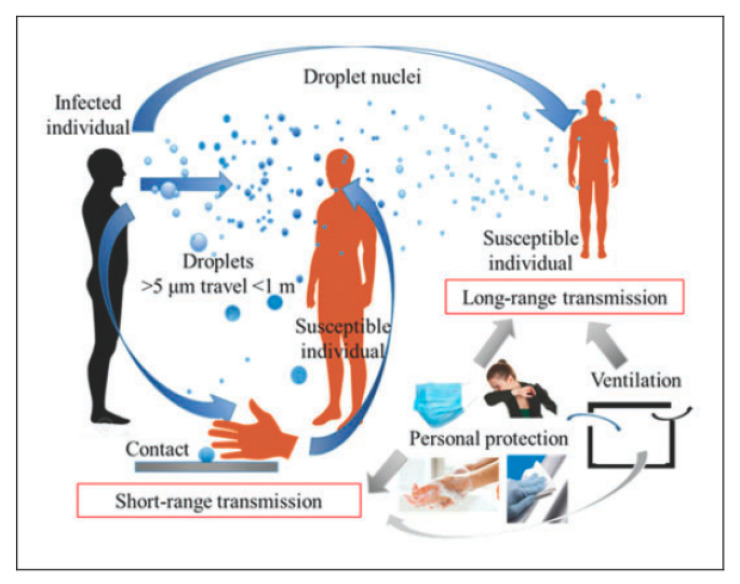
The multiple modes of SARS-CoV-2 transmission including airborne, droplet, contact, and fecal-oral transmissions that cause coronavirus disease 2019 (COVID-19) contribute to a public threat to the lives of people worldwide. Herein, different databases are reviewed to evaluate modes of transmission of SARS-CoV-2 and study the effects of negative pressure ventilation, air conditioning system, and related protection approaches of this virus. Droplet transmission was commonly reported to occur in particles with diameter >5 µm that can quickly settle gravitationally on surfaces (1-2 m). Instead, fine and ultrafine particles (airborne transmission) can stay suspended for an extended period of time (≥2 h) and be transported further, e.g., up to 8 m through simple diffusion and convection mechanisms. Droplet and airborne transmission of SARS-CoV-2 can be limited indoors with adequate ventilation of rooms, by routine disinfection of toilets, using negative pressure rooms, using face masks, and maintaining social distancing. Other preventive measures recommended include increasing the number of screening tests of suspected carriers of SARS-CoV-2, reducing the number of persons in a room to minimize sharing indoor air, and monitoring people's temperature before accessing a building. The work reviews a body of literature supporting the transmission of SARS-CoV-2 through air, causing COVID-19 disease, which requires coordinated worldwide strategies.
SARS-CoV-2 的多种传播模式,包括空气传播、飞沫传播、接触传播和粪-口传播,导致了 2019 年冠状病毒病(COVID-19),对全世界人民的生命构成了公共威胁。在此,我们回顾了不同的数据库,以评估 SARS-CoV-2 的传播模式,并研究负压通风、空调系统以及该病毒相关防护措施的效果。飞沫传播通常发生在直径>5 µm 的颗粒上,这些颗粒可以迅速因重力沉降在表面上(1-2 m)。相比之下,细小和超细颗粒(空气传播)可以长时间(≥2 h)悬浮,并通过简单的扩散和对流机制进一步传输,例如,通过空气传播可以达到 8 m 远。通过充分通风房间、常规消毒厕所、使用负压房间、使用口罩和保持社交距离,可以在室内限制 SARS-CoV-2 的飞沫和空气传播。其他推荐的预防措施包括增加对 SARS-CoV-2 疑似携带者的筛查测试次数、减少室内空气共享人数,以及在进入建筑物前监测人员的体温。这项工作综述了支持 SARS-CoV-2 通过空气传播并导致 COVID-19 疾病的文献,这需要全球协调的策略。