Immunity and Cancer Laboratory, Francis Crick Institute, London NW1 1AT, United Kingdom;
Immunity and Cancer Laboratory, Francis Crick Institute, London NW1 1AT, United Kingdom.
Proc Natl Acad Sci U S A. 2021 Jan 12;118(2). doi: 10.1073/pnas.2016425118.
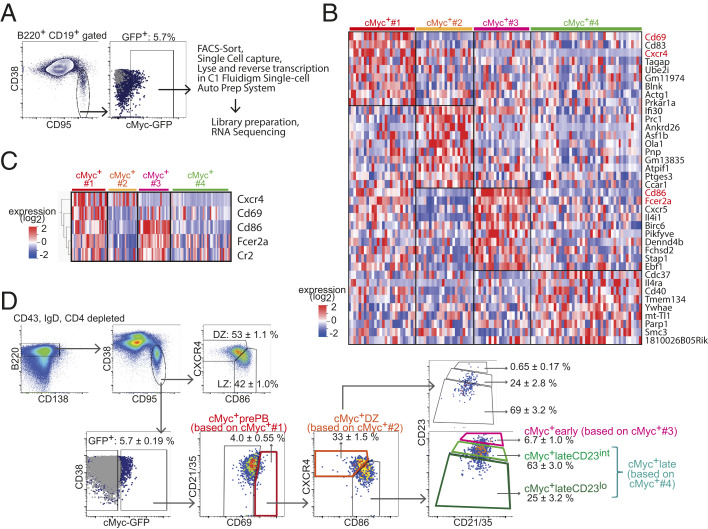
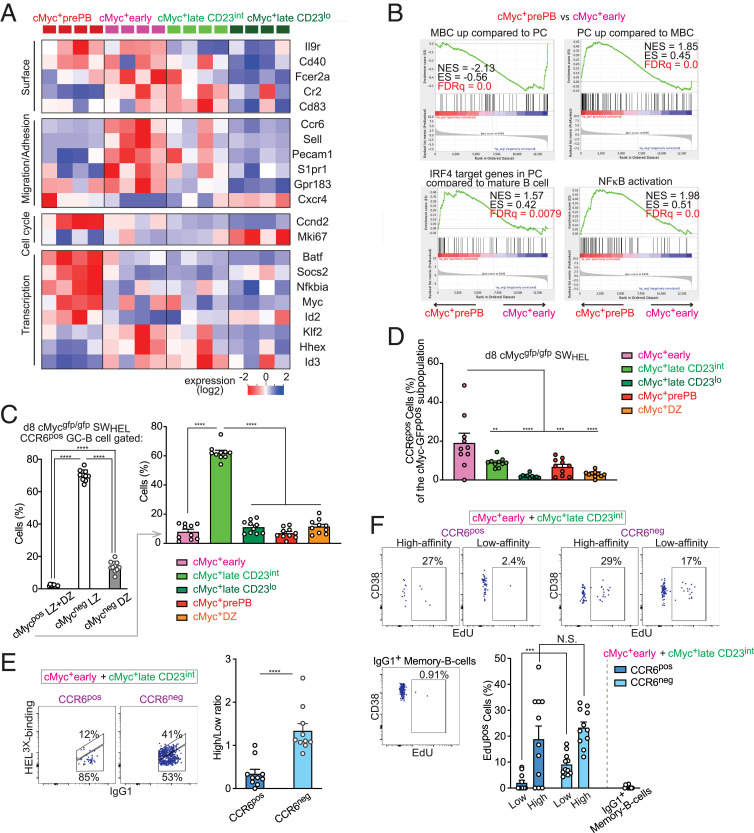
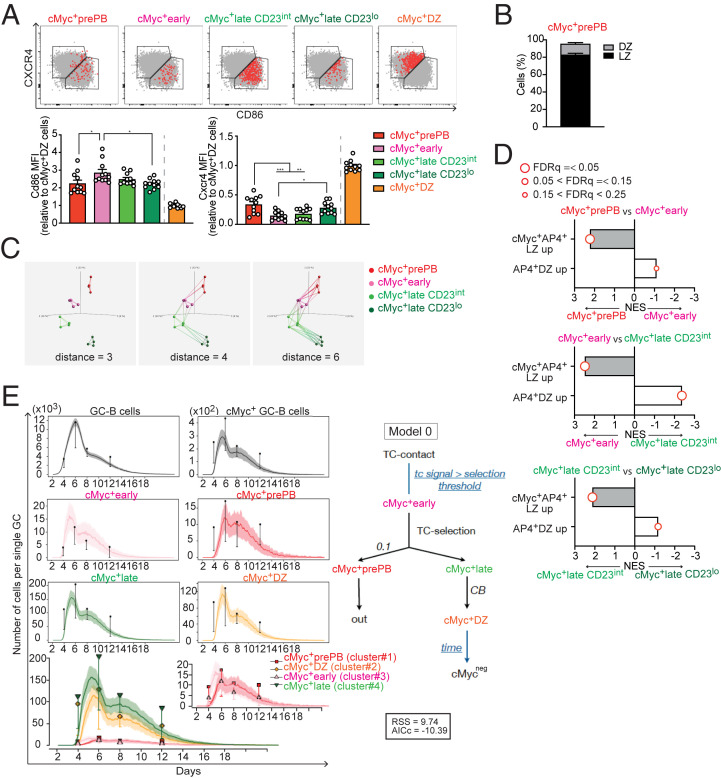
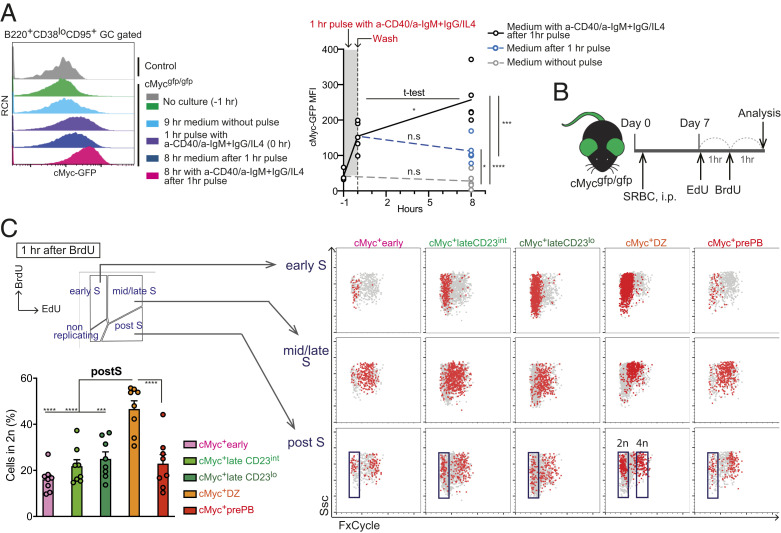
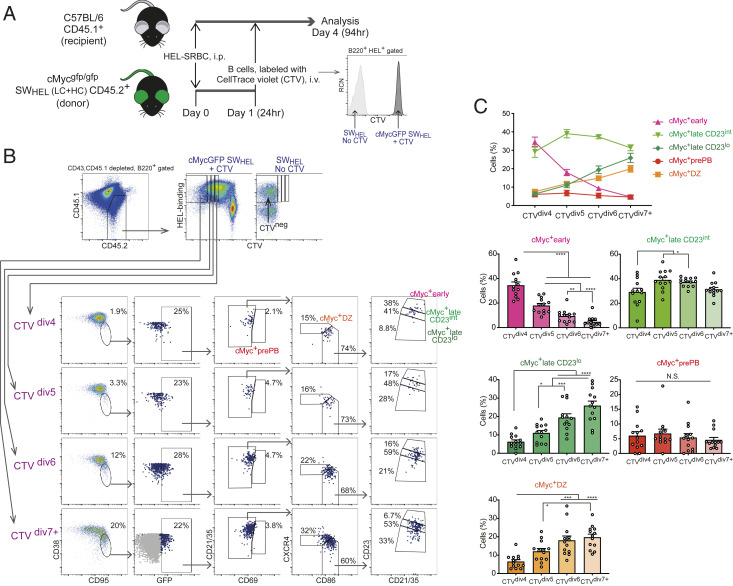
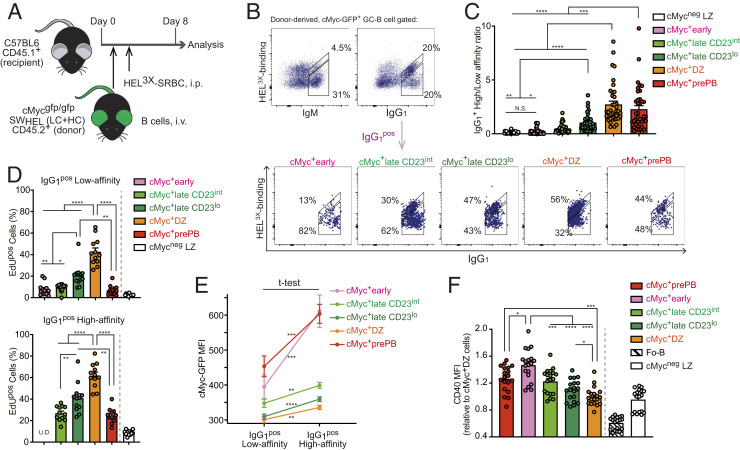
Affinity maturation depends on how efficiently germinal centers (GCs) positively select B cells in the light zone (LZ). Positively selected GC B cells recirculate between LZs and dark zones (DZs) and ultimately differentiate into plasmablasts (PBs) and memory B cells (MBCs). Current understanding of the GC reaction presumes that cMyc-dependent positive selection of LZ B cells is a competitive affinity-dependent process; however, this cannot explain the production of GC-derived lower-affinity MBCs or retention of GC B cells with varied affinities. Here, by combining single-cell/bulk RNA sequencing and flow cytometry, we identified and characterized temporally and functionally distinct positively selected cMyc GC B cell subpopulations. cMyc LZ B cell subpopulations enriched with either higher- or lower-affinity cells diverged soon after permissive positive selection. The former subpopulation contained PB precursors, whereas the latter comprised less proliferative MBC precursors and future DZ entrants. The overall affinity of future DZ entrants was enhanced in the LZ through preferential proliferation of higher-affinity cells. Concurrently, lower-affinity cells were retained in GCs and protected from apoptosis. These findings redefine positive selection as a dynamic process generating three distinct B cell fates and elucidate how positive selection ensures clonal diversity for broad protection.
亲和力成熟依赖于生发中心(GC)在亮区(LZ)中有效选择 B 细胞的能力。被阳性选择的 GC B 细胞在 LZ 和暗区(DZ)之间循环,并最终分化为浆母细胞(PB)和记忆 B 细胞(MBC)。目前对 GC 反应的理解假定 cMyc 依赖性的 LZ B 细胞阳性选择是一个竞争亲和力依赖的过程;然而,这并不能解释 GC 衍生的低亲和力 MBC 的产生或保留具有不同亲和力的 GC B 细胞。在这里,我们通过结合单细胞/批量 RNA 测序和流式细胞术,鉴定并描述了具有不同时间和功能的阳性选择 cMyc GC B 细胞亚群。在许可性阳性选择后不久,富含高亲和力或低亲和力细胞的 cMyc LZ B 细胞亚群就发生了分化。前者包含 PB 前体,而后者则包含增殖能力较低的 MBC 前体和未来的 DZ 进入者。通过高亲和力细胞的优先增殖,未来 DZ 进入者的整体亲和力在 LZ 中得到增强。同时,低亲和力细胞在 GC 中被保留下来,并免受凋亡的影响。这些发现将阳性选择重新定义为一个产生三种不同 B 细胞命运的动态过程,并阐明了阳性选择如何确保广泛保护的克隆多样性。