Nakagawa Rinako, Llorian Miriam, Varsani-Brown Sunita, Chakravarty Probir, Camarillo Jeannie M, Barry David, George Roger, Blackledge Neil P, Duddy Graham, Kelleher Neil L, Klose Robert J, Turner Martin, Calado Dinis P
Immunity and Cancer Laboratory, Francis Crick Institute, London, UK.
Bioinformatics and Biostatistics Laboratory, Francis Crick Institute, London, UK.
Nat Commun. 2024 Dec 3;15(1):10516. doi: 10.1038/s41467-024-54937-0.
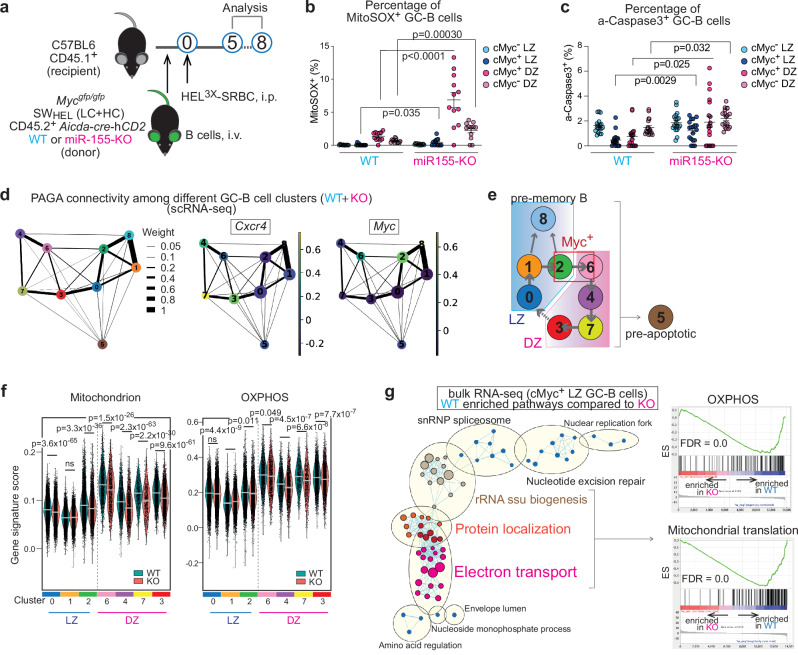
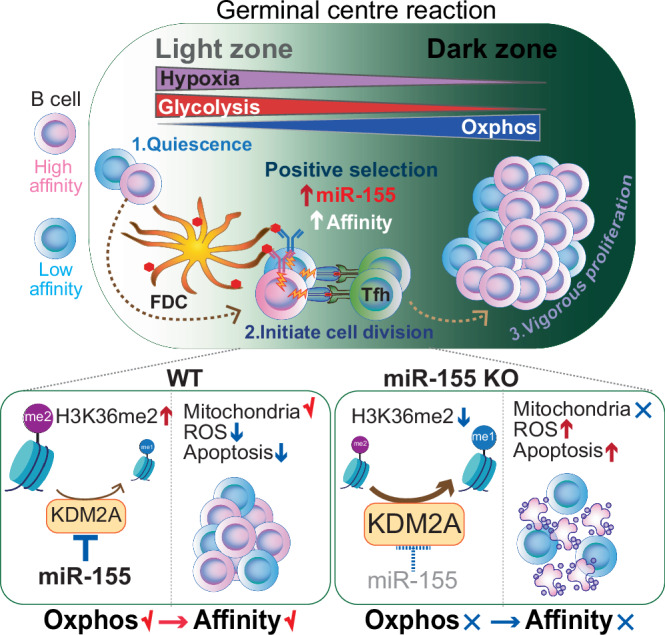
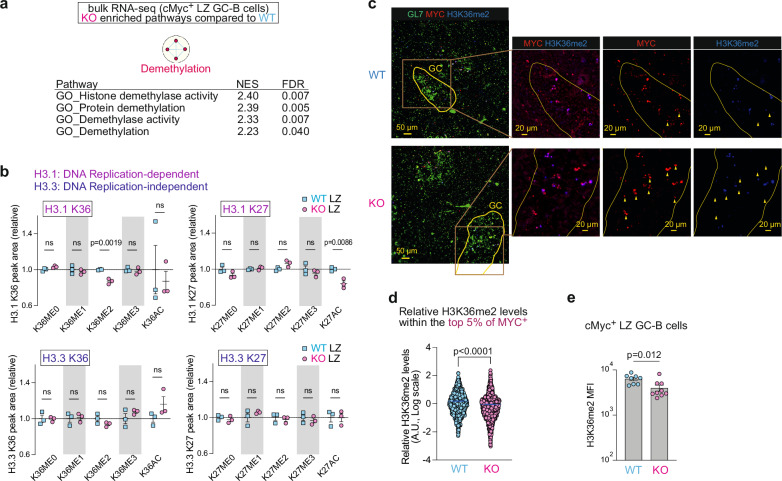
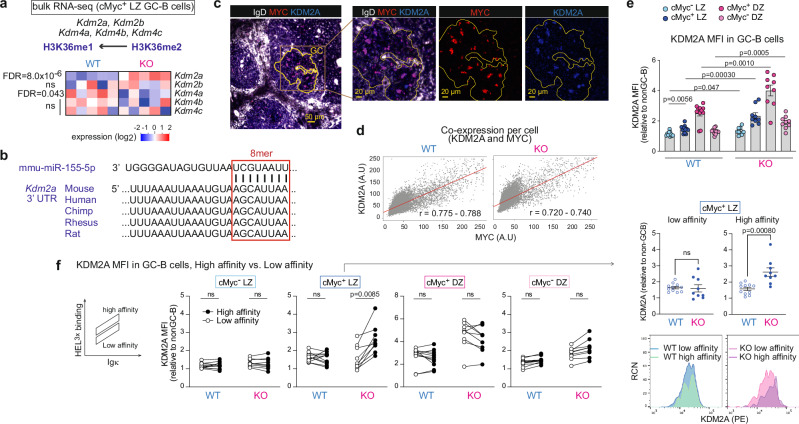
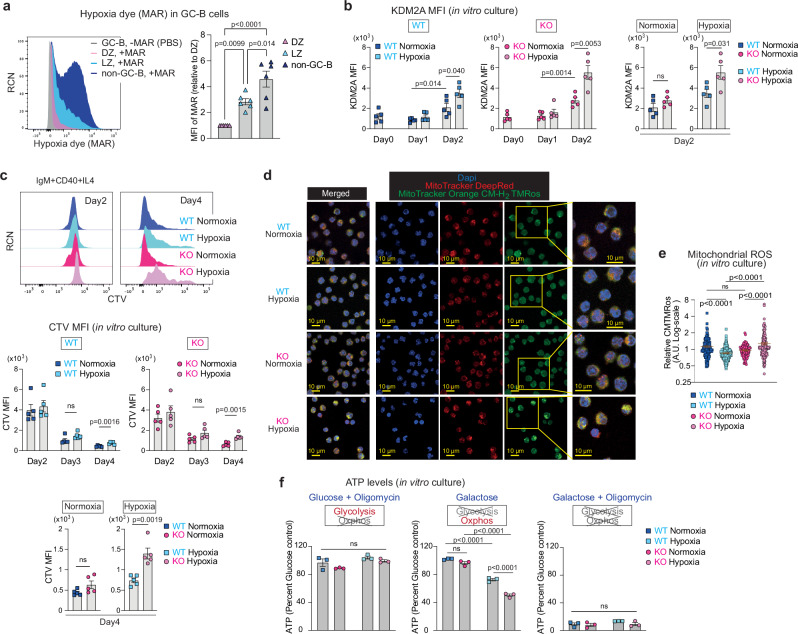
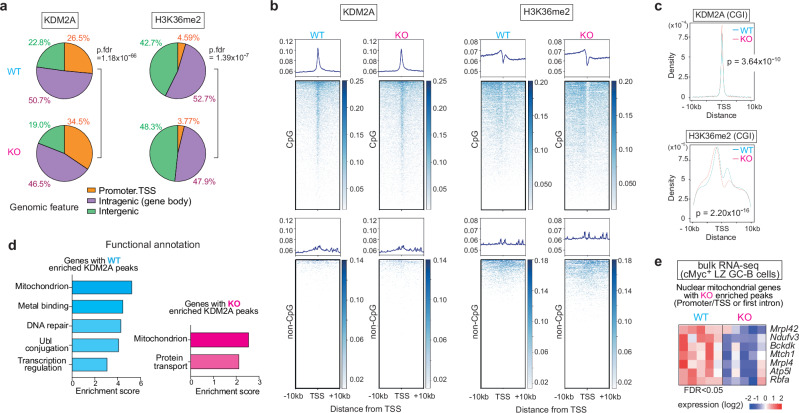
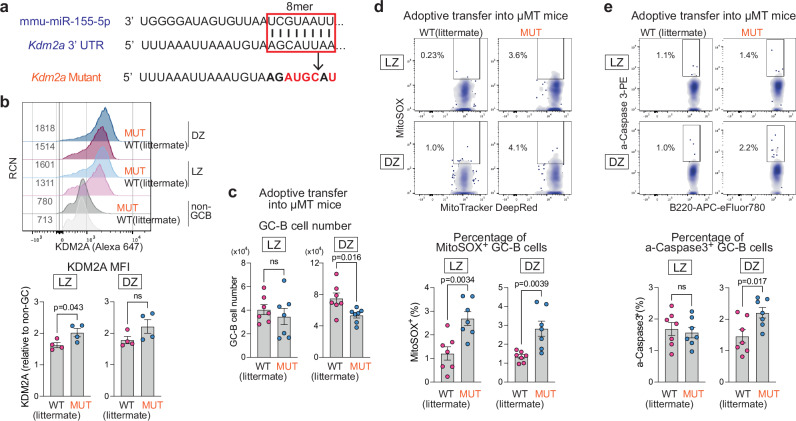
To increase antibody affinity against pathogens, positively selected GC-B cells initiate cell division in the light zone (LZ) of germinal centers (GCs). Among these, higher-affinity clones migrate to the dark zone (DZ) and vigorously proliferate by utilizing energy provided by oxidative phosphorylation (OXPHOS). However, it remains unknown how positively selected GC-B cells adapt their metabolism for cell division in the glycolysis-dominant, cell cycle arrest-inducing, hypoxic LZ microenvironment. Here, we show that microRNA (miR)-155 mediates metabolic reprogramming during positive selection to protect high-affinity clones. Mechanistically, miR-155 regulates H3K36me2 levels in hypoxic conditions by directly repressing the histone lysine demethylase, Kdm2a, whose expression increases in response to hypoxia. The miR-155-Kdm2a interaction is crucial for enhancing OXPHOS through optimizing the expression of vital nuclear mitochondrial genes under hypoxia, thereby preventing excessive production of reactive oxygen species and subsequent apoptosis. Thus, miR-155-mediated epigenetic regulation promotes mitochondrial fitness in high-affinity GC-B cells, ensuring their expansion and consequently affinity maturation.
为了增强对抗病原体的抗体亲和力,经过阳性选择的生发中心B(GC-B)细胞在生发中心(GC)的亮区(LZ)启动细胞分裂。其中,亲和力较高的克隆迁移至暗区(DZ),并通过利用氧化磷酸化(OXPHOS)提供的能量进行旺盛增殖。然而,目前尚不清楚经过阳性选择的GC-B细胞如何在以糖酵解为主、诱导细胞周期停滞、低氧的LZ微环境中调整其代谢以进行细胞分裂。在此,我们表明微小RNA(miR)-155在阳性选择过程中介导代谢重编程以保护高亲和力克隆。从机制上讲,miR-155通过直接抑制组蛋白赖氨酸去甲基化酶Kdm2a来调节低氧条件下的H3K36me2水平,Kdm2a的表达会因低氧而增加。miR-155与Kdm2a的相互作用对于在低氧条件下通过优化重要的核线粒体基因的表达来增强OXPHOS至关重要,从而防止活性氧的过度产生及随后的细胞凋亡。因此,miR-155介导的表观遗传调控促进了高亲和力GC-B细胞的线粒体适应性,确保它们的扩增以及随后的亲和力成熟。