Fernández-González Marta, Agulló Vanesa, de la Rica Alba, Infante Ana, Carvajal Mar, García José Alberto, Gonzalo-Jiménez Nieves, Cuartero Claudio, Ruiz-García Montserrat, de Gregorio Carlos, Sánchez Manuel, Masiá Mar, Gutiérrez Félix
Infectious Diseases Unit, Hospital General Universitario de Elche, Elche, Spain.
Microbiology Service, Hospital General Universitario de Elche, Elche, Spain.
J Clin Microbiol. 2021 Mar 19;59(4). doi: 10.1128/JCM.03033-20.
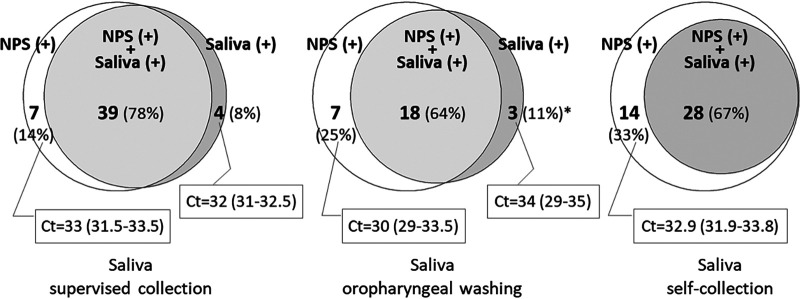
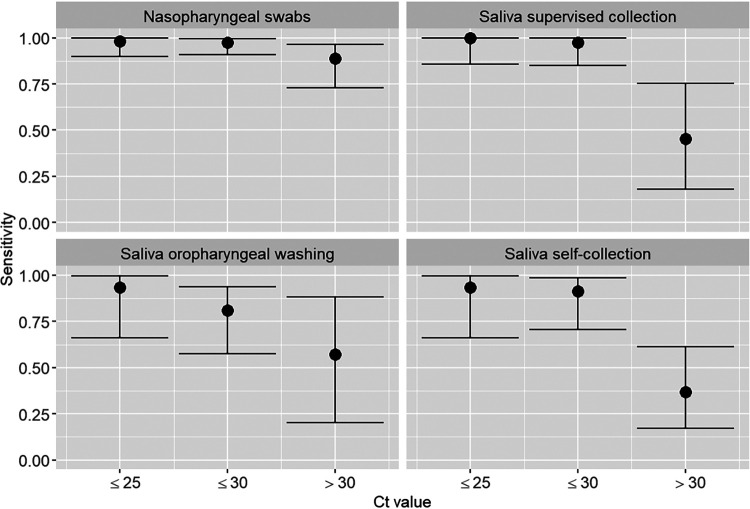
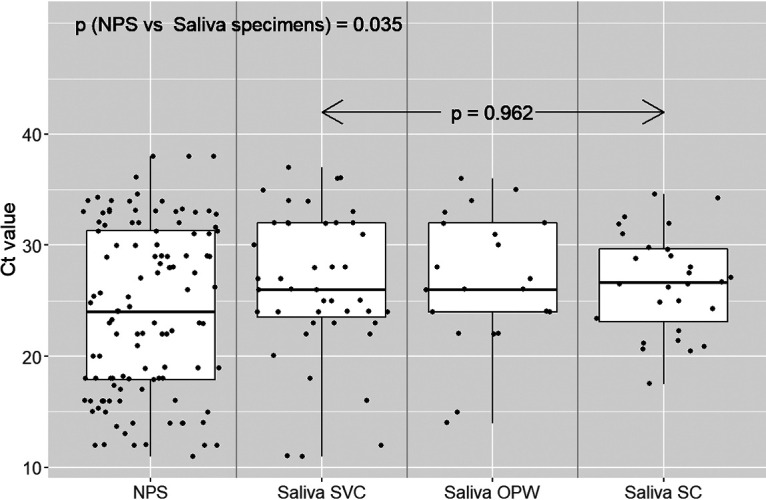
Data on the performance of saliva specimens for diagnosing coronavirus disease 2019 (COVID-19) in ambulatory patients are scarce and inconsistent. We assessed saliva-based specimens for detecting severe acute respiratory syndrome coronavirus 2 (SARS-CoV-2) by reverse transcriptase PCR (RT-PCR) in the community setting and compared three different collection methods. This prospective study was conducted in three primary care centers. RT-PCR was performed on paired nasopharyngeal swabs (NPS) and saliva samples collected from outpatients with a broad clinical spectrum of illness. To assess differences in collection methods, saliva specimens were obtained in a different way in each of the participating centers: supervised collection (SVC), oropharyngeal washing (OPW), and self-collection (SC). Pairs of NPS and saliva samples from 577 patients (median age, 39 years; 44% men; 42% asymptomatic) were collected and tested, and 120 (20.8%) gave positive results. The overall agreement with NPS results and kappa coefficients (κ) for saliva samples obtained by SVC, OPW, and SC were 95% (κ = 0.85), 93.4% (κ = 0.76), and 93.3% (κ = 0.76), respectively. The sensitivities (95% confidence intervals [95% CI]) of the saliva specimens ranged from 86% (72.6% to 93.7%) for SVC to 66.7% (50.4% to 80%) for SC samples. Sensitivity was higher for samples with lower cycle threshold ( ) values. The best RT-PCR performance was observed for SVC, with sensitivities (95% CI) of 100% (85.9% to 100%) in symptomatic individuals and 88.9% (50.7% to 99.4%) in asymptomatic individuals at values of ≤30. We conclude that saliva is an acceptable specimen for the detection of SARS-CoV-2 in the community setting. Specimens collected under supervision perform comparably to NPS and can effectively identify individuals at higher risk of transmission under real-life conditions.
关于门诊患者唾液样本用于诊断2019冠状病毒病(COVID-19)的性能数据稀缺且不一致。我们在社区环境中通过逆转录聚合酶链反应(RT-PCR)评估了基于唾液的样本用于检测严重急性呼吸综合征冠状病毒2(SARS-CoV-2)的情况,并比较了三种不同的采集方法。这项前瞻性研究在三个初级保健中心进行。对从患有广泛临床疾病谱的门诊患者中采集的配对鼻咽拭子(NPS)和唾液样本进行RT-PCR检测。为了评估采集方法的差异,在每个参与中心以不同方式获取唾液样本:监督采集(SVC)、口咽冲洗(OPW)和自我采集(SC)。收集并检测了577例患者(中位年龄39岁;44%为男性;42%无症状)的配对NPS和唾液样本,其中120例(20.8%)检测结果为阳性。SVC、OPW和SC获得的唾液样本与NPS结果的总体一致性及kappa系数(κ)分别为95%(κ = 0.85)、93.4%(κ = 0.76)和93.3%(κ = 0.76)。唾液样本的敏感性(95%置信区间[95%CI])范围从SVC的86%(72.6%至93.7%)到SC样本的66.7%(50.4%至80%)。对于循环阈值()值较低的样本,敏感性更高。观察到SVC的RT-PCR性能最佳在≤30时,有症状个体的敏感性(95%CI)为100%(85.9%至100%),无症状个体为88.9%(50.7%至99.4%)。我们得出结论,在社区环境中,唾液是用于检测SARS-CoV-2的可接受样本。在监督下采集的样本与NPS表现相当,并且在实际生活条件下能够有效地识别传播风险较高的个体。