Department of Chemistry, Molecular Sciencess Research Hub, White City Campus, Imperial College London, London, W12 0BZ, UK.
Telomere Replication and Stability group, Medical Research Council - London Institute of Medical Sciences, London, W12 0NN, UK.
Nat Commun. 2021 Jan 8;12(1):162. doi: 10.1038/s41467-020-20414-7.
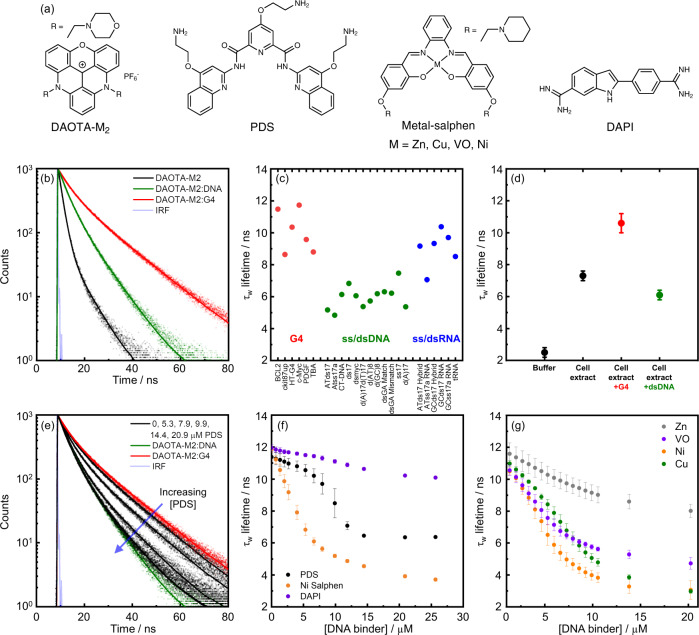
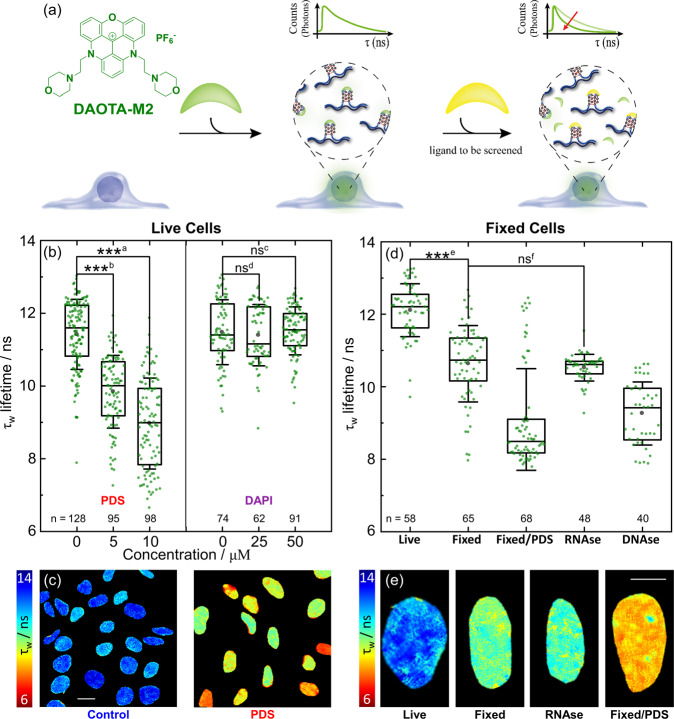
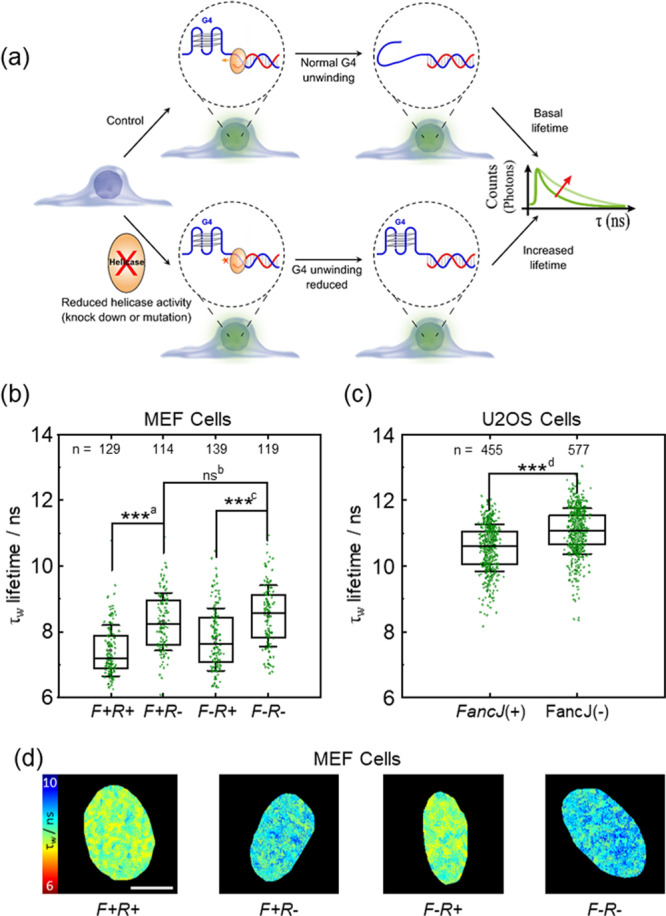
Guanine rich regions of oligonucleotides fold into quadruple-stranded structures called G-quadruplexes (G4s). Increasing evidence suggests that these G4 structures form in vivo and play a crucial role in cellular processes. However, their direct observation in live cells remains a challenge. Here we demonstrate that a fluorescent probe (DAOTA-M2) in conjunction with fluorescence lifetime imaging microscopy (FLIM) can identify G4s within nuclei of live and fixed cells. We present a FLIM-based cellular assay to study the interaction of non-fluorescent small molecules with G4s and apply it to a wide range of drug candidates. We also demonstrate that DAOTA-M2 can be used to study G4 stability in live cells. Reduction of FancJ and RTEL1 expression in mammalian cells increases the DAOTA-M2 lifetime and therefore suggests an increased number of G4s in these cells, implying that FancJ and RTEL1 play a role in resolving G4 structures in cellulo.
寡核苷酸中的鸟嘌呤富集区折叠成称为 G-四链体 (G4s) 的四重螺旋结构。越来越多的证据表明,这些 G4 结构在体内形成,并在细胞过程中发挥关键作用。然而,在活细胞中直接观察它们仍然是一个挑战。在这里,我们证明荧光探针 (DAOTA-M2) 与荧光寿命成像显微镜 (FLIM) 结合使用可以识别活细胞和固定细胞核内的 G4。我们提出了一种基于 FLIM 的细胞测定法来研究非荧光小分子与 G4 的相互作用,并将其应用于广泛的候选药物。我们还证明,DAOTA-M2 可用于研究活细胞中的 G4 稳定性。在哺乳动物细胞中降低 FancJ 和 RTEL1 的表达会增加 DAOTA-M2 的寿命,因此表明这些细胞中的 G4 数量增加,这意味着 FancJ 和 RTEL1 在细胞内解决 G4 结构中发挥作用。