Okada Yohei, Matsuyama Tasuku, Morita Sachiko, Ehara Naoki, Miyamae Nobuhiro, Jo Takaaki, Sumida Yasuyuki, Okada Nobunaga, Watanabe Makoto, Nozawa Masahiro, Tsuruoka Ayumu, Fujimoto Yoshihiro, Okumura Yoshiki, Kitamura Tetsuhisa, Iiduka Ryoji, Ohtsuru Shigeru
Department of Primary Care and Emergency Medicine, Graduate School of Medicine, Kyoto University, ShogoinKawaramachi54, Sakyo, Kyoto, 606-8507, Japan.
Preventive Services, School of Public Health, Kyoto University, Kyoto, Japan.
J Intensive Care. 2021 Jan 9;9(1):6. doi: 10.1186/s40560-021-00525-z.
Accidental hypothermia is a critical condition with high risks of fatal arrhythmia, multiple organ failure, and mortality; however, there is no established model to predict the mortality. The present study aimed to develop and validate machine learning-based models for predicting in-hospital mortality using easily available data at hospital admission among the patients with accidental hypothermia.
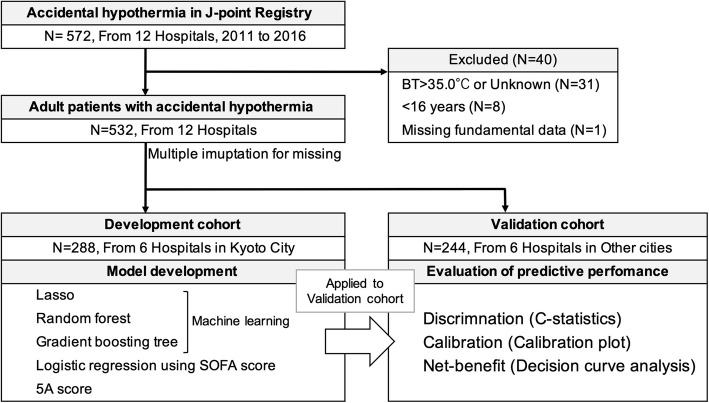
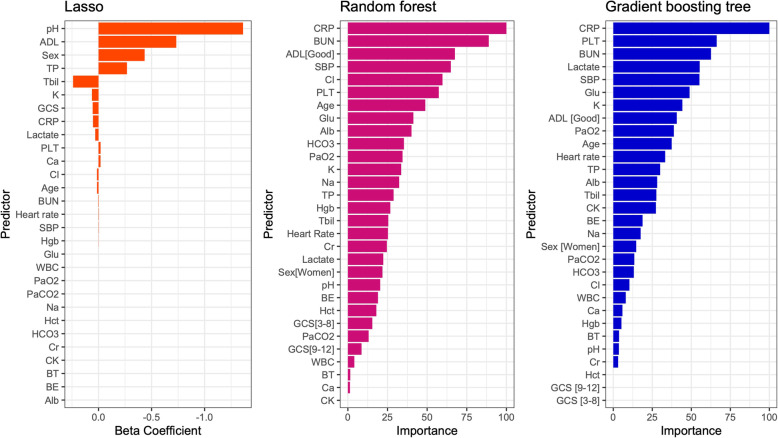
This study was secondary analysis of multi-center retrospective cohort study (J-point registry) including patients with accidental hypothermia. Adult patients with body temperature 35.0 °C or less at emergency department were included. Prediction models for in-hospital mortality using machine learning (lasso, random forest, and gradient boosting tree) were made in development cohort from six hospitals, and the predictive performance were assessed in validation cohort from other six hospitals. As a reference, we compared the SOFA score and 5A score.
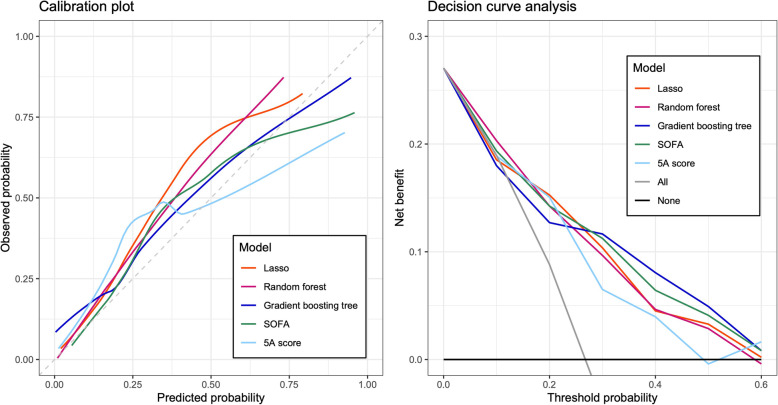
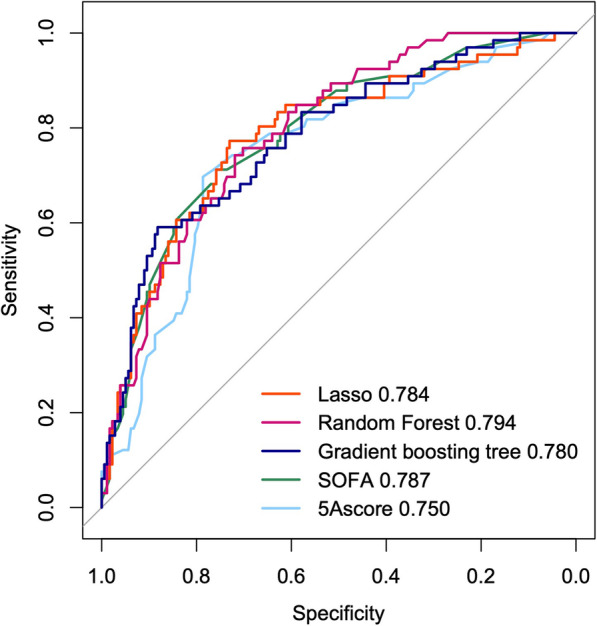
We included total 532 patients in the development cohort [N = 288, six hospitals, in-hospital mortality: 22.0% (64/288)], and the validation cohort [N = 244, six hospitals, in-hospital mortality 27.0% (66/244)]. The C-statistics [95% CI] of the models in validation cohorts were as follows: lasso 0.784 [0.717-0.851] , random forest 0.794[0.735-0.853], gradient boosting tree 0.780 [0.714-0.847], SOFA 0.787 [0.722-0.851], and 5A score 0.750[0.681-0.820]. The calibration plot showed that these models were well calibrated to observed in-hospital mortality. Decision curve analysis indicated that these models obtained clinical net-benefit.
This multi-center retrospective cohort study indicated that machine learning-based prediction models could accurately predict in-hospital mortality in validation cohort among the accidental hypothermia patients. These models might be able to support physicians and patient's decision-making. However, the applicability to clinical settings, and the actual clinical utility is still unclear; thus, further prospective study is warranted to evaluate the clinical usefulness.
意外低温是一种危急情况,存在致命性心律失常、多器官功能衰竭和死亡的高风险;然而,目前尚无预测死亡率的既定模型。本研究旨在开发并验证基于机器学习的模型,以利用意外低温患者入院时易于获取的数据预测院内死亡率。
本研究是对包括意外低温患者的多中心回顾性队列研究(J点登记)的二次分析。纳入急诊科体温35.0°C或更低的成年患者。在来自六家医院的开发队列中建立使用机器学习(套索、随机森林和梯度提升树)预测院内死亡率的模型,并在来自其他六家医院的验证队列中评估预测性能。作为参考,我们比较了序贯器官衰竭评估(SOFA)评分和5A评分。
我们在开发队列中总共纳入532例患者 [N = 288,六家医院,院内死亡率:22.0%(64/288)],以及验证队列 [N = 244,六家医院,院内死亡率27.0%(66/244)]。验证队列中各模型的C统计量[95%置信区间]如下:套索0.784 [0.717 - 0.851],随机森林0.794[0.735 - 0.853],梯度提升树0.780 [0.714 - 0.847],SOFA 0.787 [0.722 - 0.851],以及5A评分0.750[0.681 - 0.820]。校准图显示这些模型与观察到的院内死亡率校准良好。决策曲线分析表明这些模型获得了临床净效益。
这项多中心回顾性队列研究表明,基于机器学习的预测模型能够准确预测意外低温患者验证队列中的院内死亡率。这些模型可能有助于支持医生和患者的决策。然而,其在临床环境中的适用性以及实际临床效用仍不明确;因此,有必要进行进一步的前瞻性研究以评估其临床实用性。