Department of Vascular Medicine, Amsterdam UMC, University of Amsterdam, Amsterdam, Netherlands.
Department of Dermatology, University Medical Center, Johannes Gutenberg University, Mainz, Germany.
Clin Rev Allergy Immunol. 2021 Aug;61(1):66-76. doi: 10.1007/s12016-021-08832-x. Epub 2021 Jan 9.
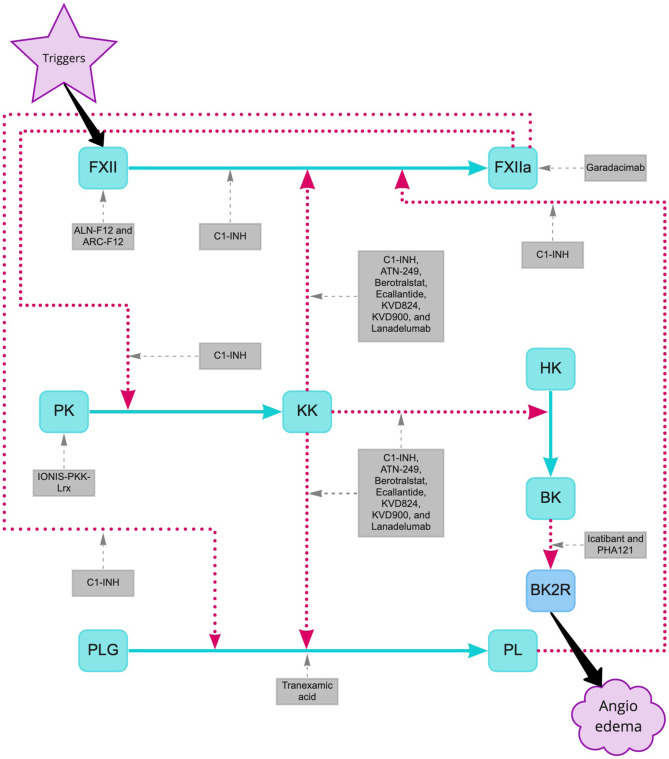
Hereditary angioedema (HAE) is a rare disease that causes episodic attacks of subcutaneous and submucosal edema, which can be painful, incapacitating, and potentially fatal. These attacks are mediated by excessive bradykinin production, as a result of uncontrolled activation of the plasma kallikrein/kinin system, which is caused by a C1 esterase inhibitor deficiency or dysfunction in HAE types 1 and 2, respectively. For many years, treatment options were limited to therapies with substantial adverse effects, insufficient efficacy, or difficult routes of administration. Increased insights in the pathophysiology of HAE have paved the way for the development of new therapies with fewer side effects. In the last two decades, several targeted novel therapeutic strategies for HAE have been developed, for both long-term prophylaxis and on demand treatment of acute attacks. This article reviews the advances in the development of more effective and convenient treatment options for HAE and their anticipated effects on morbidity, mortality, and quality of life. The emergence of these improved treatment options will presumably change current HAE guidelines, but adherence to these recommendations may become restricted by high treatment costs. It will therefore be essential to determine the indications and identify the patients that will benefit most from these newest treatment generations. Ultimately, current preclinical research into gene therapies may eventually lead the way towards curative treatment options for HAE. In conclusion, an increasing shift towards the use of highly effective long-term prophylaxis is anticipated, which should drastically abate the burden on patients with hereditary angioedema.
遗传性血管性水肿(HAE)是一种罕见的疾病,会导致皮下和黏膜下组织间歇性水肿,这种水肿可能会导致疼痛、丧失能力,并可能致命。这些发作是由过度产生缓激肽介导的,这是由于血浆激肽释放酶/激肽系统不受控制的激活所致,这分别是由 HAE 1 型和 2 型的 C1 酯酶抑制剂缺乏或功能障碍引起的。多年来,治疗选择仅限于具有重大不良反应、疗效不足或给药途径困难的疗法。对 HAE 病理生理学的深入了解为开发具有较少副作用的新疗法铺平了道路。在过去的二十年中,已经开发出了几种针对 HAE 的新型靶向治疗策略,用于长期预防和急性发作的按需治疗。本文综述了开发更有效和方便的 HAE 治疗选择的进展,以及它们对发病率、死亡率和生活质量的预期影响。这些改进的治疗选择的出现可能会改变当前的 HAE 指南,但由于治疗费用高昂,可能会限制对这些建议的遵循。因此,确定这些最新治疗方案的适应证并确定最能从中受益的患者至关重要。最终,目前针对基因治疗的临床前研究可能会为 HAE 提供治疗方法。总之,预计会越来越倾向于使用高效的长期预防治疗,这将大大减轻遗传性血管性水肿患者的负担。