Al-Griw Mohamed A, Alghazeer Rabia O, Salama Naser M, Lwaleed Bashir A, Eskandrani Areej A, Alansari Wafa S, Alnajeebi Afnan M, Babteen Nouf A, Shamlan Ghalia, Elnfati Abdul Hakim
Department of Histology and Genetics, Faculty of Medicine, University of Tripoli, Tripoli 13203, Libya.
Department of Chemistry, Faculty of Sciences, University of Tripoli, Tripoli, Libya.
Saudi J Biol Sci. 2021 Jan;28(1):948-955. doi: 10.1016/j.sjbs.2020.11.003. Epub 2020 Nov 11.
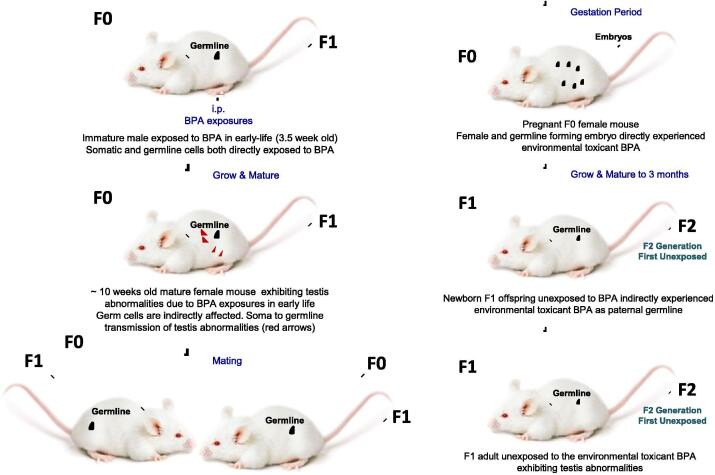
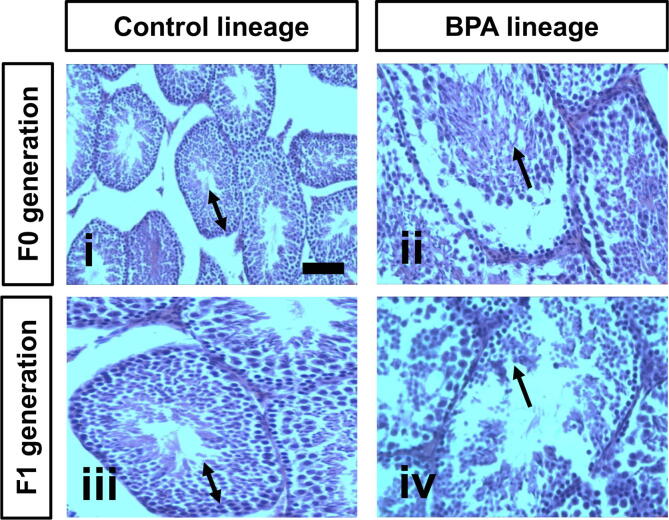
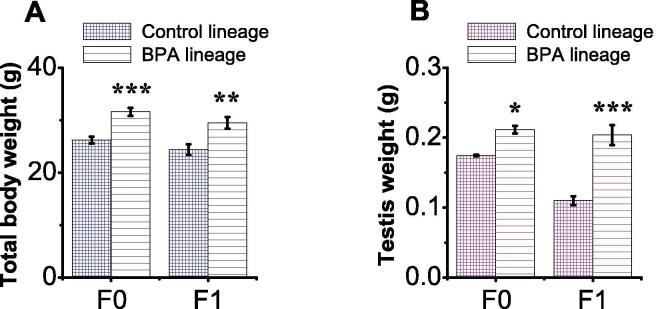
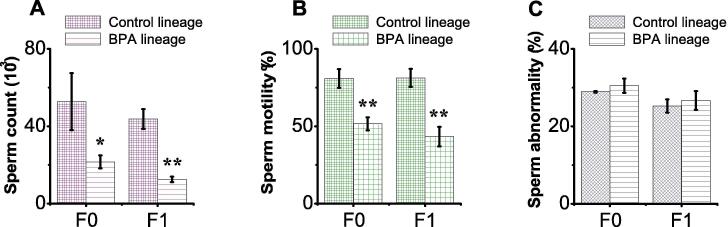
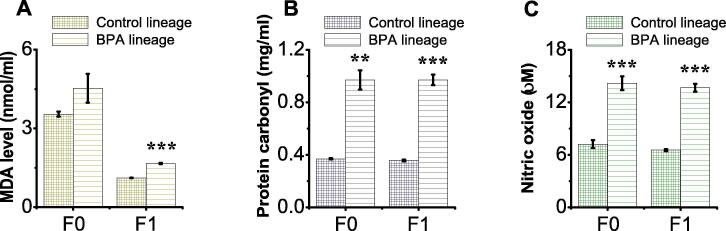
Bisphenol A (BPA), an endocrine and metabolic disruptor, is widely used to manufacture polycarbonate plastics and epoxy resins. Accumulating evidence suggests that paternal BPA exposure adversely affects male germlines and results in atypical reproductive phenotypes that might persist for generations to come. Our study investigated this exposure on testicular architecture and sperm quality in mouse offspring, and characterised underlying molecular mechanism(s). A total of 18 immature male Swiss albino mice (3.5 weeks old) were randomly divided into three groups and treated as follows: Group I, no treatment (sham control); Group II, sterile corn oil only (vehicle control); Group III, BPA (400 μg/kg) in sterile corn oil. At 9.5 weeks old, F0 males were mated with unexposed females. F0 offspring (F1 generation) were monitored for postnatal development for 10 weeks. At 11.5 weeks old, the animals were sacrificed to examine testicular architecture, sperm parameters, including DNA integrity, and oxidative stress biomarkers. Results showed that BPA significantly induced changes in the body and testis weights of the F0 and F1 generation BPA lineages compared to F0 and F1 generation control lineages. A decrease in sperm count and motility with further, increased sperm abnormalities, no or few sperm DNA alterations and elevated levels of MDA, PC and NO were recorded. Similar effects were found in BPA exposed F0 males, but were more pronounced in the F0 offspring. In addition, BPA caused alterations in the testicular architecture. These pathological changes extended transgenerationally to F1 generation males' mice, but the pathological changes were more pronounced in the F1 generation. Our findings demonstrate that the biological and health BPA impacts do not end in paternal adults, but are passed on to offspring generations. Hence, linking observed testis and sperm abnormalities in the F1 generation to BPA exposure of their parental line was evident in this work. The findings also illustrate that oxidative stress appears to be a molecular component of the testis and sperm pathologies.
双酚A(BPA)是一种内分泌和代谢干扰物,广泛用于制造聚碳酸酯塑料和环氧树脂。越来越多的证据表明,父本接触双酚A会对雄性生殖系产生不利影响,并导致可能延续几代人的非典型生殖表型。我们的研究调查了这种接触对小鼠后代睾丸结构和精子质量的影响,并确定了潜在的分子机制。总共18只未成熟的雄性瑞士白化小鼠(3.5周龄)被随机分为三组,并进行如下处理:第一组,不进行处理(假对照);第二组,仅使用无菌玉米油(溶剂对照);第三组,在无菌玉米油中加入双酚A(400μg/kg)。在9.5周龄时,F0雄性小鼠与未接触过双酚A的雌性小鼠交配。对F0后代(F1代)进行10周的出生后发育监测。在11.5周龄时,处死动物以检查睾丸结构、精子参数(包括DNA完整性)和氧化应激生物标志物。结果表明,与F0和F1代对照谱系相比,双酚A显著诱导了F0和F1代双酚A谱系的体重和睾丸重量变化。精子数量和活力下降,精子异常进一步增加,未发现或仅有少量精子DNA改变,丙二醛、磷脂酰胆碱和一氧化氮水平升高。在接触双酚A的F0雄性小鼠中也发现了类似的影响,但在F0后代中更为明显。此外,双酚A导致睾丸结构改变。这些病理变化跨代延伸至F1代雄性小鼠,但在F1代中更为明显。我们的研究结果表明,双酚A对生物和健康的影响并不止于成年父本,而是会传递给后代。因此,在这项研究中,F1代观察到的睾丸和精子异常与它们亲代谱系接触双酚A之间的联系是明显的。研究结果还表明,氧化应激似乎是睾丸和精子病理的分子组成部分。