Yuan Shuai, Zhang Ye, Dong Pei-Yu, Chen Yan Yu-Mei, Liu Jing, Zhang Bing-Qiang, Chen Meng-Meng, Zhang Shu-Er, Zhang Xi-Feng
College of Veterinary Medicine, Qingdao Agricultural University, Qingdao, 266109, China.
Advanced Medical Research Institute, Shandong University, Jinan, Shandong, 250014, China.
Heliyon. 2024 Jul 19;10(15):e34975. doi: 10.1016/j.heliyon.2024.e34975. eCollection 2024 Aug 15.
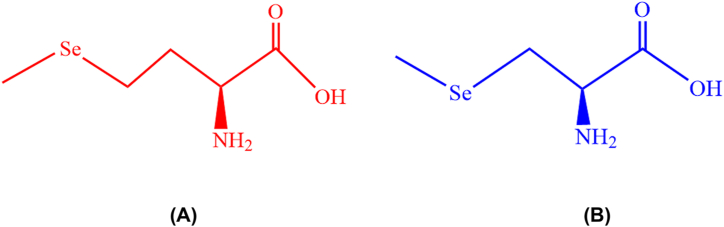
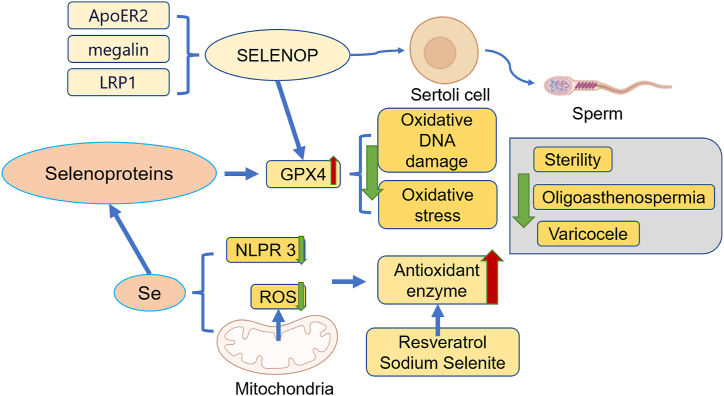
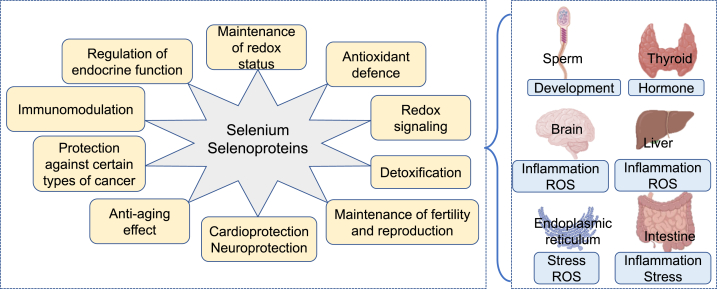
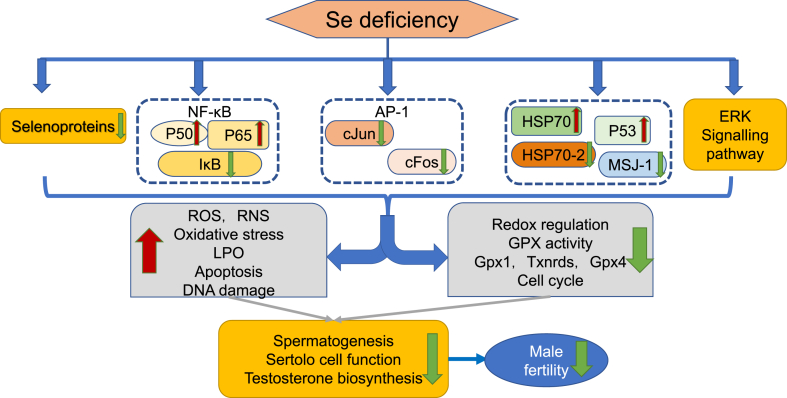
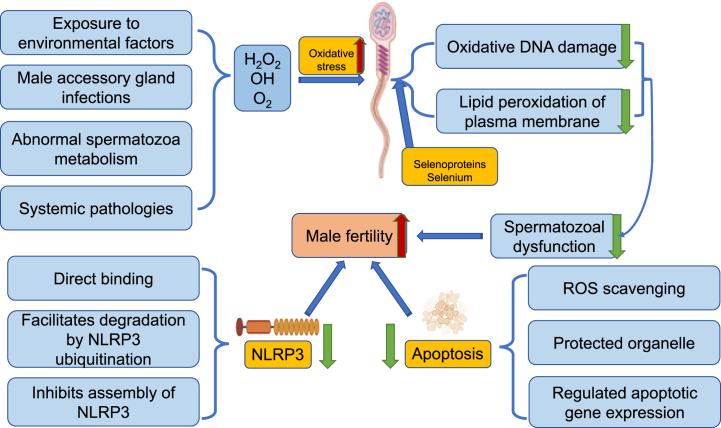
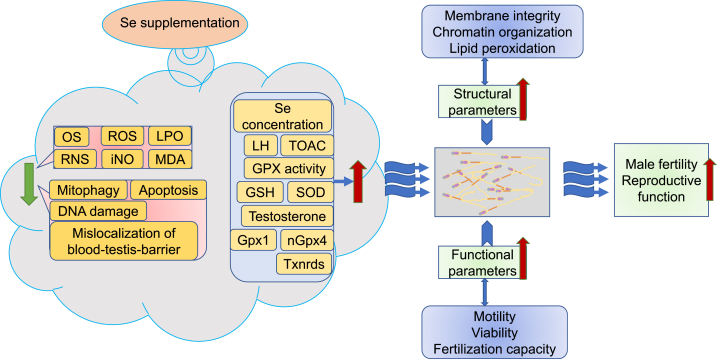
Selenium (Se), a component of selenoproteins and selenocompounds in the human body, is crucial for the development of male reproductive organs, DNA synthesis, thyroid hormone, metabolism, and defence against infections and oxidative damage. In the testis, it must exceed a desirable level since either a shortage or an overabundance causes aberrant growth. The antioxidant properties of selenium are essential for preserving human reproductive health. Selenoproteins, which have important structural and enzymatic properties, control the biological activities of Se primarily. These proteins specifically have a role in metabolism and a variety of cellular processes, such as the control of selenium transport, thyroid hormone metabolism, immunity, and redox balance. Selenium nanoparticles (SeNPs) are less hazardous than selenium-based inorganic and organic materials. Upon being functionalized with active targeting ligands, they are both biocompatible and capable of efficiently delivering combinations of payloads to particular cells. In this review, we discuss briefly the chemistry, structure and functions of selenium and milestones of selenium and selenoproteins. Next we discuss the various factors influences male infertility, biological functions of selenium and selenoproteins, and role of selenium and selenoproteins in spermatogenesis and male fertility. Furthermore, we discuss the molecular mechanism of selenium transport and protective effects of selenium on oxidative stress, apoptosis and inflammation. We also highlight critical contribution of selenium nanoparticles on male fertility and spermatogenesis. Finally ends with conclusion and future perspectives.
硒(Se)是人体中硒蛋白和硒化合物的组成成分,对男性生殖器官发育、DNA合成、甲状腺激素、新陈代谢以及抵御感染和氧化损伤至关重要。在睾丸中,它必须超过理想水平,因为短缺或过量都会导致异常生长。硒的抗氧化特性对维护人类生殖健康至关重要。硒蛋白具有重要的结构和酶特性,主要控制硒的生物活性。这些蛋白质在新陈代谢和各种细胞过程中发挥特定作用,如控制硒运输、甲状腺激素代谢、免疫和氧化还原平衡。硒纳米颗粒(SeNPs)比基于硒的无机和有机材料危害更小。在用活性靶向配体进行功能化后,它们既具有生物相容性,又能够有效地将多种载荷组合递送至特定细胞。在本综述中,我们简要讨论硒的化学、结构和功能以及硒和硒蛋白的发展历程。接下来我们讨论影响男性不育的各种因素、硒和硒蛋白的生物学功能,以及硒和硒蛋白在精子发生和男性生育中的作用。此外,我们还讨论硒运输的分子机制以及硒对氧化应激、细胞凋亡和炎症的保护作用。我们还强调了硒纳米颗粒对男性生育和精子发生的关键贡献。最后给出结论和未来展望。