Thelen Mitchell, Brown-Borg Holly M
Department of Biomedical Sciences, University of North Dakota School of Medicine and Health Sciences, Grand Forks, ND, United States.
Front Aging Neurosci. 2020 Dec 23;12:617071. doi: 10.3389/fnagi.2020.617071. eCollection 2020.
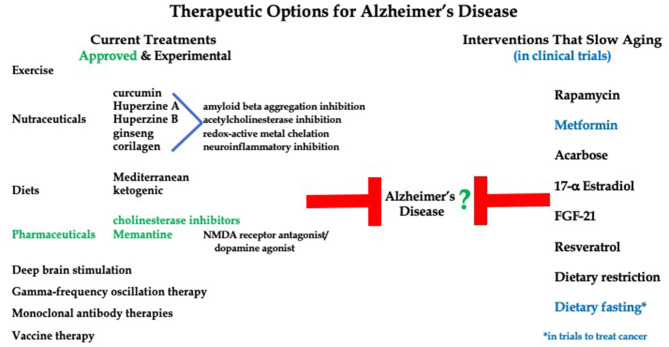
The aging process causes many changes to the brain and is a major risk factor for the development of neurodegenerative diseases such as Alzheimer's Disease (AD). Despite an already vast amount of research on AD, a greater understanding of the disease's pathology and therapeutic options are desperately needed. One important distinction that is also in need of further study is the ability to distinguish changes to the brain observed in early stages of AD vs. changes that occur with normal aging. Current FDA-approved therapeutic options for AD patients have proven to be ineffective and indicate the need for alternative therapies. Aging interventions including alterations in diet (such as caloric restriction, fasting, or methionine restriction) have been shown to be effective in mediating increased health and lifespan in mice and other model organisms. Because aging is the greatest risk factor for the development of neurodegenerative diseases, certain dietary interventions should be explored as they have the potential to act as a future treatment option for AD patients.
衰老过程会给大脑带来许多变化,并且是神经退行性疾病(如阿尔茨海默病,简称AD)发生发展的主要风险因素。尽管针对AD已有大量研究,但仍迫切需要更深入地了解该疾病的病理及治疗方案。另一个同样需要进一步研究的重要区别在于,能否区分AD早期阶段大脑所观察到的变化与正常衰老过程中发生的变化。目前美国食品药品监督管理局(FDA)批准的针对AD患者的治疗方案已被证明无效,这表明需要替代疗法。包括饮食改变(如热量限制、禁食或蛋氨酸限制)在内的衰老干预措施已被证明在调节小鼠和其他模式生物的健康状况及延长寿命方面有效。由于衰老是神经退行性疾病发生发展的最大风险因素,因此应探索某些饮食干预措施,因为它们有可能成为未来AD患者的治疗选择。