Kim Shengshu, Lee Ho Jun, Park Joong Hyun, Kim Taeyeon, Nam Kiyeun
Department of Physical Medicine and Rehabilitation, Dongguk University Ilsan Hospital, Dongguk University College of Medicine, Goyang-si, South Korea.
Department of Neurology, Inje University Sanggye Paik Hospital, Inje University College of Medicine, Seoul-si, South Korea.
Front Med (Lausanne). 2020 Nov 30;7:577301. doi: 10.3389/fmed.2020.577301. eCollection 2020.
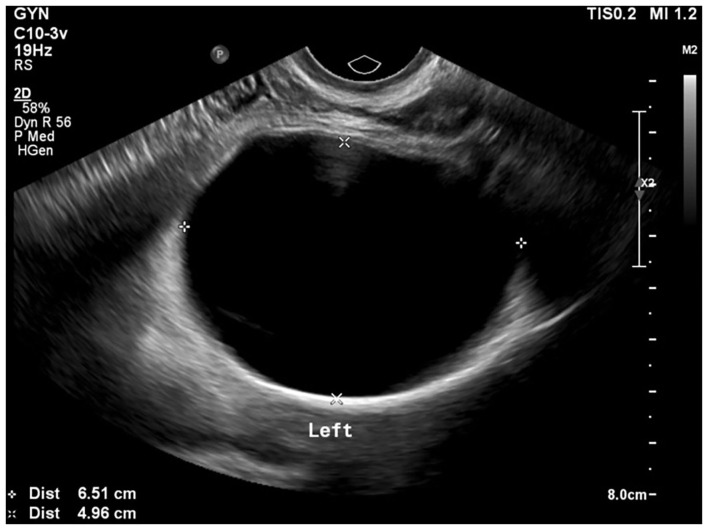
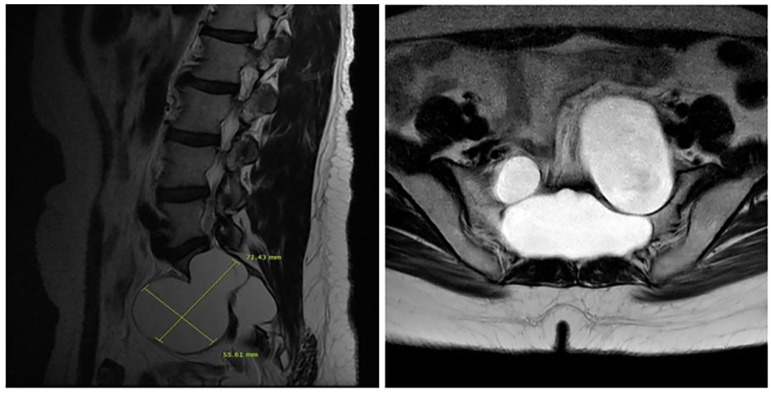
A Tarlov cyst (TC) is a perineural cyst filled with cerebrospinal fluid that originates from the dorsal ganglion or the spinal posterior nerve root. TCs are usually asymptomatic and incidentally found in the sacral region. Endopelvic extension of TCs is uncommon and can be misdiagnosed as an adnexal mass on gynecological ultrasound imaging. We performed a search for all clinical studies of TCs that mimicked adnexal masses that had been published through October 12, 2020. We placed no restrictions on language or year of publication in our search, and we performed searches with the following keywords: perineural cyst, Tarlov cyst, sclerotherapy, management, and prognosis. We included all misdiagnosed cases or cases considered as adnexal masses on pelvic sonography. We identified 21 cases of TCs mimicking adnexal masses and conducted a comprehensive analysis of these 21 cases to assess the epidemiology, symptoms, initial diagnoses, provisional ultrasound diagnoses, confirmative modalities, sizes, locations, treatments, and outcomes. The 21 cases included 16 symptomatic cases (76%) and 5 cases with incidental findings (24%), and the average patient age was 41.3 years. The initial diagnosis was performed with ultrasonography in all cases. The most frequent misdiagnosis was unspecified adnexal mass. Confirmative diagnostic modalities were MRI only (67%), CT only (5%), and both MRI and CT (28%). Treatments were surgery (33%), conservative treatment (19%), percutaneous intervention (5%), and alcohol sclerotherapy (5%). In two symptomatic cases misdiagnosed as pelvic masses, cystectomy was performed and leakage of cerebrospinal fluid occurred, necessitating repair of the leak. In one of the asymptomatic patients, cauda equina syndrome occurred after alcohol sclerotherapy for misdiagnosed TC. However, the patient improved with no neurologic deficit after 18 months of conservative treatment. The possibility of large TCs should be considered when assessing adnexal masses in sonography. Since TCs can masquerade as pelvic masses, they should be considered if the mass appears tubular/cystic or multilocular/multiseptate, does not move with respiration, and originates from the sacrum in sonography with or without neurologic symptoms. Accurate diagnosis can prevent medical mismanagement and reduce patient discomfort.
塔尔洛夫囊肿(TC)是一种充满脑脊液的神经周围囊肿,起源于背根神经节或脊髓后神经根。TC通常无症状,多在骶骨区域偶然发现。TC向盆腔内延伸并不常见,在妇科超声检查中可能被误诊为附件包块。我们检索了截至2020年10月12日发表的所有将TC误诊为附件包块的临床研究。检索时对语言和发表年份均无限制,使用了以下关键词进行检索:神经周围囊肿、塔尔洛夫囊肿、硬化疗法、治疗及预后。我们纳入了所有误诊病例或在盆腔超声检查中被视为附件包块的病例。我们确定了21例将TC误诊为附件包块的病例,并对这21例病例进行了全面分析,以评估其流行病学、症状、初始诊断、初步超声诊断、确诊方式、大小、位置、治疗及结局。这21例病例包括16例有症状的病例(76%)和5例偶然发现的病例(24%),患者平均年龄为41.3岁。所有病例均首先通过超声进行初始诊断。最常见的误诊是未明确的附件包块。确诊诊断方式仅为MRI的占67%,仅为CT的占5%,MRI和CT两者均有的占28%。治疗方法包括手术(33%)、保守治疗(19%)、经皮介入(5%)和酒精硬化疗法(5%)。在2例被误诊为盆腔包块的有症状病例中,进行了囊肿切除术,出现了脑脊液漏,需要对漏口进行修复。在1例无症状患者中,因误诊的TC接受酒精硬化疗法后出现了马尾综合征。然而,经过18个月的保守治疗,患者病情好转,无神经功能缺损。在超声评估附件包块时,应考虑到存在大TC的可能性。由于TC可伪装成盆腔包块,因此当包块在超声检查中表现为管状/囊性或多房/多隔、不随呼吸移动且起源于骶骨时,无论有无神经症状,均应考虑到TC的可能。准确诊断可避免医疗管理不当并减轻患者不适。