Li Wei, Xiao Lihua
Heilongjiang Key Laboratory for Zoonosis, College of Veterinary Medicine, Northeast Agricultural University, Harbin, Heilongjiang, China.
Center for Emerging and Zoonotic Diseases, College of Veterinary Medicine, South China Agricultural University, Guangzhou, Guangdong, China.
One Health. 2020 Dec 24;12:100209. doi: 10.1016/j.onehlt.2020.100209. eCollection 2021 Jun.
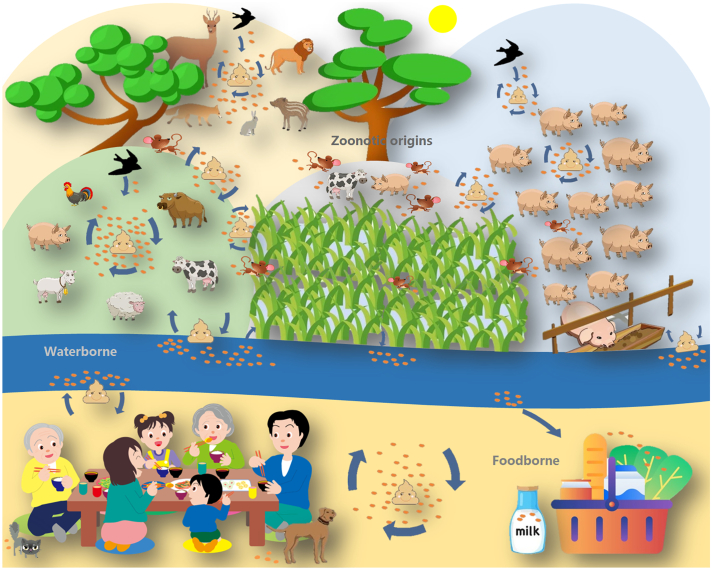
, a fungus-like protist parasite, causes symptomatic and asymptomatic intestinal infections in terrestrial animals and is also abundant in the environment. This parasite has been isolated from a variety of host types including humans, livestock, companion animals, birds, and wildlife, as well as the natural and urban environments including drinking source water, coastal water, recreational water, wastewater, vegetables in retail markets, and raw milk on farms. exhibits high genetic diversity among host species and environmental sources and at least 500 genotypes have been identified thus far. Since its discovery in AIDS patients in 1985, scientists across the world have worked to demonstrate the natural history and public health potential of this pathogen. Here we review molecular typing studies on and summarize relevant data to identify the potential sources of human and nonhuman infections and environmental contamination. This review also discusses the possible transmission routes of and the associated risk factors, and advocates the importance of the One Health approach to tackle infections.
一种类似真菌的原生生物寄生虫,可导致陆生动物出现有症状和无症状的肠道感染,在环境中也大量存在。这种寄生虫已从包括人类、牲畜、伴侣动物、鸟类和野生动物在内的多种宿主类型中分离出来,以及从包括饮用水源、沿海水域、娱乐用水、废水、零售市场的蔬菜和农场的生牛奶在内的自然和城市环境中分离出来。该寄生虫在宿主物种和环境来源之间表现出高度的遗传多样性,迄今为止已鉴定出至少500种基因型。自1985年在艾滋病患者中发现以来,世界各地的科学家一直在努力证明这种病原体的自然史和公共卫生潜力。在这里,我们回顾了关于该寄生虫的分子分型研究,并总结相关数据以确定人类和非人类感染及环境污染的潜在来源。本综述还讨论了该寄生虫可能的传播途径及相关风险因素,并倡导采用“同一健康”方法应对该寄生虫感染的重要性。