Alzheimer Scotland Dementia Research Centre, University of Edinburgh, Edinburgh, UK.
Lothian Birth Cohorts, Department of Psychology, University of Edinburgh, Edinburgh, UK.
J Alzheimers Dis. 2021;79(3):1063-1074. doi: 10.3233/JAD-200910.
Air pollution has been consistently linked with dementia and cognitive decline. However, it is unclear whether risk is accumulated through long-term exposure or whether there are sensitive/critical periods. A key barrier to clarifying this relationship is the dearth of historical air pollution data.
To demonstrate the feasibility of modelling historical air pollution data and using them in epidemiologicalmodels.
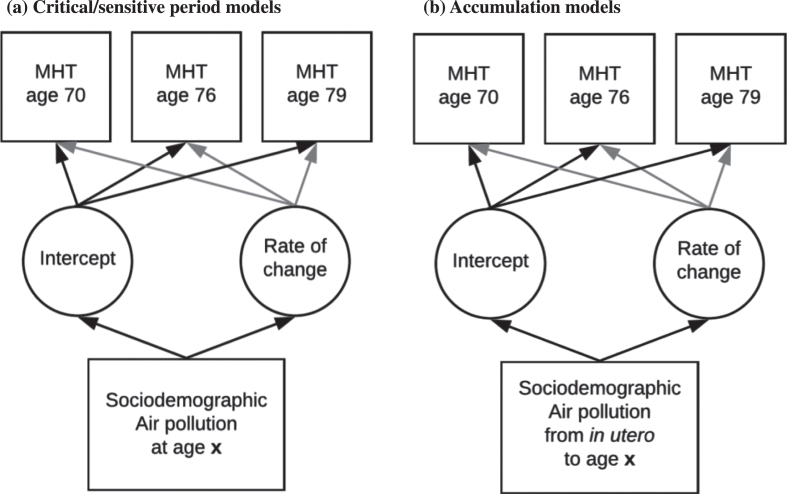
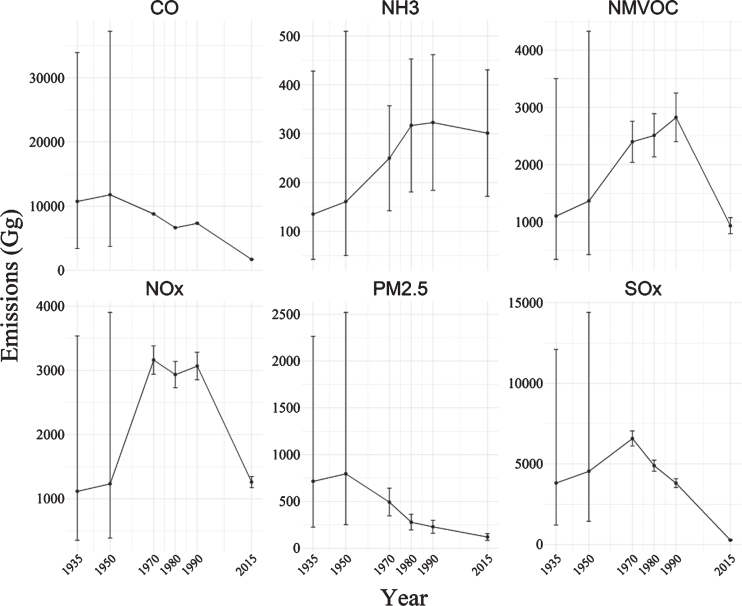
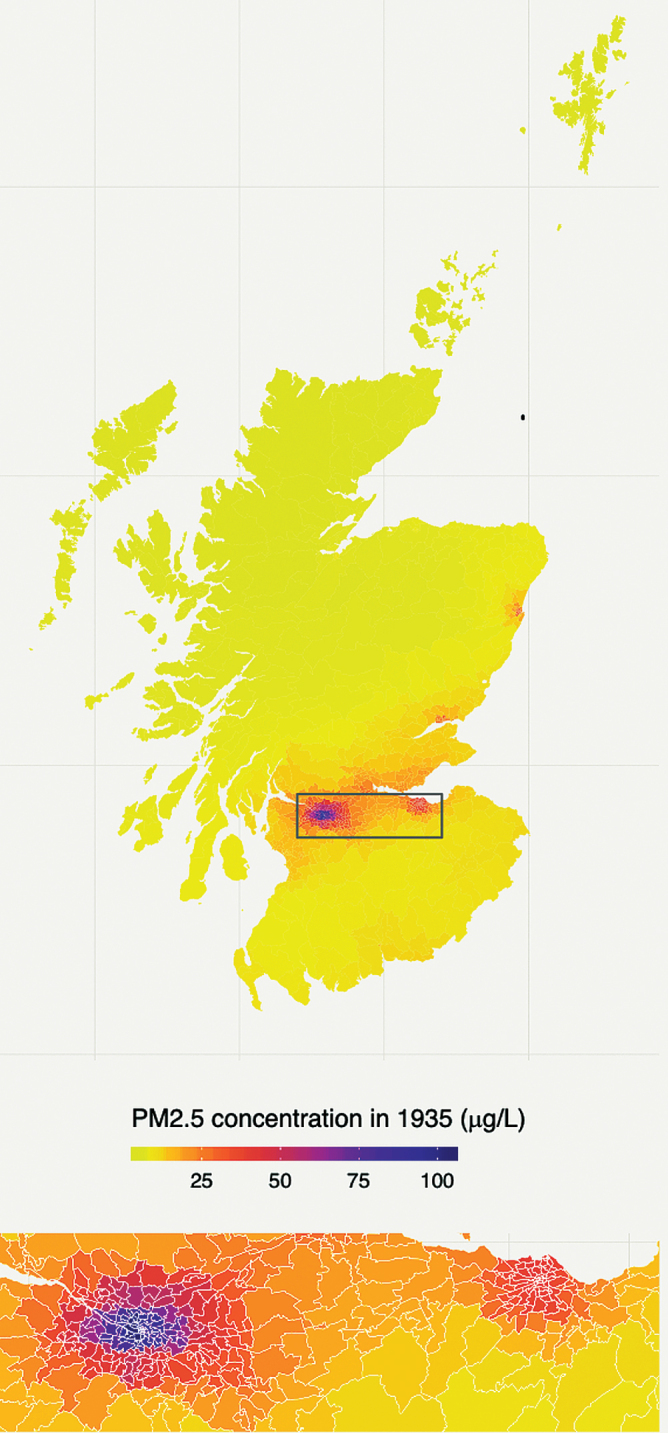
Using the EMEP4UK atmospheric chemistry transport model, we modelled historical fine particulate matter (PM2.5) concentrations for the years 1935, 1950, 1970, 1980, and 1990 and combined these with contemporary modelled data from 2001 to estimate life course exposure in 572 participants in the Lothian Birth Cohort 1936 with lifetime residential history recorded. Linear regression and latent growth models were constructed using cognitive ability (IQ) measured by the Moray House Test at the ages of 11, 70, 76, and 79 years to explore the effects of historical air pollution exposure. Covariates included sex, IQ at age 11 years, social class, and smoking.
Higher air pollution modelled for 1935 (when participants would have been in utero) was associated with worse change in IQ from age 11-70 years (β = -0.006, SE = 0.002, p = 0.03) but not cognitive trajectories from age 70-79 years (p > 0.05). There was no support for other critical/sensitive periods of exposure or an accumulation of risk (all p > 0.05).
The life course paradigm is essential in understanding cognitive decline and this is the first study to examine life course air pollution exposure in relation to cognitive health.
空气污染与痴呆症和认知能力下降一直存在关联。然而,目前尚不清楚风险是否是通过长期暴露积累的,还是存在敏感/关键时期。厘清这种关系的一个关键障碍是缺乏历史空气污染数据。
旨在论证对历史空气污染数据进行建模并将其应用于流行病学模型的可行性。
利用 EMEP4UK 大气化学输送模型,我们对 1935 年、1950 年、1970 年、1980 年和 1990 年的细颗粒物(PM2.5)浓度进行了建模,并将这些数据与 2001 年的当代模型数据相结合,以评估生活在洛锡安出生队列 1936 年的 572 名参与者一生中的暴露情况,这些参与者都有终身居住史记录。我们构建了线性回归和潜在增长模型,使用 11 岁、70 岁、76 岁和 79 岁时通过莫雷豪斯测试测量的认知能力(智商)来探索历史空气污染暴露的影响。协变量包括性别、11 岁时的智商、社会阶层和吸烟情况。
在参与者处于子宫内的 1935 年,模型预测的空气污染水平较高与从 11 岁到 70 岁期间智商的变化(β=-0.006,SE=0.002,p=0.03)较差有关,但与 70 岁至 79 岁期间的认知轨迹无关(p>0.05)。没有证据表明存在其他关键/敏感暴露期或风险积累(所有 p>0.05)。
理解认知能力下降需要采用生命历程范式,这是首个研究生命历程空气污染暴露与认知健康之间关系的研究。