University of New South Wales, Australia.
Neuroscience Research Australia, Australia.
J Alzheimers Dis. 2019;70(s1):S145-S163. doi: 10.3233/JAD-180631.
Both air pollution and dementia are current and growing global issues. There are plausible links between exposure to specific air pollutants and dementia.
To systematically review the evidence base with respect to the relationship between air pollution and later cognitive decline and dementia.
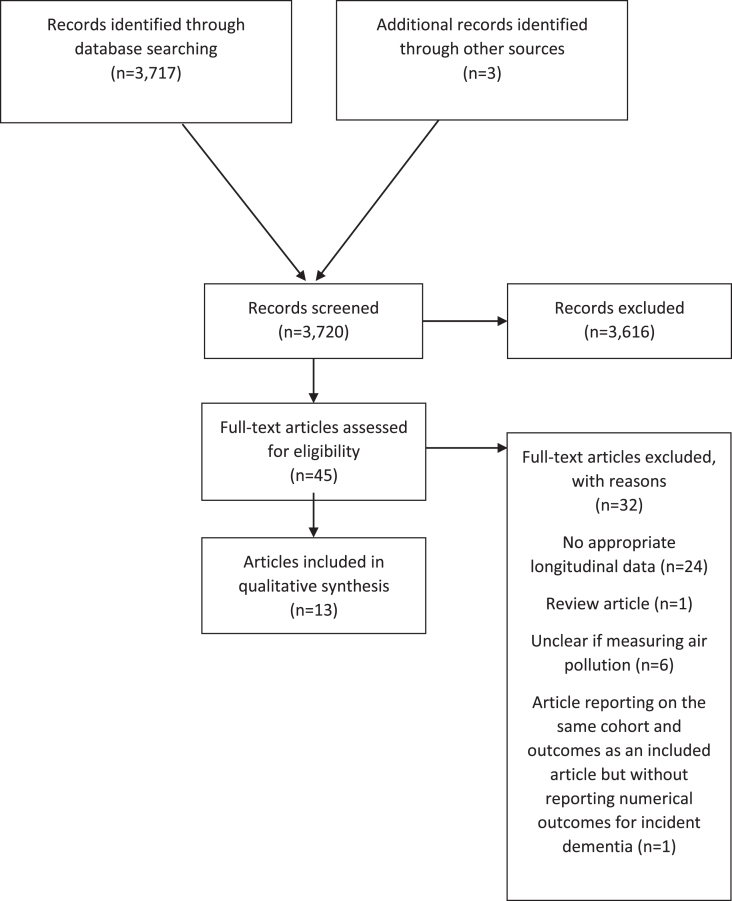
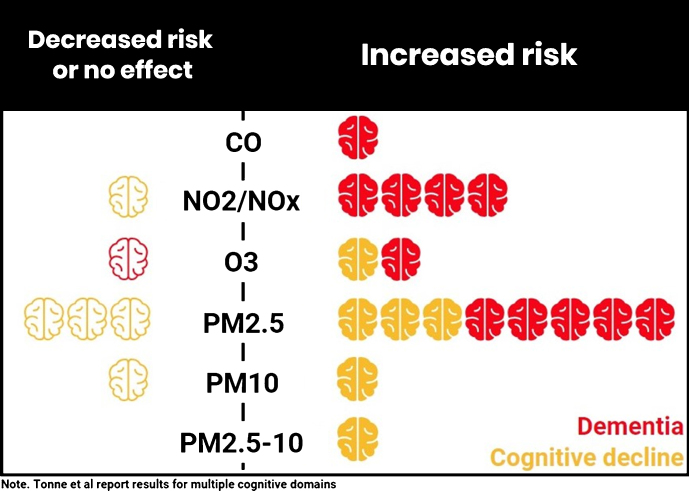
Medline, Embase, and PsychINFO® were searched from their inception to September 2018, for publications reporting on longitudinal studies of exposure to air pollution and incident dementia or cognitive decline in adults. Studies reporting on exposure to tobacco smoke including passive smoking or on occupational exposure to pollutants were excluded. Using standard Cochrane methodology, two readers identified relevant abstracts, read full text publications, and extracted data into structured tables from relevant papers, as defined by inclusion and exclusion criteria. Papers were also assessed for validity. CRD42018094299Results:From 3,720 records, 13 papers were found to be relevant, with studies from the USA, Canada, Taiwan, Sweden, and the UK. Study follow-up ranged from one to 15 years. Pollutants examined included particulate matter ≤2.5 μ (PM2.5), nitrogen dioxide (NO2), nitrous oxides (NOx), carbon monoxide (CO), and ozone. Studies varied in their methodology, population selection, assessment of exposure to pollution, and method of cognitive testing. Greater exposure to PM2.5, NO2/NOx, and CO were all associated with increased risk of dementia. The evidence for air pollutant exposure and cognitive decline was more equivocal.
Evidence is emerging that greater exposure to airborne pollutants is associated with increased risk of dementia.
空气污染和痴呆都是当前全球日益严重的问题。暴露于特定空气污染物与痴呆之间存在合理的关联。
系统回顾与空气污染和随后认知能力下降及痴呆之间关系的证据基础。
从建库起至 2018 年 9 月,检索 Medline、Embase 和 PsychINFO®,以获取报告成人暴露于空气污染和发生痴呆或认知能力下降的前瞻性研究的文献。排除报告吸烟(包括被动吸烟)或职业性暴露于污染物的研究。使用标准 Cochrane 方法,两位读者确定相关摘要,阅读全文出版物,并根据纳入和排除标准从相关论文中提取数据到结构化表格中。还对论文进行了有效性评估。
从 3720 条记录中,发现 13 篇相关文献,这些文献来自美国、加拿大、中国台湾、瑞典和英国。研究随访时间从 1 年到 15 年不等。检查的污染物包括颗粒物≤2.5μ(PM2.5)、二氧化氮(NO2)、氮氧化物(NOx)、一氧化碳(CO)和臭氧。研究方法、人群选择、污染暴露评估和认知测试方法各不相同。PM2.5、NO2/NOx 和 CO 的暴露量增加与痴呆风险增加相关。空气污染暴露与认知能力下降之间的证据更加不确定。
有证据表明,暴露于空气中的污染物增加与痴呆风险增加有关。